

Peptide manufacturing is the production of peptide-based active pharmaceutical ingredients (APIs) — short chains of amino acids engineered into therapeutic drug substances.
Unlike small-molecule drugs, which follow relatively predictable synthetic pathways, peptides occupy a complex middle ground: too structurally intricate for standard small-molecule workflows, yet not biologically derived like monoclonal antibodies or recombinant proteins.
This hybrid nature creates a distinct set of peptide manufacturing challenges spanning synthesis, purification, impurity profiling, and regulatory filing.
For pharma and biotech, these challenges carry real commercial weight. As programs multiply, choosing the right peptide manufacturing companies — those with the technical depth to handle complex sequences at scale — has become a decisive factor in speed-to-market and regulatory success.
Why Peptide Synthesis Is More Complex Than It Looks
Solid phase peptide synthesis (SPPS) is the dominant manufacturing route for therapeutic peptides. It works by building an amino acid chain step by step on a solid resin support. In theory, it is straightforward. In practice, every coupling step carries compounding risk.
A typical 30-amino-acid peptide requires 30 sequential coupling and deprotection cycles. Even at 99% efficiency per step, cumulative yield loss and impurity accumulation become significant by the end. The result is a crude mixture containing dozens of closely related byproducts that must be identified, controlled, and removed.
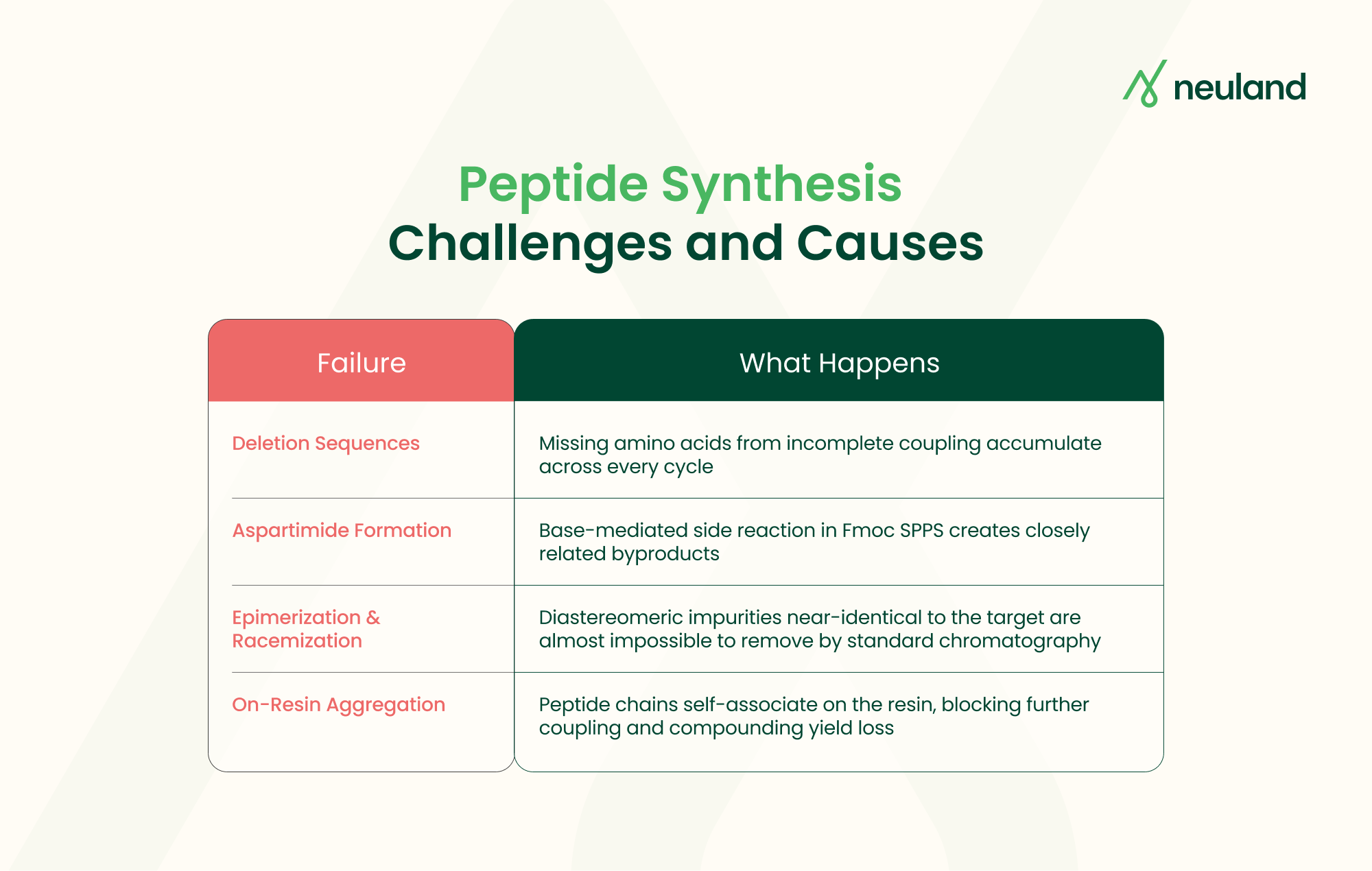
The material intensity of SPPS compounds the problem further. A 2024 industry assessment of 40 peptide manufacturing processes found that the average process mass intensity for SPPS is approximately 13,000 — compared to a median of 168–308 for small molecules. That scale of solvent and reagent use has direct cost, waste, and sustainability implications at commercial scale.
For teams evaluating solid phase peptide synthesis versus solution phase or hybrid routes, route selection itself becomes a critical early decision that shapes everything downstream.
Why Peptide Purification Is Never a Simple Fix
Once synthesis is complete, purification introduces a second tier of challenges. Peptide impurities are not generic contaminants. They are structurally similar fragments of the target molecule itself, often differing by a single amino acid, a stereocenter, or an oxidation state.
This creates problems that standard chromatographic methods struggle to resolve:
- Co-eluting impurities: Deletion sequences and epimers are nearly isobaric with the target, making separation by reverse-phase HPLC unreliable without orthogonal methods
- Counterion carryover: TFA is widely used as an ion-pairing reagent in SPPS, but residual TFA in the final drug substance is considered undesirable and potentially toxic in clinical use; exchange to chloride or acetate adds process steps and yield loss
- Preparative chromatography as a cost bottleneck: For difficult separations, prep LC is often the only viable option, but it dominates manufacturing cost at scale
Scale-Up Exposes Every Weakness in the Process
What works at the lab scale frequently fails at the manufacturing scale. This is one of the most commercially consequential risks in peptide drug development.
When moving from grams to kilograms, several physical realities shift:
- Mass transfer changes — resin swelling, solvent exchange, and mixing dynamics in large reactors behave differently than in lab vessels, affecting coupling completeness
- Heat transfer — temperature gradients at scale can alter epimerization rates and side reaction profiles
- Downstream loadability — preparative chromatography columns that perform well at small scale often show reduced resolution and loadability at commercial volumes, forcing adjustments to pooling strategy
Regulatory Expectations for Peptide APIs Are Tightening
Peptides occupy a regulatory grey zone that is rapidly becoming more defined — and more demanding.
The EMA's dedicated synthetic peptide guideline becomes legally effective on June 1, 2026. It explicitly covers manufacturing routes, peptide-specific impurity types, including stereoisomers and deletion sequences, pooling strategy in preparative chromatography, and comparability requirements. Meanwhile, FDA expectations around peptide impurity profiling — particularly for ANDA submissions — are increasingly stringent.
At the same time, ICH Q7 GMP guidance for active pharmaceutical ingredient manufacturing governs GMP compliance for API production, and ICH Q11 covers drug substance development documentation — neither framework was written with peptide-specific risks in mind. Sponsors must bridge this gap themselves or work with a CDMO that already has.
For teams building a sourcing strategy, understanding how to source pharmaceutical peptide APIs with regulatory readiness built in from the start is increasingly non-negotiable.
How CDMOs Solve These Peptide Manufacturing Challenges
Experienced CDMOs address peptide manufacturing challenges not by reacting to problems but by designing them out. The capabilities that matter most span five areas:
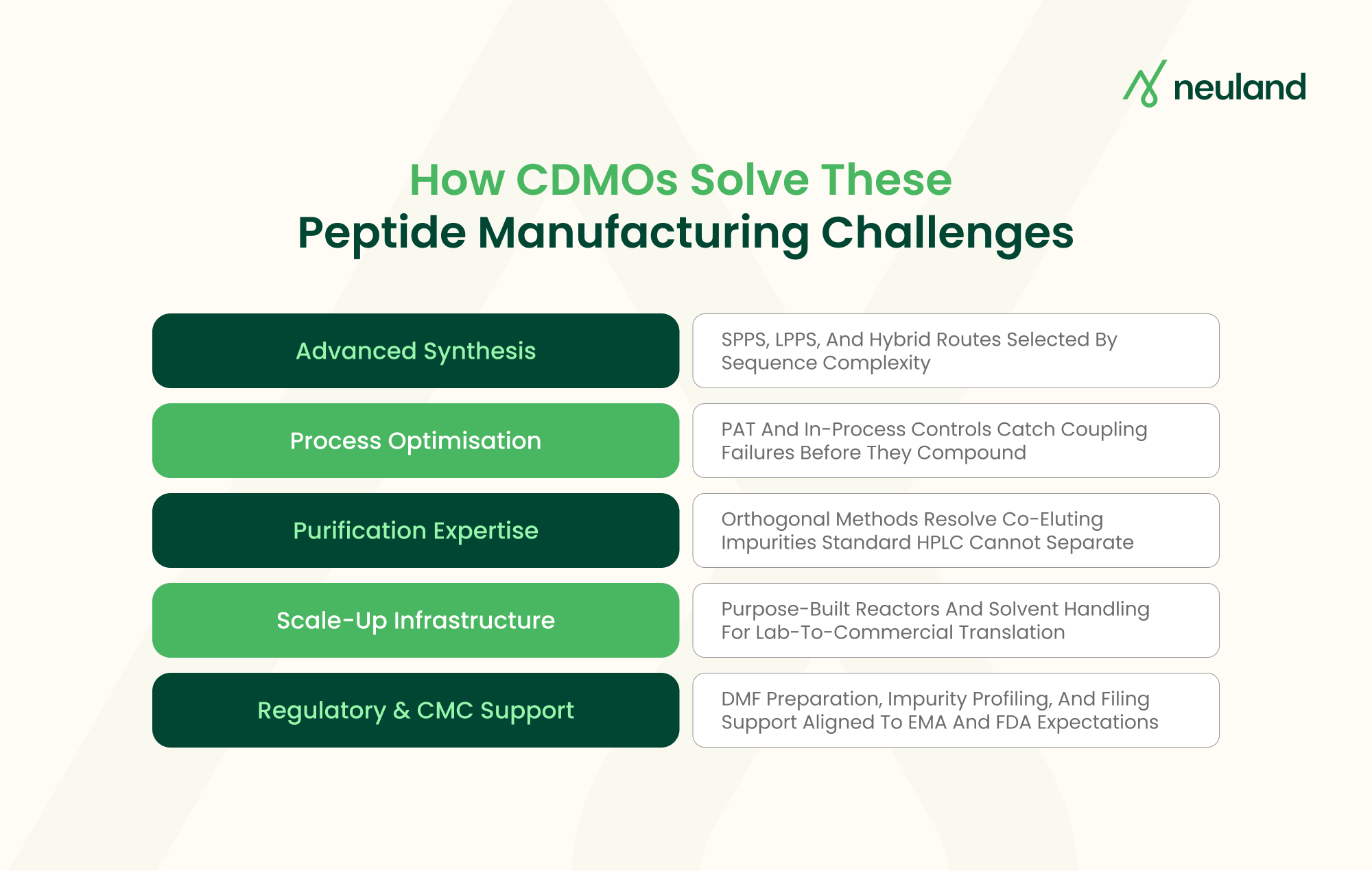
Neuland Laboratories is one example of a CDMO built for this kind of work. Neuland supports clients across SPPS, LPPS, and hybrid routes.
Their team brings deep experience in complex sequences, non-natural amino acid incorporation, and the analytical characterization that peptide filings demand.
Regulatory approvals from the FDA, EMA, and PMDA make them well-positioned for companies planning global programs.
What to Look for in a Peptide Manufacturing Partner
Not every CDMO has the technical depth to handle complex peptide programs. As the field matures and regulatory expectations tighten, the criteria for selection have become increasingly specialized.
When evaluating a potential partner, focus on these three critical pillars:
1. Experience with Complex Peptides
General peptide capability is no longer enough. Different structures require distinct synthesis strategies and analytical toolchains.
- Specific Expertise: Ensure they have handled disulfide-rich peptides, lipidated analogs, macrocyclic sequences, or peptide-drug conjugates (PDCs).
- Proof of Success: Request case studies that include scale and purity data for candidates sharing your project’s structural risk profile.
- Technical Tooling: Verify they have the purification approaches (e.g., preparative HPLC) necessary for your specific molecule.
2. Scale-Up Capability
The transition from development to Commercial GMP is where most scale-up failures occur. Look for "hard signals" rather than vague capability claims:
- Infrastructure: Verify reactor volumes, maximum batch sizes, and annual throughput.
- Downstream Scalability: Assess their ability to maintain purity levels when moving from lab-scale to preparative-scale production.
- Transition Management: Evaluate their formal process for moving a project from the R&D phase into a validated GMP environment.
3. Quality and Regulatory Track Record
A clean inspection history with the FDA and EMA is the baseline. To ensure long-term success, drill deeper into their operational compliance:
- Quality Controls: Audit their data integrity controls, deviation management, and CAPA (Corrective and Preventive Actions) protocols.
- Cleaning Validation: Confirm rigorous protocols are in place to prevent cross-contamination, a key requirement of ICH Q7 compliance.
- CMC Support: Ensure the regulatory team has direct experience preparing peptide-specific CMC sections, as these differ significantly from standard small-molecule API documentation.
For a structured framework covering the full range of technical, regulatory, and operational criteria, the complete guide to choosing the right CDMO partner provides a practical evaluation approach.
Why the Right Partner Decides Whether These Challenges Get Solved
The challenges in peptide manufacturing are real, but they are not unsolvable. Synthesis impurities can be controlled. Purification bottlenecks can be designed around. Scale-up risks can be managed with the right infrastructure. Regulatory expectations can be met with experienced CMC support.
What separates programs that reach approval from those that stall is the partner behind the molecule. Neuland Labs, which has built specialized peptide services, validated quality systems, and regulatory track records, brings solutions that most companies cannot replicate internally. The decision to engage that expertise early shapes timelines, costs, and filing outcomes.
For pharma and biotech teams planning a peptide program, the right CDMO partner is not a procurement choice. It is a strategic one. Talk to Neuland's team today.
FAQs
The main challenges are synthesis impurity accumulation (deletion sequences, epimerization, aspartimide formation), purification complexity, difficulties scaling from lab to commercial production, and navigating regulatory frameworks not originally designed for synthetic peptides.
Key impurities, deletion sequences, diastereomers, and oxidation variants are structurally near-identical to the target molecule. Standard single-method chromatography often cannot resolve them, requiring orthogonal techniques and careful counterion management.
CDMOs bring platform synthesis capabilities, in-process controls, specialized purification infrastructure, and regulatory CMC expertise that most pharma and biotech companies cannot cost-effectively build in-house
Prioritize demonstrated experience with your specific peptide class, analytical capability for peptide-specific impurities, scale-up infrastructure, a clean regulatory inspection record, and a tech transfer model that minimizes rework between development and commercial manufacturing.