
Peptide purification is the process of isolating a target peptide from the crude mixture produced during synthesis, removing structurally similar impurities to achieve the purity levels regulators require. It is consistently the most expensive and technically demanding step in peptide API manufacturing.
That cost pressure is only growing. The global peptide purification system market is projected to grow to USD 1,339.83 million by 2035. As peptide pipelines expand and molecules get longer and more complex, the gap between what standard purification can handle and what drug programs actually need is widening.
This article covers the main peptide purification methods, why purification is uniquely difficult for peptides, and how advanced RP-HPLC techniques are closing that gap.
What Makes Peptide Purification Different From Small Molecule Purification?
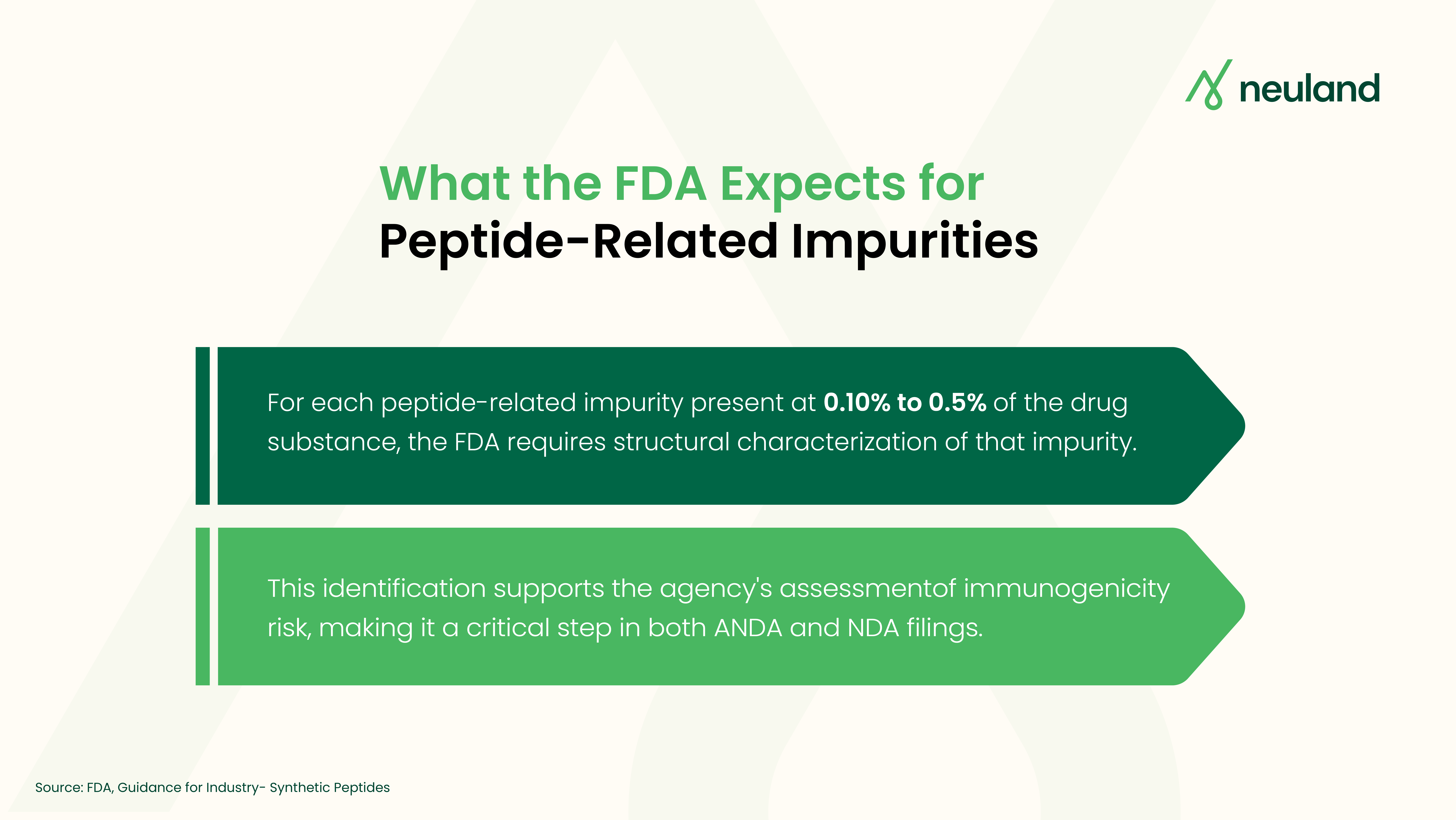
Small molecule impurities are usually structurally distinct from the target compound. Standard chromatographic methods can separate them with relative ease. Peptide impurities are a fundamentally different problem.
The crude product from the solid-phase peptide synthesis technique contains dozens of byproducts that are nearly identical to the target molecule. Deletion sequences differ by a single amino acid. Epimers differ by one stereocenter. Oxidation variants share the same mass. These impurities co-elute on standard HPLC columns, making separation extremely challenging.
Five factors determine how difficult peptide purification will be for any given molecule. Understanding these peptide purification challenges early helps teams build the right separation strategy from the start:
- Sequence length: Longer peptides accumulate more synthesis-related impurities. A 40-residue peptide generates far more deletion sequences than a 10-residue one.
- Post-translational modifications: Phosphorylation, glycosylation, and lipidation add structural complexity that affects chromatographic behavior and resolution.
- Conjugation: PEGylated peptides, peptide-drug conjugates, and fatty acid conjugates like semaglutide's C18 chain create additional purification challenges due to altered hydrophobicity.
- Chemical stability: Peptides containing methionine, cysteine, or tryptophan are prone to oxidation during processing. Aspartate residues can undergo isomerization. These degradation products must be resolved from the target.
- Purity requirements: Injectable peptide APIs typically require purity above 95%, with individual impurities controlled to ICH Q3A thresholds. Achieving this from a complex crude mixture demands high-resolution separations.
Peptide Purification Methods Compared
Not all peptide purification techniques serve the same purpose. The right method depends on the molecule's properties, the scale of production, and the purity target. Here's how the main approaches compare:
| Method | Mechanism | Best For | Limitations |
| Crystallization | Selective precipitation from solution | Short, well-behaved peptides with favorable crystallization properties | Not applicable to most complex or long peptides |
| Normal-phase chromatography | Separation by polarity on silica | Early-stage intermediates, protecting group removal | Low resolution for closely related peptide impurities |
| RP-HPLC (standard) | Separation by hydrophobicity on C18/C8 | Industry standard for peptide API purification | Column loading capacity limits throughput at commercial scale |
| SSP-Prep-RP-HPLC | Modified C18 with surrogate stationary phase | Complex peptides requiring high throughput and resolution | Requires method development expertise for SSP optimization |
Reversed-phase HPLC remains the dominant method in cGMP peptide manufacturing. Peptide purification HPLC at preparative scale has a practical bottleneck: the loading capacity of a typical C18 column is roughly 1% of total column volume.
For commercial-scale programs producing kilograms of API, this translates into long campaign times, high solvent consumption, and elevated costs. That's the problem Neuland's SSP technology was designed to solve.
What is SSP-Prep-RP-HPLC?
SSP stands for Surrogate Stationary Phase. It's a technique Neuland developed to increase the loading capacity and selectivity of standard reversed-phase HPLC columns without requiring new hardware.
Here's how it works in simple terms:
A hydrophobic quaternary ammonium salt is applied to a standard C18 preparative column. This salt binds to the C18 chains and to residual silanol groups on the silica surface, creating additional binding sites that the peptide can interact with. The result is a modified stationary phase that offers more surface area for separation.
The practical impact is significant:
- Loading capacity increases 7 to 12 times compared to an unmodified C18 column
- Selectivity improves because the SSP changes how peptide impurities interact with the stationary phase, directly affecting the alpha (selectivity) term in the resolution equation
- Existing equipment works. No new columns or instruments are required. The SSP is applied to standard preparative HPLC columns already in use
This approach was documented in a Pharmaceutical Technology Q&A with Neuland's VP & Head of Peptides and a consultant from CMC Development. The technology is covered by US Patent 9,724,622.
Planning a complex peptide program where purification is a concern? Talk to Neuland's peptide purification team.
Which Peptide Types Benefit Most From Advanced Purification?
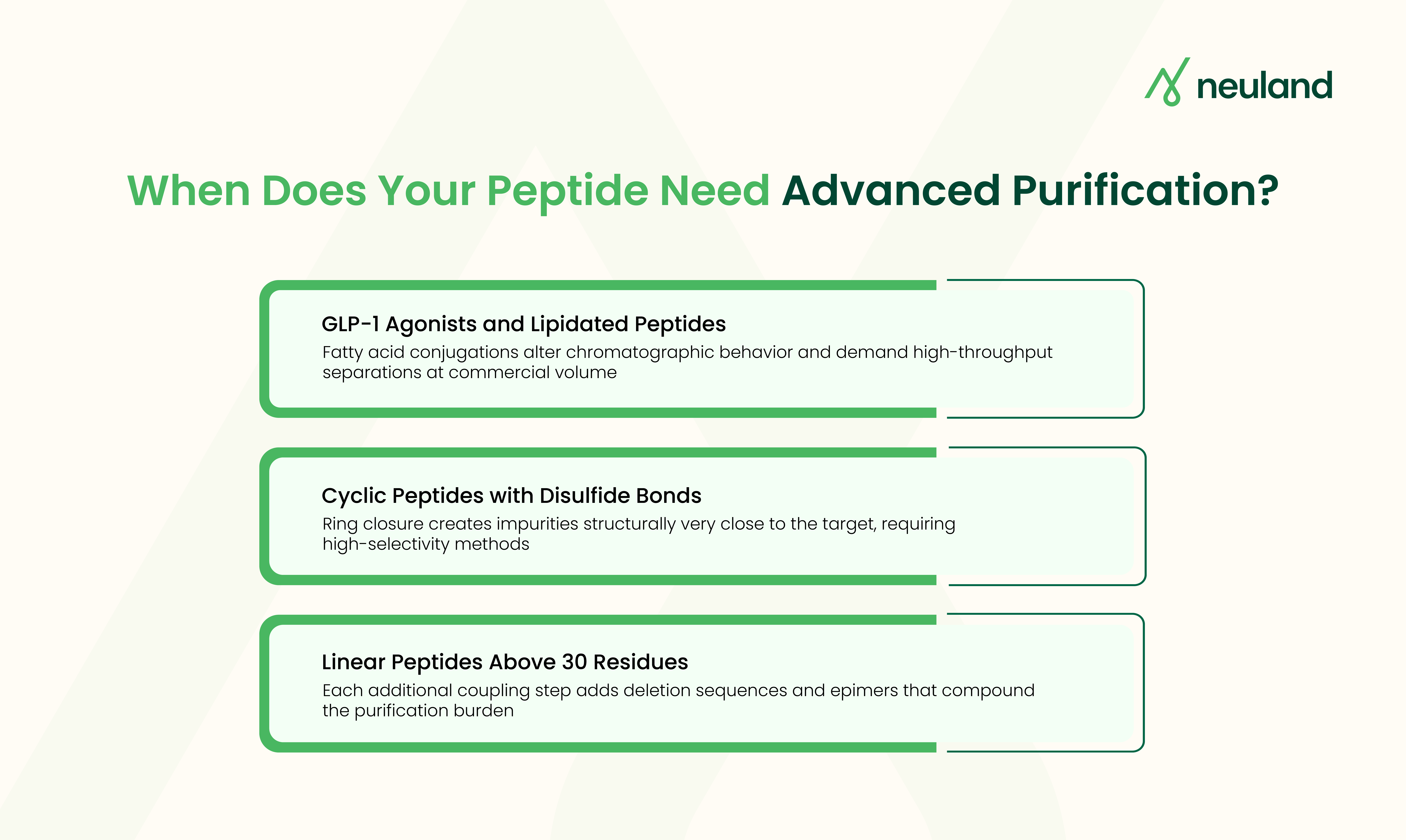
Not every peptide program needs SSP-enhanced HPLC. But certain categories consistently push standard purification beyond its limits:
GLP-1 receptor agonists like semaglutide and tirzepatide are long, modified peptides with lipid or fatty acid conjugations that alter chromatographic behavior. Their commercial volumes (multi-kilogram to multi-ton) make purification throughput a direct cost driver.
Cyclic peptides with disulfide bonds or head-to-tail cyclization produce unique impurity profiles during ring closure. These impurities are often structurally very close to the target, requiring high-selectivity separations.
Long-chain linear peptides above 30 residues generate increasingly complex crude mixtures. The number of deletion sequences, epimers, and truncation products grows with every additional coupling step.
For these molecules, selecting the right peptide purification method early in development prevents costly process changes during scale-up. A peptide CDMO with deep purification expertise evaluates the molecule's risk profile and builds the separation strategy alongside the synthesis route, not after it.
What to Look for in a Peptide CDMO for Purification-Intensive Programs
Purification capability separates peptide CDMOs that can handle research-grade work from those that can deliver filing-ready commercial API. When evaluating partners for purification-intensive programs, focus on these areas:
- Preparative HPLC capacity: Ask about column sizes, throughput, and whether the partner has experience with multi-column campaigns at the kilogram scale.
- Orthogonal separation methods: Standard RP-HPLC may not resolve every impurity. Partners with ion-exchange, HILIC, or SSP-enhanced chromatography offer more options.
- Analytical method integration: The purification strategy should be developed alongside analytical methods, not independently. Impurity profiling, method validation, and stability testing all depend on the purification approach chosen.
- Regulatory experience: Purification parameters feed directly into the CMC filing. A CDMO that has supported IND and NDA submissions for peptide APIs understands how to document pooling criteria, fraction collection, and impurity fate in a way that regulators accept.
Neuland Laboratories brings this depth to peptide purification through its proprietary SSP-Prep-RP-HPLC technology, dedicated peptide manufacturing infrastructure, and experience across peptides ranging from 3 to 40 amino acids at scales. Their regulatory approvals from the FDA, EMA, and PMDA ensure that the purification data they generate is built for global filings.
For teams working on purification-intensive peptide programs, the CDMO's purification capability is often the deciding factor in program success. Get in touch with Neuland's team today.
Frequently Asked Questions
What is complex peptide purification? Complex peptide purification is the process of separating a target peptide API from structurally similar impurities produced during synthesis. These impurities include deletion sequences, epimers, and oxidation variants that differ from the target by as little as one amino acid or one stereocenter, making standard chromatographic separation extremely difficult. |
Why is peptide purification more expensive than small molecule purification? Peptide purification is more expensive because it relies heavily on preparative RP-HPLC, which has limited loading capacity and consumes large volumes of solvent at commercial scale. Purification can account for 50 to 60% of total peptide manufacturing cost. The structural similarity between target peptides and their impurities also means that multiple purification passes or orthogonal methods are sometimes needed. |
What is SSP-Prep-RP-HPLC and how does it improve peptide purification? SSP-Prep-RP-HPLC is a technique that modifies standard C18 reversed-phase columns by applying a hydrophobic quaternary ammonium salt as a surrogate stationary phase. This increases the column's loading capacity by 7 to 12 times and improves selectivity for closely eluting impurities. It works with existing HPLC equipment, making it a practical upgrade for peptide manufacturing facilities. |
How do peptide CDMOs approach purification strategy for new molecules? Experienced peptide CDMOs evaluate the molecule's sequence, length, modification pattern, and known impurity profile before selecting a purification approach. They develop the separation strategy in parallel with synthesis route development, not as an afterthought. This integrated approach prevents the costly scenario where a synthesis process produces a crude mixture that the purification method can't adequately resolve. |
Can peptide purification methods be scaled from lab to commercial production? Yes, but scaling peptide purification introduces real challenges. Column performance, resolution, and loading behavior all change between analytical-scale and preparative-scale systems. CDMOs with commercial-scale purification experience understand these transitions and build scalability into the method from the start, including validated pooling criteria and fraction collection parameters that hold up under regulatory review. |