
Peptide drugs are one of the fastest-growing modalities in pharma. But they're also among the most likely to stall at filing.
The reason? Peptide API projects face regulatory challenges that small molecules don't. There's no single ICH framework for impurity thresholds. Characterization demands are closer to biologics. And the peptide manufacturing process creates dozens of similar byproducts that standard methods can't always resolve.
Between 2020 and 2024, roughly 75% of FDA Complete Response Letters cited quality or manufacturing issues. Peptide drug development programs are especially exposed because existing guidelines weren't designed for synthetic peptides.
This article explains where filings break down and how to build a CMC strategy that holds up under review.
Why Peptide API Filings Face a Regulatory Gap
Synthetic peptides don't fit neatly into existing frameworks. They're too complex for small-molecule rules. But they're not made by living cells like biologics. The FDA classifies peptides of 40 amino acids or fewer under the NDA pathway. Yet it expects analytical depth close to biologic-level scrutiny.
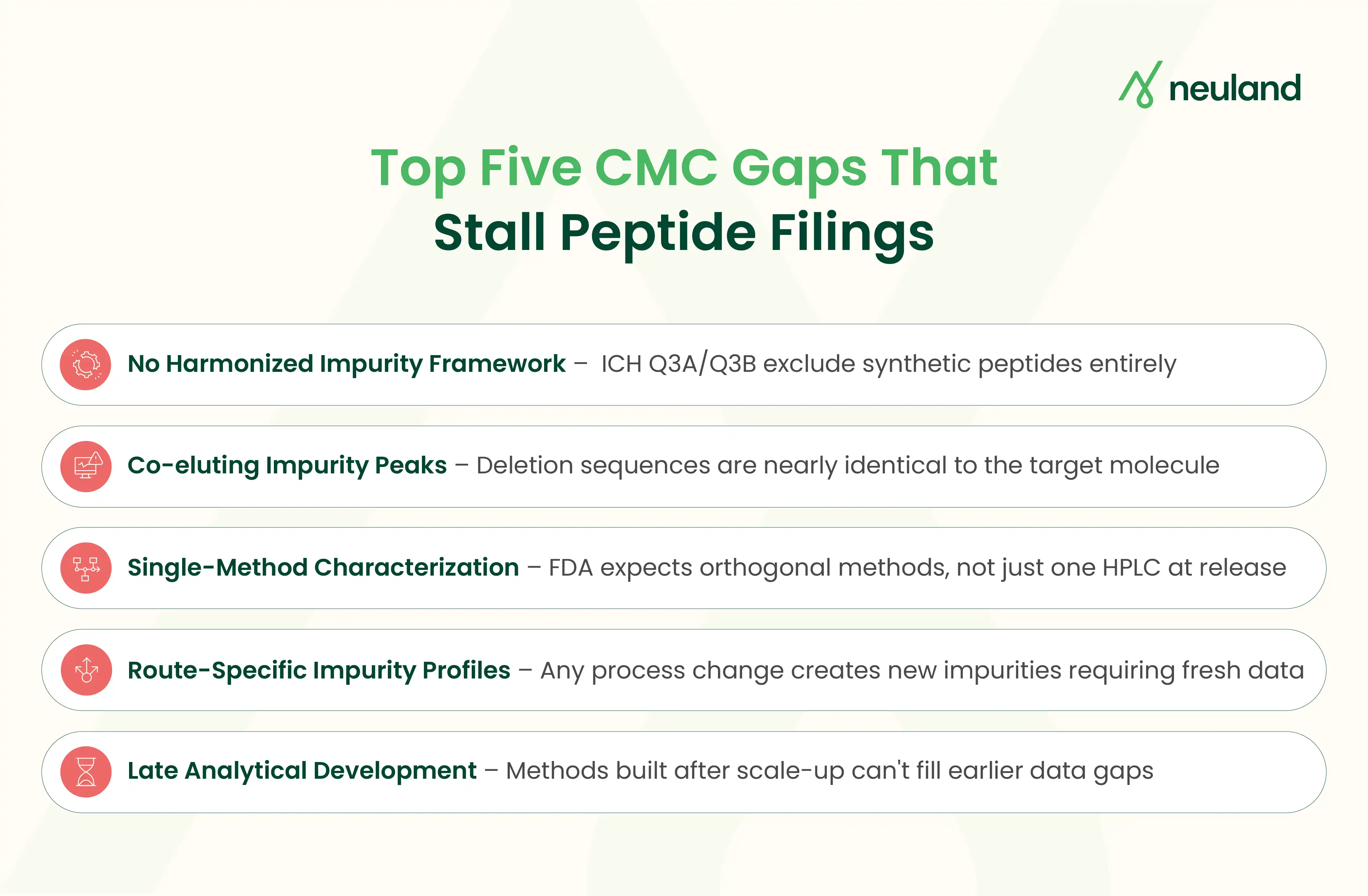
The core problem is this: ICH Q3A and Q3B, the standard impurity guidelines, explicitly exclude synthetic peptides. ICH Q6A partially covers them but skips higher-molecular-weight species. And Q6B targets recombinant products only.
So sponsors must piece together requirements from ICH Q11, USP General Chapter 1503, USP 1504, and regional pharmacopeial monographs. The EMA released a draft guideline in October 2023. It's still unfinalized.
Different reviewers within the same agency can apply different standards. That creates inconsistent deficiency letters.
Where Peptide API Impurities Create Filing Problems
Peptide impurities are the single biggest source of CMC deficiencies in peptide filings. And the challenge is fundamentally different from small molecules.
A typical 30-amino-acid peptide can produce 50 to 100 potential impurities. Each coupling step in solid-phase synthesis may create:
- Deletion sequences (missing one amino acid)
- Racemization products from chiral center disruption
- Oxidation variants at methionine, cysteine, or tryptophan
- Deamidation products at asparagine and glutamine
- Aggregation and truncated sequences
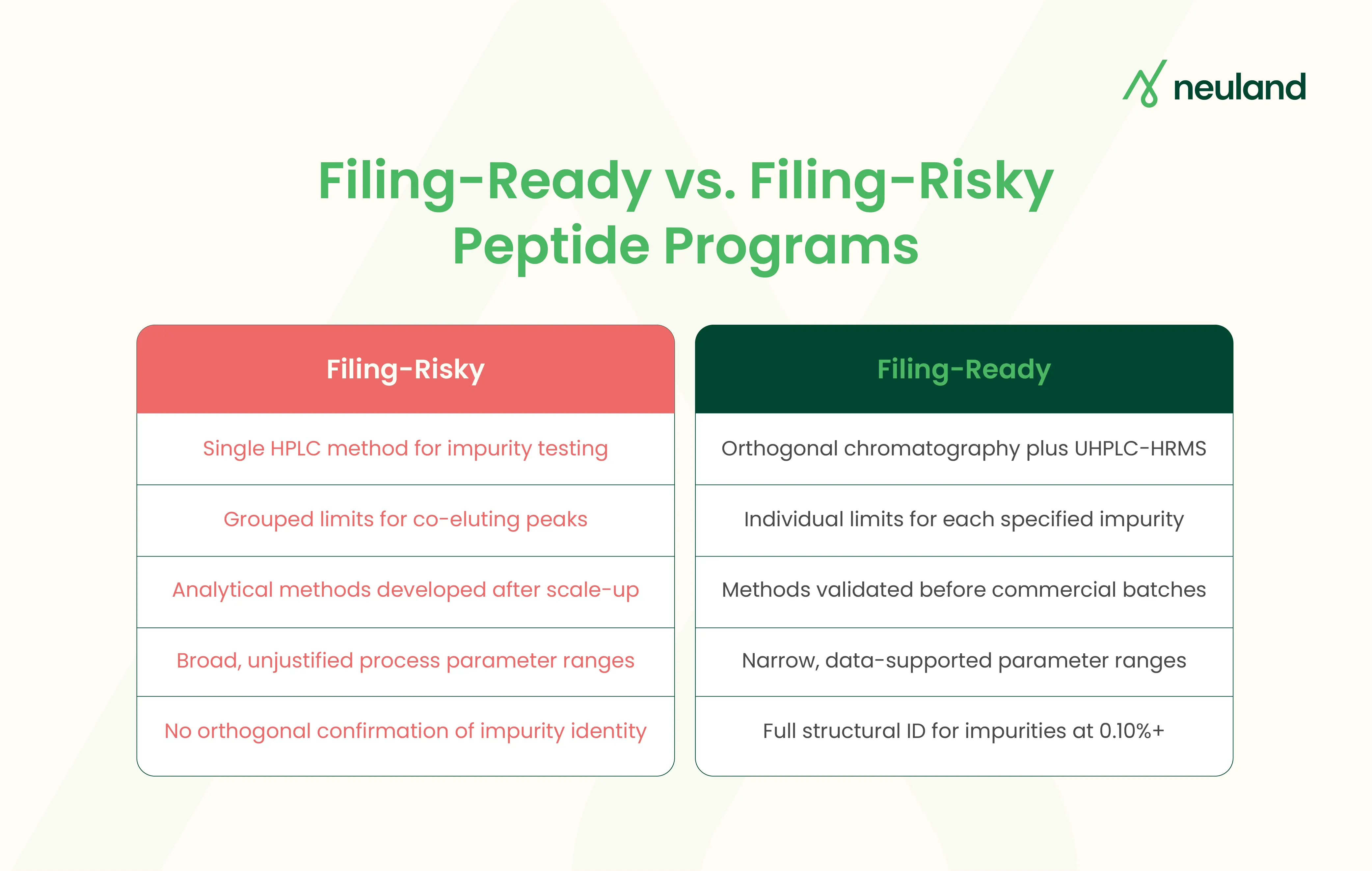
These byproducts are nearly identical to the target molecule. Co-elution is the norm, not the exception. The FDA requires structural identification of all impurities at 0.10% or above. Anything exceeding 0.5% needs safety justification. Without orthogonal analytical methods built early, sponsors discover at filing that their data can't support their specs.
How the Peptide Manufacturing Process Introduces Regulatory Risk
Manufacturing challenges show up directly in submissions.
Solid-phase synthesis is sequential. Twenty to forty coupling cycles happen in one reactor. A deviation at step 12 doesn't just cut yield. It creates a unique impurity that must be identified and controlled.
Here's what makes the process harder to defend at review:
- Process impurities are route-specific. Change the synthetic approach, and the impurity profile changes too.
- Scale-up alters behavior. Heat transfer, coupling kinetics, and cleavage efficiency shift with reactor volume.
- Purification decisions are final. HPLC fraction collection directly determines the finished impurity profile.
Pharmaceutical GMP guidelines under ICH Q7 apply. But they weren't written with peptide-specific risks in mind. That puts the burden on sponsors to go beyond baseline compliance
What Peptide Characterization Must Cover for Reviewers
Incomplete characterization is the second most common reason filings receive deficiency letters.
The FDA expects more than a single HPLC method at release. Here's what a filing-ready package typically includes:
- Sequence confirmation via LC-MS/MS
- Purity testing by multiple chromatographic methods
- Impurity identification using UHPLC-HRMS for peaks at 0.10%+
- Forced degradation studies targeting oxidation, deamidation, and aggregation
- Stability-indicating methods validated with mass balance data
Build this toolkit before scale-up. If methods come after commercial batches, there's often no way to fill data gaps.
How to Prevent Delays Before They Start
Sponsors who avoid delays share a common trait. They treat CMC strategy as a development decision, not a filing exercise.
That means engaging a manufacturing partner with peptide-specific regulatory experience early. Ideally, before toxicity studies begin. With over 70% of peptide APIs now outsourced to contract manufacturers, your CDMO's quality system becomes your quality system in the FDA's eyes.
Early alignment should cover:
- Analytical methods built around the full impurity profile
- Process parameters with data-supported ranges at each step
- Starting material specs for stereoisomeric purity and residual solvents
- A control strategy addressing process, degradation, and formulation impurities
Neuland Laboratories brings this kind of depth to peptide drug development programs. With three cGMP-certified manufacturing facilities, over 360 R&D scientists, and a dedicated peptide platform covering both solid-phase and hybrid synthesis. Neuland supports sponsors from early process development through commercial-scale production.
Its regulatory CMC support covers analytical method development, impurity profiling, stability studies, and DMF preparation, all built to meet FDA, EMA, and PMDA expectations.
Phase I peptide trials surged from 18 in 2023 to 137 in 2025. The companies that build filing-ready CMC packages early won't just avoid delays. They'll reach approval faster.
| Planning a peptide API program? Talk to Neuland's team about building a regulatory-ready development strategy from the start. Get in touch |
FAQs
A CDMO supports regulatory compliance for peptide API development by providing validated manufacturing, analytical method development, and CMC documentation. Experienced CDMOs maintain active DMFs, run orthogonal impurity testing, and prepare Module 3 filing sections. This reduces deficiency risk and speeds up review cycles.
Peptide impurities are harder to control because each synthesis step can produce deletion sequences, racemization products, and oxidation variants nearly identical to the target. Standard ICH guidelines (Q3A/Q3B) exclude synthetic peptides, leaving sponsors without a harmonized threshold framework.
Peptide drug development programs receive more Complete Response Letters because the CMC requirements are unusually demanding. Regulators expect orthogonal characterization, individual impurity limits, and stability data with mass balance. Gaps in any of these areas trigger deficiency letters.
The pharmaceutical GMP guidelines that apply include ICH Q7 for API production and ICH Q11 for drug substance development. These weren't written specifically for peptides. Sponsors must supplement them with USP chapters 1503/1504 and EMA draft guidance where applicable.
A strong peptide characterization package includes sequence confirmation by mass spectrometry, purity testing by multiple methods, impurity identification via UHPLC-HRMS, forced degradation studies, and validated stability-indicating methods. All of this should be developed before scale-up to avoid data gaps at filing.