
Peptide synthesis has become one of the most important areas in modern drug development. With over 100 peptide drugs approved globally and the peptide therapeutics market reaching $49.7 billion in 2025, demand for scalable production methods has never been higher.
The three main peptide synthesis methods are solid-phase peptide synthesis (SPPS), liquid-phase peptide synthesis (LPPS), and hybrid approaches that combine both. Each has distinct strengths. The right choice depends on your peptide's length, complexity, scale, and timeline.
This article breaks down how each method works, where it fits, and how to make the right decision for your program.
What Is Peptide Synthesis and Why the Method Matters
Peptide synthesis is the process of joining amino acids in a defined sequence to build a peptide chain. The method you choose affects yield, purity, cost, timeline, and scalability. It also shapes the regulatory path for peptide drug development.
Three main approaches dominate the field today:
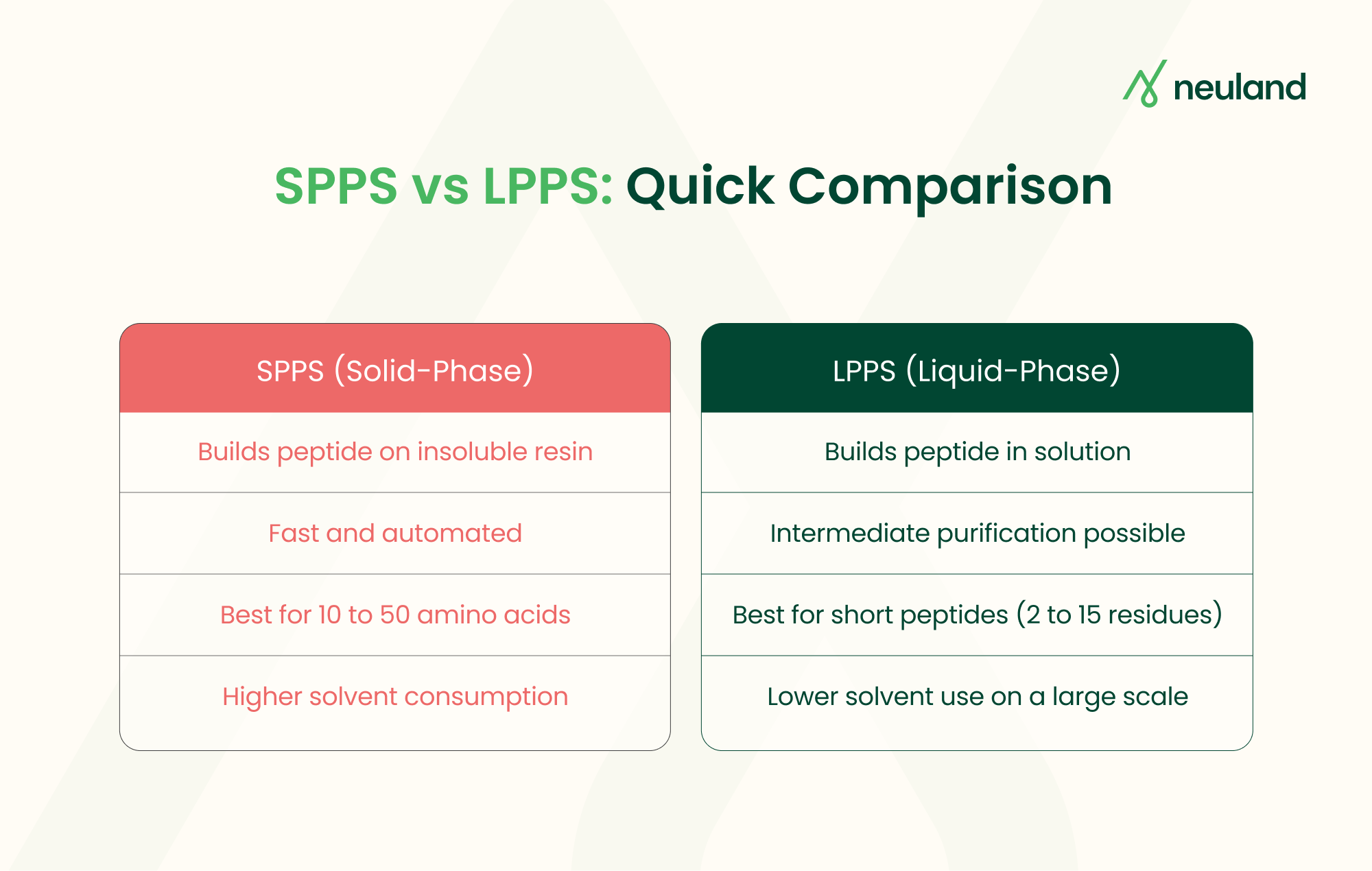
- Solid-phase peptide synthesis (SPPS) builds the peptide on an insoluble resin support
- Liquid-phase peptide synthesis (LPPS) assembles the peptide in solution, often using soluble tags
- Hybrid peptide synthesis combines SPPS fragment preparation with LPPS fragment coupling
Each method suits different peptide types and development stages. Getting the choice right early prevents costly rework later.
Solid-Phase Peptide Synthesis (SPPS)
Invented by Robert Bruce Merrifield in 1963, SPPS revolutionized peptide chemistry. The chain grows on an insoluble resin bead, with each amino acid added sequentially through protection, coupling, and deprotection cycles.
Where SPPS Works Best
SPPS is the go-to method for most peptide API manufacturing today. It supports automation, delivers reproducible batches, and scales from milligrams to kilograms without changing the underlying chemistry.
Advantages of solid phase peptide synthesis include:
- Speed. Automated synthesizers can complete a short peptide in hours
- Reproducibility. Each coupling cycle follows standard parameters
- Scalability. Supports R&D through commercial production
- Non-natural amino acid compatibility. Useful for modified peptides
When SPPS Struggles
SPPS has real limitations. For long peptides (typically beyond 50 residues), cumulative coupling inefficiencies create significant impurity loads. Sequence-specific aggregation on the resin can block further coupling. And the method consumes large volumes of solvents like DMF and NMP.
SPPS has a Process Mass Intensity of around 13,000, making it one of the most solvent-intensive modalities in pharma.
SPPS also faces purification bottlenecks at commercial scale. Preparative HPLC is expensive and can account for a major share of total production cost.
Liquid-Phase Peptide Synthesis (LPPS)
LPPS builds peptides in solution rather than on a solid support. Each amino acid is added, the intermediate is purified by crystallization or extraction, and the process repeats.
Where LPPS Works Best
LPPS is especially useful for short peptides (2 to 10 amino acids) where solution chemistry is simpler and cheaper than setting up automated SPPS runs. It also plays a critical role in large scale peptide manufacturing where solvent costs and purification bottlenecks matter.
The method allows intermediate isolation and characterization at every step. That's valuable for high-purity GMP programs, where proving sequence fidelity is part of the filing package.
When LPPS Struggles
LPPS is labor-intensive. Each step requires purification, which slows the process for longer sequences. It's generally not efficient beyond about 15 residues on its own. For research-grade work where speed matters more than cost, SPPS is usually the better choice.
Hybrid Peptide Synthesis
Hybrid peptide synthesis combines the strengths of SPPS and LPPS. Protected fragments are built by SPPS, then joined in solution through fragment condensation. This approach handles peptides that neither method can produce efficiently on its own.
Why Hybrid Methods Are Gaining Ground
The clearest real-world example is Eli Lilly's tirzepatide, the GLP-1/GIP dual agonist sold as Mounjaro and Zepbound. Lilly's team developed a hybrid SPPS/LPPS strategy to produce tirzepatide at kilogram scale, published in Organic Process Research and Development in 2021.
The approach used SPPS to build protected fragments, then assembled them in solution with flow chemistry and nanofiltration for intermediate purification. This would have been impractical with either method alone.
Hybrid synthesis is especially valuable for:
- Peptides longer than 40 amino acids
- Sequences with complex modifications or disulfide bonds
- Commercial-scale programs where cost and yield both matter
- Peptides requiring native chemical ligation (NCL)
When Hybrid Is Not the Right Choice
Hybrid synthesis adds complexity. For short peptides or early-stage research, the overhead of fragment design and purification isn't justified. It's a commercial-scale solution for problems that emerge when linear approaches run out of room.
How to Choose the Right Method: SPPS vs LPPS vs Hybrid
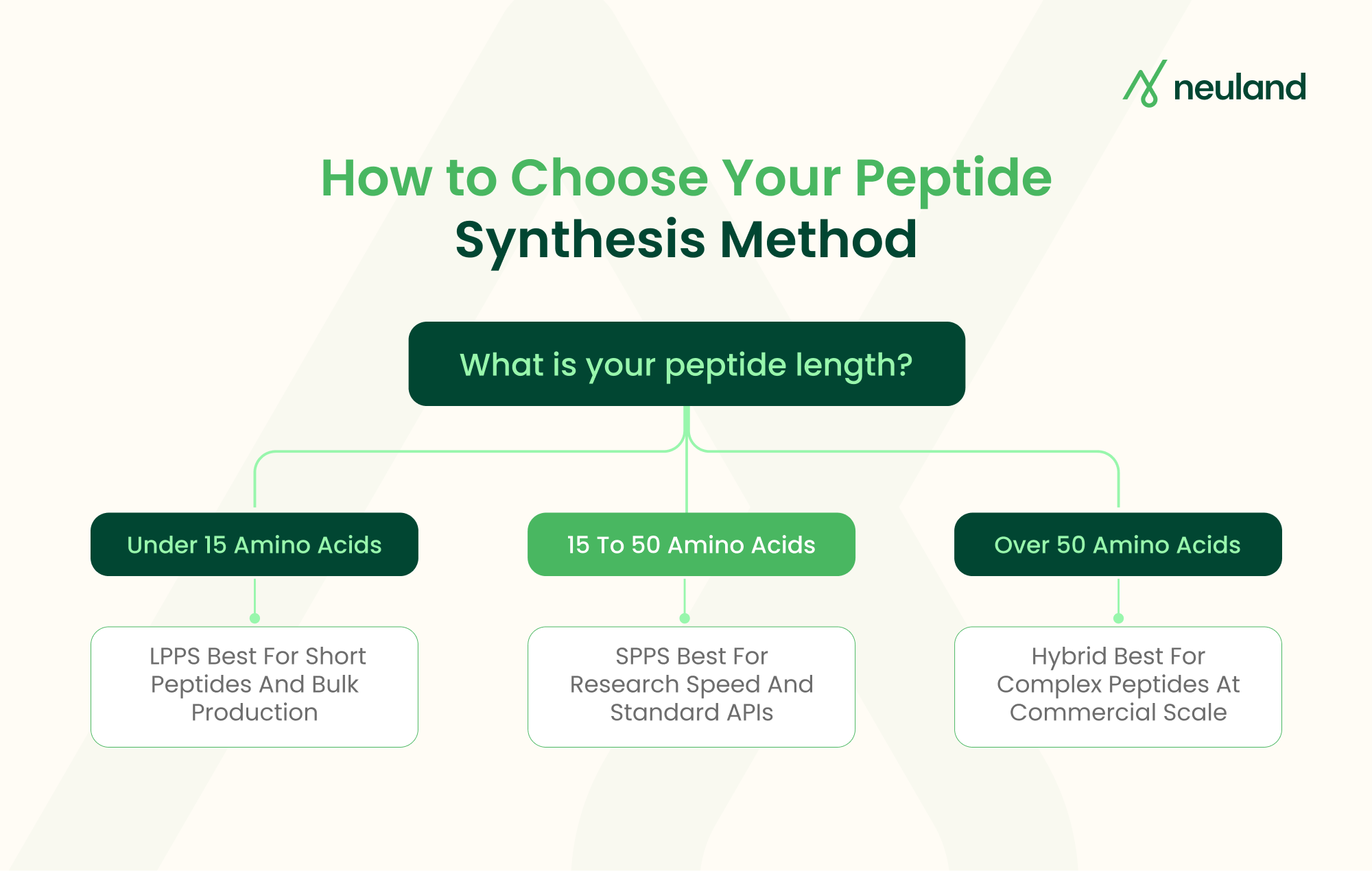
The SPPS vs LPPS vs hybrid decision depends on four main factors: length, scale, cost, and timeline. Here's a quick decision framework:
Factor | SPPS | LPPS | Hybrid |
|---|---|---|---|
| Typical length | 10 to 50 amino acids | 2 to 15 amino acids | 40+ amino acids |
| Best scale | Milligram to kilogram | Short peptides at large scale | Commercial kilogram scale |
| Cost driver | Solvents, resin, HPLC | Stepwise purification labor | Fragment development |
| Speed | Fastest for research | Slower for long peptides | Moderate, optimized at scale |
| Commercial examples | Leuprolide, octreotide | Short peptide APIs | Tirzepatide, semaglutide variants |
Practical Decision Steps
When evaluating peptide synthesis techniques for your program, walk through these questions:
- How long is your peptide? Under 15 residues may favor LPPS. Between 15 and 50 points to SPPS. Beyond 50, consider hybrid.
- What scale do you need? Clinical research favors SPPS for speed. Commercial manufacturing may benefit from LPPS or hybrid for cost.
- What are your purity targets? High-purity GMP material may justify LPPS intermediate purification or hybrid fragment control.
- What's your timeline? SPPS delivers fastest for standard sequences. Hybrid approaches require more upfront design time but pay off at scale.
Most commercial programs today benefit from custom peptide synthesis services that can evaluate all three methods and select the right one for each stage of development.
Peptide Purification and HPLC Consideration
No matter which method you choose, peptide purification is usually the most expensive step. HPLC is the industry standard, especially reverse-phase HPLC for final API isolation. At commercial scale, purification costs can easily reach 40 to 60 percent of total production spend.
Hybrid and LPPS approaches can reduce this burden by purifying intermediates along the way. SPPS defers purification to the end, putting more pressure on a single HPLC campaign.
Strong CDMOs invest heavily in chromatography, method development, and impurity profiling. These capabilities separate commercial-ready partners from research-grade ones.
The Right Peptide CDMO Partner for Every Method
Choosing a synthesis method is only part of the decision. The partner you work with shapes how well that method translates into a filing-ready program. A strong peptide CDMO brings experience across SPPS, LPPS, and hybrid approaches, matching the method to the molecule rather than forcing a single platform.
Neuland Laboratories brings this flexibility to peptide API manufacturing. With a dedicated peptide platform, three cGMP-certified facilities, and commercial-scale capacity coming online in 2026, Neuland supports clients across all three methods.
Their team handles complex sequences, non-natural amino acid incorporation, and the analytical characterization that peptide filings demand. Approvals from the FDA, EMA, and PMDA make them a strong fit for sponsors planning global programs.
For teams planning their next peptide program, the right method and the right partner work together. Talk to Neuland's team today.
FAQs
Choosing the right peptide synthesis method for your API depends on peptide length, required scale, cost constraints, and timeline. Short peptides often favor LPPS. Medium-length peptides suit SPPS. Long or complex peptides usually require a hybrid approach that combines SPPS fragments with solution-phase coupling.
The best peptide synthesis method for large-scale manufacturing depends on the molecule. Hybrid approaches are increasingly preferred for complex commercial peptides because they reduce solvent waste and improve yield. SPPS remains common for medium-length peptides, and LPPS is used for shorter sequences at high volume.
Synthesizing long or complex peptides introduces challenges like cumulative coupling inefficiencies, sequence aggregation, and difficult purification. As peptide length grows, each additional residue increases the impurity load. Hybrid strategies using fragment condensation help overcome these limits by breaking the sequence into manageable sections.
The difference between solid phase and liquid phase peptide synthesis is where the reaction takes place. SPPS builds the peptide on an insoluble resin bead, while LPPS assembles it in solution. SPPS is faster and more automated. LPPS allows intermediate purification and is better suited for short peptides or specialized GMP work.
Hybrid peptide synthesis combines SPPS for fragment preparation with LPPS or solution-phase coupling to join those fragments. It's used when peptides are too long or too complex for SPPS alone. Eli Lilly's tirzepatide is a well-known commercial example, manufactured at kilogram scale using a hybrid approach.