

R&D ROI is increasingly determined by execution, i.e., how quickly you translate CMC development into reliable clinical supply and filing-ready documentation.
A Tufts Center for the Study of Drug Development analysis estimates each day of delay costs ~US$800k in unrealized/lost sales plus ~US$40k in direct daily clinical trial costs.
CDMO partnerships are strategic ROI levers for CEOs/MDs. The right contract development and manufacturing organization integrates process development, manufacturing, and regulatory support to reduce risk, compress timelines, and defer capital investment.
Why In-House R&D Struggles to Protect ROI
In-house development can drive innovation, but often struggles with execution as programs scale. Key pain points include:
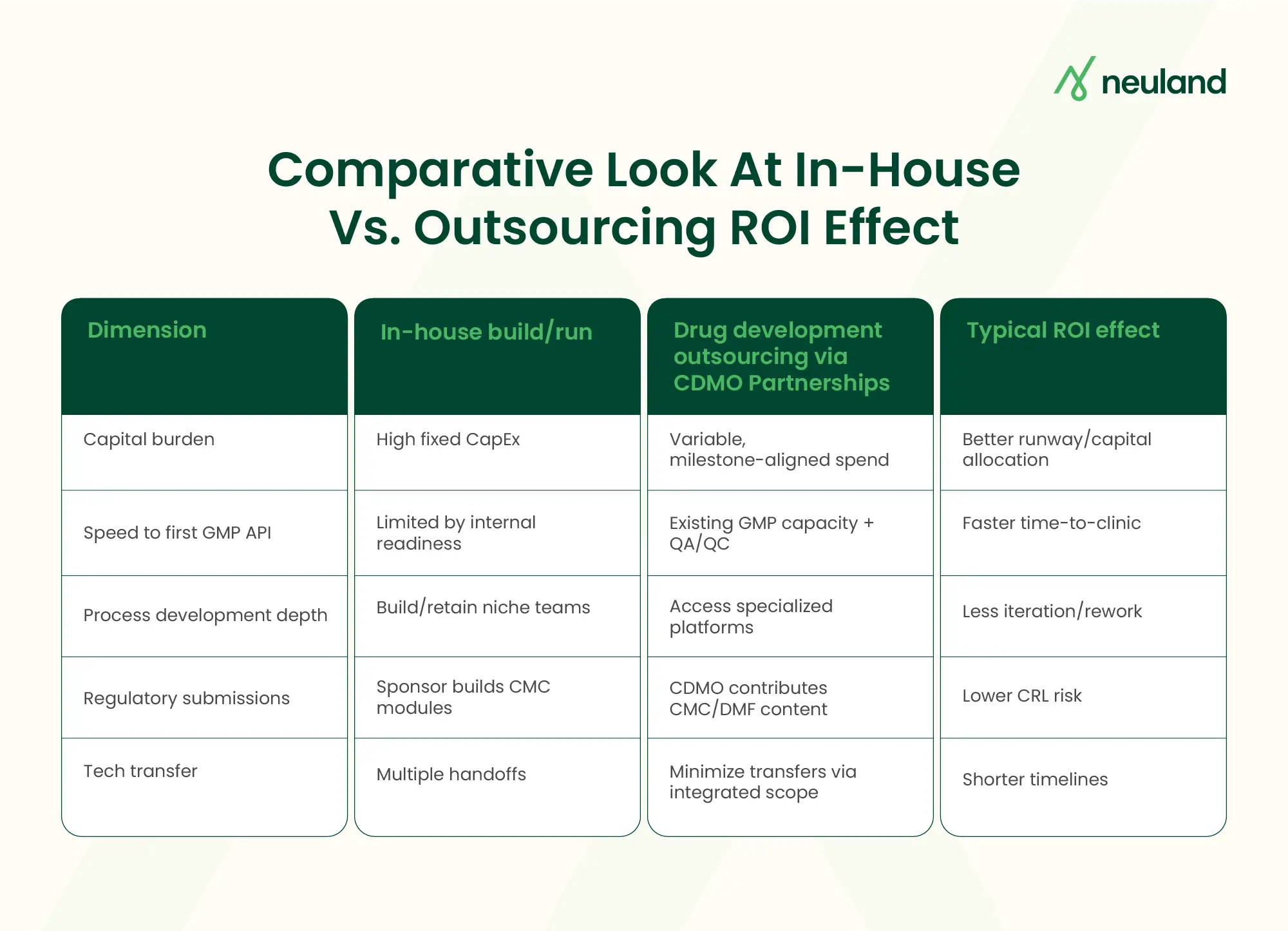
- Capacity and capital: Building new GMP facilities or expanding labs requires multi-year commitments and huge CapEx. Many biotechs cannot justify this for a single asset.
- Expertise breadth: Modern drugs (especially peptides) demand specialized process development and analytical capabilities. Maintaining these in-house adds cost and risk.
- Regulatory hurdles: Sponsors must handle full CMC development and validation data for IND/IMPD filings. Any gap or late change (e.g., process tweak) can trigger costly delays.
- Rework risk: Late-stage changes often require repeating validations, which stretches timelines and budgets. Multiple handoffs (R&D → pilot → plant) further increase the chance of glitches.
Every month of delay burns millions in expense and shortens effective market exclusivity, eroding R&D ROI. Thankfully, manufacturing issues are a common preventable blockade with CDMO partnerships.
How CDMO Partnerships Improve R&D ROI
Partnering with a CDMO turns these challenges into advantages:
Faster Timelines Through Integrated Development
Strategic CDMO partnerships compress development timelines by eliminating structural delays common in internal models. A mature contract development and manufacturing organization already operates GMP-compliant infrastructure, established quality systems, and validated processes.
This enables earlier initiation of clinical supply manufacturing and shortens the path from preclinical development to first-in-human studies.
More importantly, integrated CDMO services align process development, scale-up, and API manufacturing under a unified operational framework. When development and manufacturing are coordinated rather than sequential, handoff risks decrease.
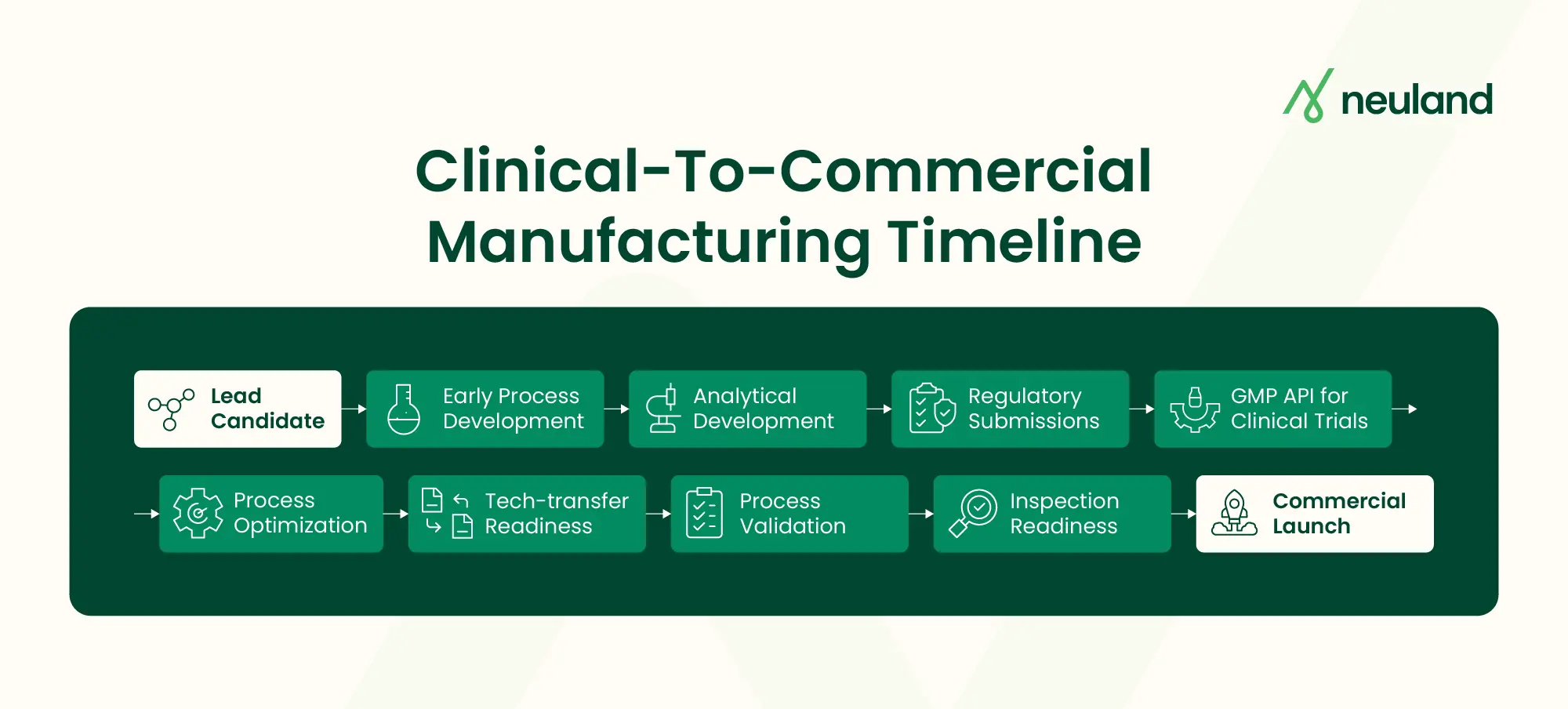
Fewer technical transfers and fewer redevelopment cycles translate directly into accelerated clinical to commercial manufacturing progression and stronger capital efficiency.
Risk Reduction Across CMC and Regulatory Pathways
A significant portion of development risk originates in late-stage CMC gaps. Experienced CDMO outsourcing partners mitigate this by embedding quality and compliance into early CMC development strategy.
Process characterization, validation planning, and documentation are structured to support smoother regulatory submissions and reduce the probability of avoidable deficiencies.
This proactive alignment lowers the likelihood of rework during scale-up or commercialization. In practical terms, reducing redevelopment cycles and failed batches protects both timelines and investor capital—making drug development outsourcing a strategic risk-management decision rather than an operational shortcut.
Capital Efficiency and Scalable Growth
Building internal infrastructure converts uncertainty into fixed overhead. In contrast, pharma outsourcing transforms capital expenditure into milestone-based operating investment. Sponsors gain access to specialized capabilities without long-term facility commitments.
For example, a well-aligned peptide CDMO or broader development partner can scale from early clinical quantities to commercial volumes without disruptive transitions.
That scalability ensures continuity, preserves development knowledge, and enables efficient outsourcing of drug development from early studies through commercialization—strengthening overall R&D ROI.
CDMO Selection Framework: Strategic Criteria That Protect ROI
Selecting the right CDMO partner is central to realizing value from CDMO partnerships. For CEOs and Managing Directors, the evaluation must go beyond capacity and pricing to structural fit and execution capability.
- Technical alignment: Assess whether the CDMO has demonstrated expertise aligned with your molecule class, impurity profile, and scale requirements. Depth in process development, route optimization, and robust impurity control directly impacts scalability and long-term cost of goods in API manufacturing.
- Development and CMC integration: Evaluate how early the partner embeds the CMC development strategy. Strong CDMO services should integrate analytical development, validation planning, and process characterization to minimize redevelopment.
- Regulatory credibility: Review inspection history, global filings, and documentation rigor supporting regulatory submissions. A disciplined quality culture reduces the probability of late-stage delays that erode R&D ROI.
- Operational continuity: Determine whether the provider can support end-to-end outsourcing with minimal tech transfer friction. Fewer handoffs within CDMO outsourcing models translate to lower execution risk and better capital efficiency.
Strategic Fit: Neuland Labs As a Partner
CDMO partnerships are strategic ROI levers, not cost centers. Neuland Labs exemplifies the right CDMO fit for small molecules and peptides. Key advantages include:
- End-to-end capability: Neuland offers process development, GMP API manufacturing, and analytical support under one roof.
- Peptide expertise: Dedicated peptide synthesis facilities and know-how ensure seamless scale-up from milligrams to kilograms.
- Regulatory support: With dozens of U.S. DMFs and global filings, Neuland aids smooth IND/NDA submissions.
- Proven quality: Inspected by FDA/EMA/PMDA, Neuland’s strong compliance record reduces approval risk.
In summary, Neuland’s integrated model addresses every ROI lever above, enabling faster decisions and fewer delays.
Next steps: Discuss your R&D outsourcing strategy, evaluate CDMO partnership fit, and talk to our development team to see how a partnership can accelerate your drug development.
FAQs
Track cycle time from development to clinical to commercial manufacturing, cost per milestone, batch success rates, deviation frequency, CMC-related delays, tech transfer efficiency, and capital avoided through pharma outsourcing versus internal API manufacturing investment.
Yes—well-structured CDMO partnerships centralize process development, quality, and regulatory coordination within one CDMO, reducing cross-functional friction rather than adding layers of operational oversight.
IP is safeguarded through master service agreements, strict confidentiality clauses, defined ownership of process improvements, and controlled data systems within CDMO outsourcing frameworks that separate sponsor IP from platform technologies.
Strategic drug development outsourcing models are inherently scalable, allowing sponsors to expand programs, adjust volumes, or pivot therapeutic focus without fixed infrastructure expansion, leveraging flexible CDMO services capacity.