
Key Takeaways
- A CDMO is your end-to-end partner. It combines process development and cGMP manufacturing under one roof, removing the handoff risk of using separate vendors.
- CDMO vs CMO comes down to scope. A CMO only manufactures; a CDMO covers route scouting through commercial supply.
- The shift is structural, not cyclical. 73% of FDA-approved drugs outsourced API manufacturing in 2025, and the market is projected to hit $315 billion by 2034.
- Five forces are driving demand. The BIOSECURE Act, GLP-1 capacity constraints, ADC complexity, M&A consolidation, and AI-driven manufacturing.
- Choosing well means looking past the brochure. Weigh capability fit, regulatory record, tech transfer, total cost, and ability to scale.
A CDMO (Contract Development and Manufacturing Organization) is a company that provides end-to-end pharmaceutical development and manufacturing services to pharma and biotech firms.
Now, ‘what is a CDMO’ is covered. But why does it matter? Consider this.
AstraZeneca abandoned a £450 million vaccine plant expansion in the UK due to shifting government policies. Even a pharmaceutical giant with deep pockets couldn't justify the risks of building a massive in-house manufacturing facility.
It was a glaring example of the industry's unpredictable nature. Developing a new drug is a high-stakes, high-cost endeavor with some major challenges:
- Changing global policies can delay or derail production
- One missing ingredient can bring development to a halt
- Building facilities and maintaining regulatory compliance is expensive and unpredictable
Nowadays, more biotech and pharma firms are outsourcing drug development and production to specialized partners such as CDMOs.
This guide goes beyond defining what a CDMO is. It covers the CDMO meaning in practical terms, how CDMO services work, the forces reshaping the industry, and how to choose the right pharmaceutical CDMO for your program.
CDMO Meaning: What Does CDMO Stand For?
CDMO stands for Contract Development and Manufacturing Organization. The term combines two functions that were historically separate in outsourcing drug manufacturing:
- Development covers process chemistry, analytical method development, and the preparation of clinical trial materials
- Manufacturing covers scale-up, cGMP production, and commercial supply
By integrating both under one roof, a CDMO eliminates the handoff risk that comes with splitting development and manufacturing across separate vendors. The team that develops your process is the team that manufactures your product, which reduces tech transfer failures, timeline slippage, and quality issues.
CDMO vs CMO vs CRO: Key Differences Explained
This is one of the most common points of confusion when evaluating outsourcing partners. Here is how CDMOs, CMOs, and CROs differ across the dimensions that actually matter for decision-making:
| CDMO | CMO | CRO | |
| Full Name | Contract Development & Manufacturing Organization | Contract Manufacturing Organization | Contract Research Organization |
| Core Function | Development + manufacturing (end-to-end) | Manufacturing only | Research and clinical trials only |
| Typical Use Case | Taking a molecule from process development through commercial supply | Scaling production of an already-developed product | Running preclinical studies, clinical trials, or regulatory submissions |
| Regulatory Involvement | Deep: CMC documentation, DMF filings, GMP manufacturing, FDA/EMA/PMDA readiness | Moderate: GMP compliance for manufacturing | High for clinical: IND submissions, trial management, safety reporting |
| Cost Model | Project-based or FTE-based through development; per-batch or per-kg at commercial scale | Per-batch or per-unit manufacturing fees | Per-study or milestone-based fees |
| Scale Range | Lab (grams) through commercial (multi-ton) | Pilot through commercial | Not applicable (research only) |
| When to Choose | You need a single partner from NCE development through commercial API supply | You have a validated process and need manufacturing capacity | You need clinical trial design, execution, or regulatory strategy |
One more distinction worth knowing: CRAMS (Contract Research and Manufacturing Services) broadly overlaps with what a CDMO does today. If you encounter it, think of it as a traditional version of the integrated CDMO model.
Must read: Choosing the Right Outsourcing Partner in Drug Development
The Global CDMO Market in 2026
The numbers tell a clear story about where the industry is headed.
The global pharmaceutical CDMO market is projected to reach $315.08 Billion by 2034, driven by 7.24% CAGR.
A few data points that explain the growth:
- API manufacturing accounts for 64% of total CDMO revenue, making it the largest service segment, while large/biologic molecules are projected to advance at a 10.54% CAGR from 2026 to 2031
- 73% of FDA-approved drugs outsourced their API manufacturing in 2025, the highest rate on record.
This is not a temporary outsourcing wave. It reflects a structural shift in how drugs get made. Pharma and biotech companies are reallocating capital toward discovery and clinical programs while relying on CDMOs to handle the increasingly complex work of development and manufacturing.
What CDMO Services Cover in Pharma
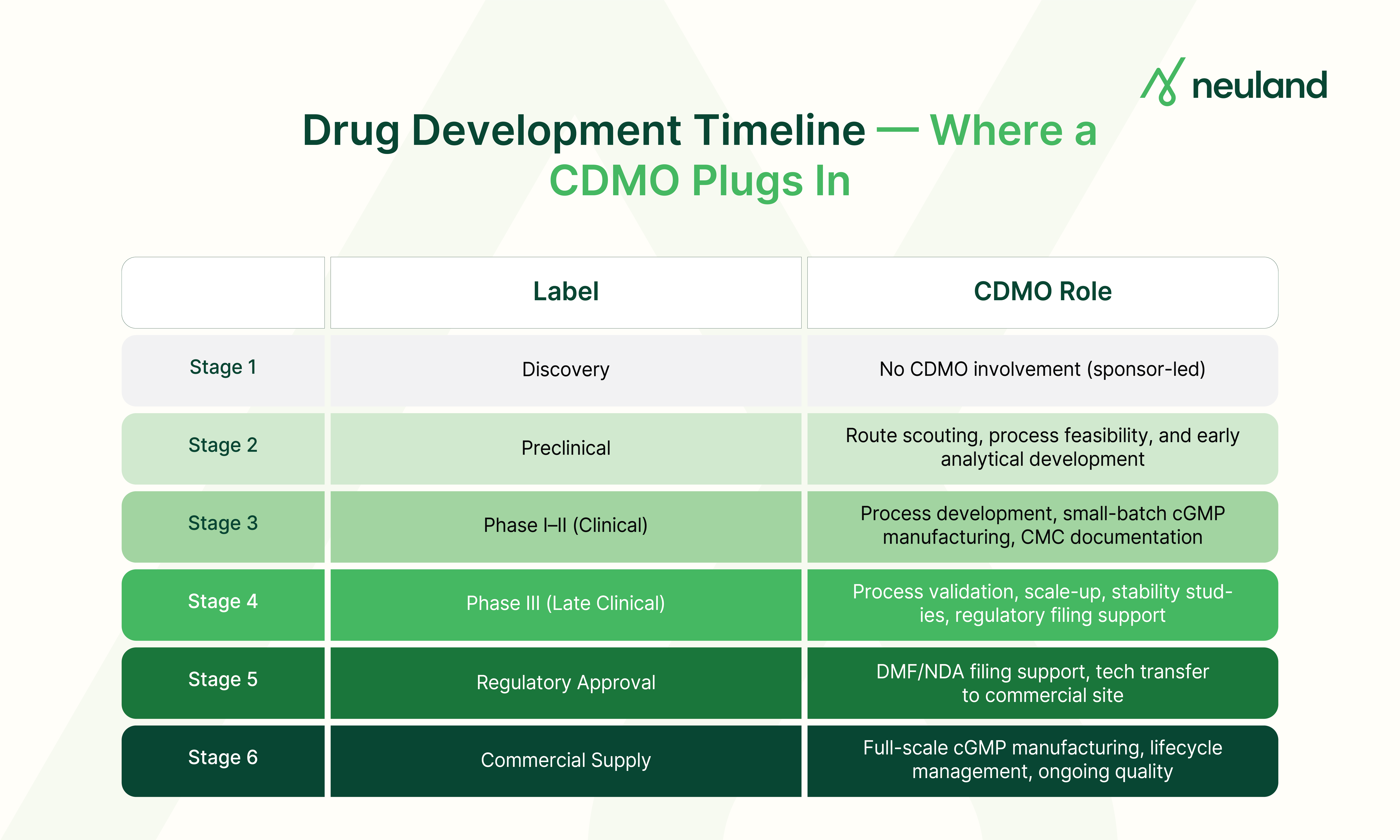
The scope of CDMO services varies by provider, but a full-service pharmaceutical CDMO typically covers:
- Development services: Route scouting and process development for active pharmaceutical ingredients (APIs), analytical method development and validation, and process safety and engineering assessments.
- Manufacturing services: Clinical-trial material production (Phase I through III), process validation and scale-up, commercial-scale cGMP manufacturing, and packaging and labeling.
- Regulatory and quality support: CMC documentation for IND, NDA, and DMF filings, regulatory compliance across FDA, EMA, and PMDA requirements, quality control and assurance systems, and stability studies per ICH guidelines.
- Specialized capabilities: Peptide synthesis (SPPS, LPPS, hybrid), high-potency API (HPAPI) handling with engineered containment, complex small molecule chemistry (cryogenic reactions, hydrogenation, bromination), and biologics or biosimilar manufacturing at select CDMOs.
Not every CDMO covers all of these. Some are full-service, end-to-end providers. Others specialize in a specific modality or development stage. The right choice depends on your molecule, your program stage, and where you need the most support. More on that in the selection section below.
Why Pharma and Biotech Companies Are Turning to CDMOs
The CDMO model is not new. What is new is the set of forces making it essential. Five macro trends are accelerating the shift toward outsourcing drug manufacturing and development.
Regulatory Uncertainty and the BIOSECURE Act
The BIOSECURE Act is the clearest example of how regulatory policy is reshaping CDMO strategy. The Act passed the US House of Representatives in September 2024 with a bipartisan 306–81 vote, targeting five named Chinese biotech entities:
- BGI Group
- MGI
- Complete Genomics
- WuXi AppTec
- WuXi Biologics
A 2025-2026 version (S.3469) was introduced in the 119th Congress.
The practical impact: US-funded drug developers will need to transition away from these manufacturers by 2032. A BIO survey found that 79% of biopharma companies have at least one contract with a China-based CDMO.
Even if specific provisions evolve, the direction is clear. Companies are diversifying their supply chains, re-evaluating long-standing dependencies, and prioritizing CDMO partners in regions with lower geopolitical exposure. For API CDMO providers in India and other emerging manufacturing hubs, this represents a significant strategic opening.
GLP-1 Drugs and Capacity Demand
The commercial success of GLP-1 receptor agonists (semaglutide, tirzepatide) for diabetes and obesity has created unprecedented demand for peptide synthesis. GLP-1 prescriptions grew at roughly 38% annually between 2022 and 2024, and total GLP-1 sales are forecast to exceed $100 billion by 2030.
This single therapeutic class is consuming a disproportionate share of global CDMO capacity, particularly for large-scale cGMP peptide manufacturing. Lead times at major peptide CDMOs have stretched to 18–24 months, and capacity reservations now need to happen well before clinical milestones.
As peptides advance in clinical pipelines across therapeutic areas beyond diabetes and weight loss, sustained capacity expansions and strategic partnerships will likely intensify in the coming years.
- Saharsh Davuluri, CEO and Managing Director, Neuland Labs
ADCs and High-Potency API Manufacturing
Over 300 antibody-drug conjugate (ADC) candidates are currently in clinical development. ADCs require a unique combination of HPAPI handling (the cytotoxic payload), biologics manufacturing (the antibody), and conjugation chemistry, making them one of the most CDMO-dependent modalities in the industry.
The ADC CDMO market was valued at $8.87 billion in 2024 and is expected to reach $16.5 billion by 2030. CDMOs with validated high-containment infrastructure and conjugation platforms are among the most capacity-constrained partners in pharma right now.
M&A Consolidation: The Novo/Catalent Effect
Novo Holdings' $16.5 billion acquisition of Catalent in 2024 was the largest CDMO transaction in history. Three major Catalent sterile fill-finish sites (Anagni, Bloomington, Brussels) were redirected to exclusive Novo Nordisk production.
The ripple effect was immediate. Smaller sponsors lost manufacturing slots they had counted on for years. The deal accelerated a broader industry shift toward end-to-end integrated CDMOs and made independent, multi-capability providers more strategically valuable for sponsors who cannot afford single-source dependency.
AI and Continuous Manufacturing
Leading CDMOs are integrating AI-driven process optimization, continuous flow reactors, and real-time data analytics into their operations. Continuous manufacturing reduces batch cycle times, improves consistency, and lowers material waste. AI tools are entering chemistry and process development, predictive maintenance, and quality systems, helping CDMOs compress timelines that used to take months into weeks.
Planning a complex molecule program?
Neuland works alongside pharma and biotech teams from pre-IND through commercial supply, backed by 42+ years of API expertise, 846+ DMFs filed globally, and end-to-end CDMO services across three FDA-inspected facilities. Contact us to discuss your next project.
Key Benefits of Working With a CDMO
Higher Yield Through Process Optimization
In drug manufacturing, every extra percentage point in yield is time, money, and efficiency gained. CDMOs specialize in process optimization, identifying inefficiencies and refining methods to maximize output.
Neuland Case Study: Neuland Labs improved a biopharma client's API yield from 34% to 61%, cutting production cycles and material waste. A safer, more efficient process was implemented, and a critical milestone was achieved at a fraction of the anticipated cost.
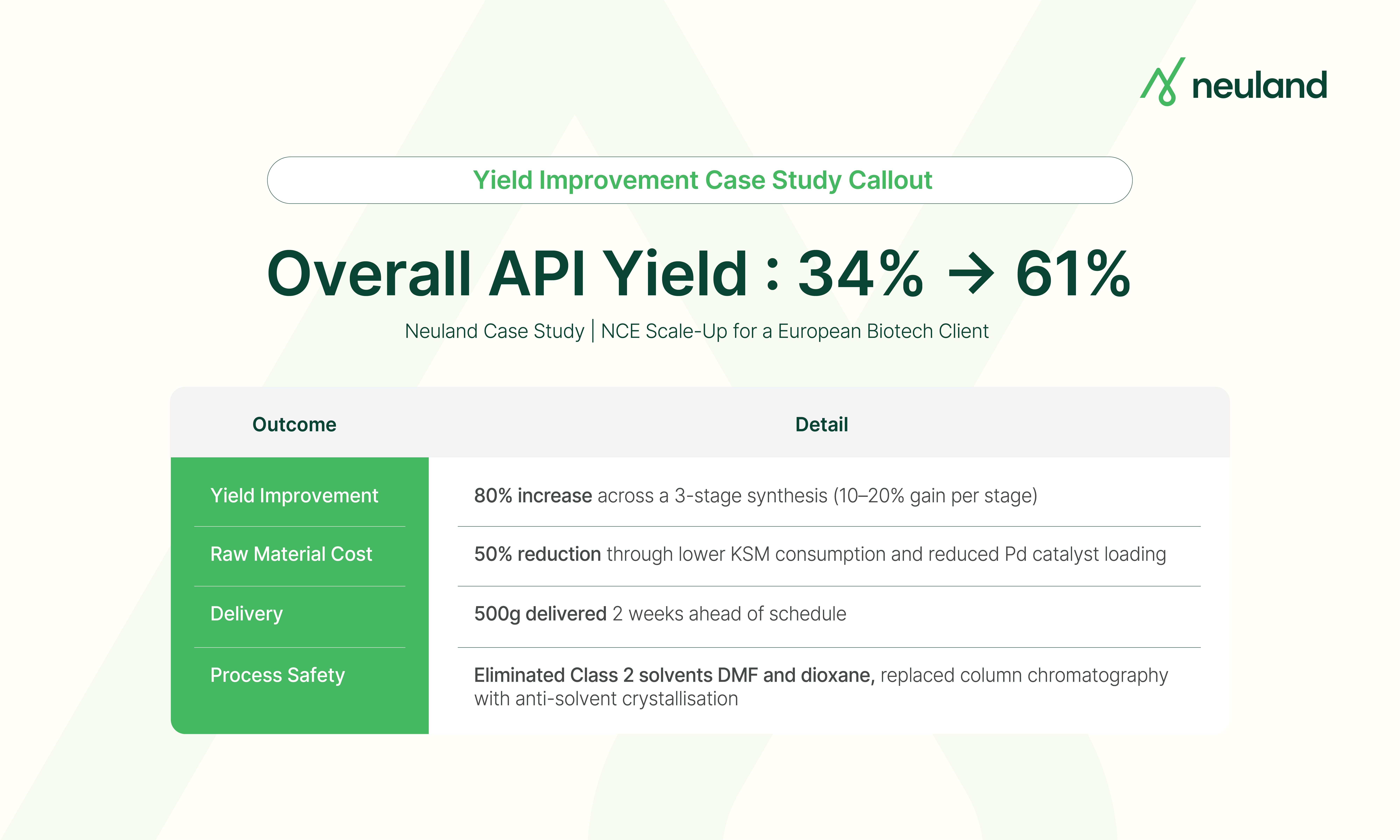
This kind of improvement is not unusual when a specialized CDMO applies its process chemistry expertise to an unoptimized route. It is one of the most tangible, measurable CDMO benefits pharma companies gain from the partnership.
Cost Savings Without Compromising Quality
Owning a manufacturing facility sounds appealing until you factor in the real costs. Equipment, staffing, compliance, maintenance, building, and running an in-house GMP manufacturing operation are significant financial commitments. CDMOs already have the infrastructure, technology, and trained personnel in place. By leveraging that existing capacity, companies can redirect capital toward discovery and clinical programs.
One important caveat: not all CDMO pricing is transparent. While some offer attractive base rates, unexpected costs for process adjustments, regulatory filings, or tech transfers can add up. The selection section below addresses how to evaluate the total cost of ownership.
Phase-Appropriate Scaling
A good biotech CDMO scales with your program. Early-phase work (grams to kilograms for clinical trials) requires flexibility and speed. Commercial manufacturing (multi-ton volumes) requires consistency, validated processes, and regulatory readiness.
The best CDMOs provide a continuum from custom development through custom manufacturing without requiring a disruptive mid-program partner switch.
Sustainability and Green Chemistry
Leading CDMOs are phasing out toxic, outdated solvents in favor of safer, eco-friendly alternatives. Less waste means fewer purification steps and a streamlined production process. Continuous flow reactors and biocatalytic processes are also gaining traction, improving yield and scalability while simplifying waste treatment. In a market where sustainability is becoming a competitive and regulatory requirement, having a CDMO that prioritizes efficiency and eco-conscious production adds measurable value.
Must read: Building a More Sustainable Supply Chain in Pharma
How to Choose the Right CDMO: A Selection Framework
Every CDMO will tell you they can handle your program. Here are five questions that separate capable partners from capable marketing:
1. Does their capability match your molecule?
A small molecule API CDMO is not the same as a biologics CDMO or a peptide synthesis specialist. Match the partner to the chemistry, not the brochure.
2. What is their regulatory track record?
Ask for inspection history, not just certifications. An FDA-inspected facility with zero 483 observations is materially different from one with ten. Check DMF filing history and multi-agency approvals (FDA, EMA, PMDA) if you are targeting multiple markets.
3. How do they handle technology transfer?
Industry data suggests roughly 50% of tech transfers experience quality problems. Ask about their tech transfer process, dedicated teams, and project management systems. CDMOs that keep development and manufacturing on the same site reduce this risk structurally.
4. What is the total cost of ownership?
The RFP price covers an estimated 60–70% of what the relationship actually costs. Factor in technology transfer fees, raw material markups, change orders, stability storage, and internal management hours when comparing proposals.
5. Can they scale with you?
Your Phase I partner should be able to support Phase III and commercial supply without a disruptive transition. Ask about capacity, expansion plans, and their track record in taking processes from kilo lab to commercial volumes.
Looking for a CDMO partner that fits?
Neuland Labs supports pharma and biotech programs from pre-IND through commercial supply, with deep expertise in complex small molecules and peptide API manufacturing
Summary
A CDMO is a single partner that takes a molecule from early development through commercial manufacturing, cutting the timeline and quality risks of juggling multiple vendors. Its services span development, manufacturing, and regulatory support, with the right scope depending on your molecule and stage. As the BIOSECURE Act, GLP-1 demand, ADC complexity, and consolidation reshape the industry, picking a CDMO with the right capability fit, regulatory record, and ability to scale is now a make-or-break decision.
FAQs
CDMO stands for Contract Development and Manufacturing Organization. It is a company that provides both drug development services (process chemistry and analytical development) and GMP manufacturing services (clinical supply through commercial production) to pharmaceutical and biotech companies.
A CMO (Contract Manufacturing Organization) focuses only on manufacturing a product that has already been developed and validated. A CDMO adds development capabilities on top of manufacturing, handling everything from route scouting and process optimization through scale-up and commercial production. The integrated model reduces handoff risk and compresses timelines.
Costs vary significantly based on molecule complexity, development stage, batch size, and regulatory requirements. Early-phase development projects may range from hundreds of thousands to low single-digit millions. Commercial manufacturing is typically priced per batch or per kilogram. The most important consideration is total cost of ownership, not just the per-unit price, since tech transfer fees, change orders, and regulatory support costs can add 30–40% beyond the base quote.
The CDMO model serves both, but the relationship dynamics differ. Biotech companies, particularly early-stage firms with 10–500 employees, often lack in-house manufacturing infrastructure entirely. For them, the CDMO is not just a partner but the operational backbone of their supply chain. Large pharma companies typically use CDMOs to supplement capacity, access specialized chemistry (peptide synthesis, HPAPI handling), or accelerate timelines for specific programs while maintaining some in-house manufacturing.
Focus on five areas: capability fit for your specific molecule and modality, regulatory track record (inspection outcomes, DMF history, multi-agency approvals), technology transfer process and project management systems, total cost of ownership beyond the RFP price, and the ability to scale from clinical supply through commercial manufacturing without a disruptive transition. Site visits and reference calls with existing clients are non-negotiable steps before signing.