Meet us at Tides Europe 2026, Stand No. 805, Nov 3-5, RAI Amsterdam, Netherlands Schedule a Meeting

A promising drug candidate means nothing without a reliable active ingredient supply. Yet most pharma and biotech companies still treat API sourcing as a procurement task — not a risk decision.
That's a costly mistake. According to the U.S. Pharmacopeia's Medicine Supply Map, China overtook India in new API Drug Master File filings for the first time in 2024. The U.S. now accounts for a tiny fraction. When supply is this concentrated, a single disruption can stall trials and destroy years of investment.
This article breaks down where the real risks sit — and how the right CDMO partnership protects your pipeline.
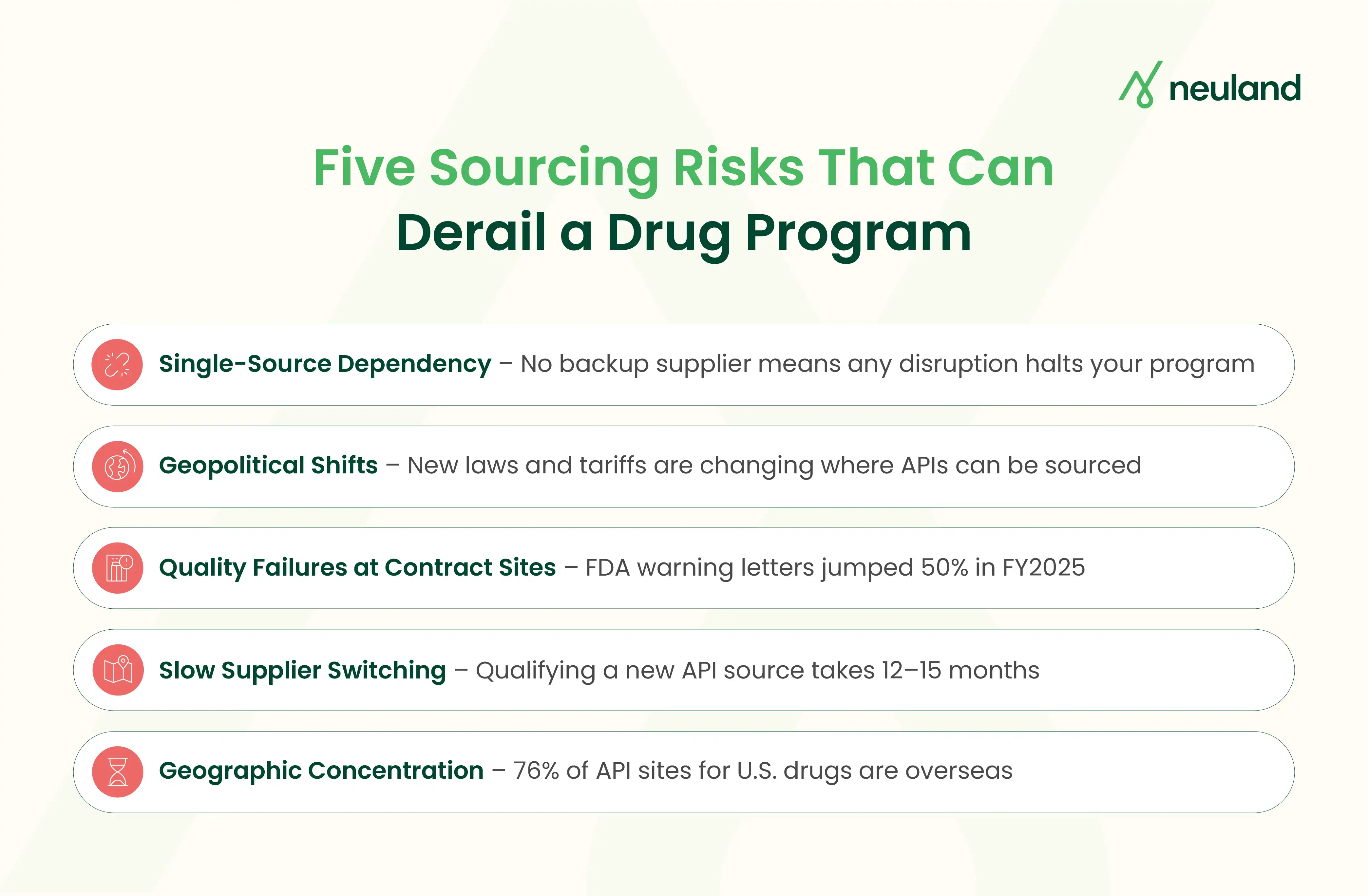
Only 24% of API manufacturing facilities for U.S.-marketed drugs are domestic. The rest are spread across India, China, and Europe. And since India imports most of its API intermediates from China, "diversifying to India" doesn't fully reduce single-country exposure.
The average U.S. drug shortage now lasts over 1,200 days. And the causes often trace back to quality failures at one facility.
Example: When FDA inspectors found data fabrication at Viatris's Indore plant in 2024, the warning letter and import ban cost the company $500 million in revenue. Its stock dropped 15% in a single day.
Risk management in drug development usually focuses on clinical outcomes. But sourcing introduces a different kind of exposure — one that's harder to spot until it's too late.
Here are the most common failure points:
Example: In early 2025, the FDA placed clinical holds on all of Atara Biotherapeutics' active programs — not for safety issues, but for GMP failures at a third-party manufacturer.
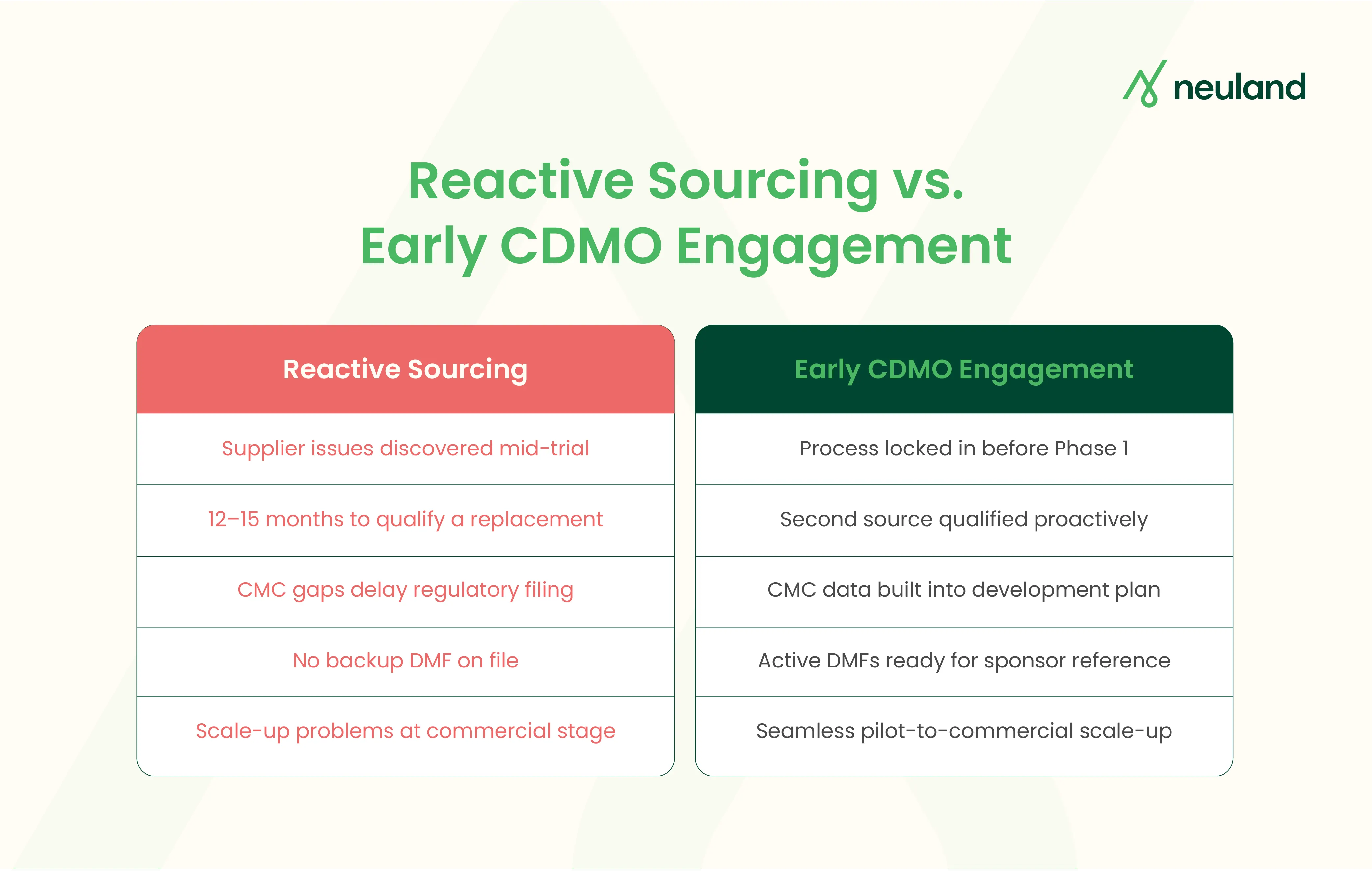
The best way to protect a pipeline is to choose a manufacturing partner early. Ideally, right after candidate selection.
A Tufts CSDD study (June 2025) found that early CDMO engagement cuts development timelines by 14 to 34 months. That's time saved across process development, tech transfer, and regulatory preparation.
Early collaboration helps teams:
Drug development now costs $2.23 billion per asset on average. Protecting that investment starts with early supply decisions.
Not every CDMO can take your program from development to commercial scale. When evaluating a partner for drug substance manufacturing, assess capability across three areas:
A strong CDMO pharma partner offers experience with complex chemistries — cryogenic reactions, high-potency compounds, hydrogenation, and peptide synthesis. Handling multiple modalities under one roof reduces technology transfer risk.
API drug manufacturing must work at lab, pilot, and commercial scale. Look for validated commercial API manufacturing capacity. Reactor volume, batch consistency data, and process analytical technology all matter.
Your CDMO API manufacturing partner should hold active DMFs with the FDA and other agencies. A clean inspection history signals lower risk during pre-approval audits. Ask how many regulatory filings the CDMO has supported across INDs, ANDAs, and NDAs.
Looking to reduce pipeline risk through smarter API sourcing decisions? Partner with a CDMO that brings proven depth and a strong regulatory track record. Explore Neuland's API products |
Qualify a second source before you need one. Dual sourcing eliminates the 12–15 month gap that makes reactive switching so painful.
Then align your API manufacturing services partner with your regulatory strategy. The CMC section of any filing depends on your CDMO's drug substance data. Getting that wrong — or late — delays approvals.
API sourcing is a pipeline decision, not a procurement decision. Companies that treat it that way protect their programs, timelines, and investors. And we’re here to help you protect it.
Neualnd Labs is a CDMO with 40+ years of industrial experience with an established DMF portfolio for a faster FDA review process.
It is also strategically expanding into commercial-scale peptide manufacturing, with Module One of a new facility expected to be operational by summer 2026. The peptide facility has already secured $30 million in firm customer commitments and targets the massive GLP-1 market opportunity.
The company exports to 80+ countries and holds regulatory approvals from the FDA, EDQM, and PMDA. Talk to an API expert today to get started.
The biggest risk in pharmaceutical API sourcing is single-source dependency. If your only supplier faces a quality failure or regulatory action, your entire program stalls. Dual sourcing and early CDMO engagement are the most effective ways to reduce this exposure.
Sourcing decisions affect risk management in drug development because supply disruptions cause clinical holds, filing delays, and revenue losses. Choosing a qualified CDMO with active DMFs and inspection-ready facilities directly lowers manufacturing-related setbacks.
Companies should engage a CDMO early for manufacturing support because it aligns process development with regulatory expectations from the start. Early engagement cuts timelines by up to 34 months and avoids costly rework during scale-up.
The API supply chain contributes to drug shortages because 76% of manufacturing sites for U.S. drugs are overseas. Geographic concentration and single-supplier markets make the system fragile. One quality failure at a key facility can disrupt supply for years.
CDMO services help protect pipeline investments by providing validated manufacturing, regulatory documentation, and scale-up expertise. A strong partner handles drug substance manufacturing, DMF filings, and pre-approval inspections — shielding the sponsor's timeline from avoidable supply failures.