Meet us at Tides Europe 2026, Stand No. 805, Nov 3-5, RAI Amsterdam, Netherlands Schedule a Meeting

Turning a drug candidate into a viable therapy requires developing a process to produce that molecule at scale.
Active pharmaceutical ingredient (API) process development is the discipline of designing and optimizing the manufacturing process for the API. It takes a lab-scale concept and prepares it for efficient, large-scale production.
This article will explore what API process development entails, its key stages, how it differs from API manufacturing, and best practices for success.
API process development involves creating a production process for an active pharmaceutical ingredient that consistently delivers quality, purity, and yield.
This involves optimizing reactions, selecting raw materials and solvents, defining equipment, and setting critical parameters. Crucially, the process must be efficient and cost-effective, and built under good manufacturing practices and ready for validation.
By the end of this, the team has established a validated API production process that can be executed repeatedly to produce the API with consistent quality attributes.
This foundation, in turn, supports later stages of drug development by ensuring the active pharmaceutical ingredient manufacturing process is reproducible and compliant.
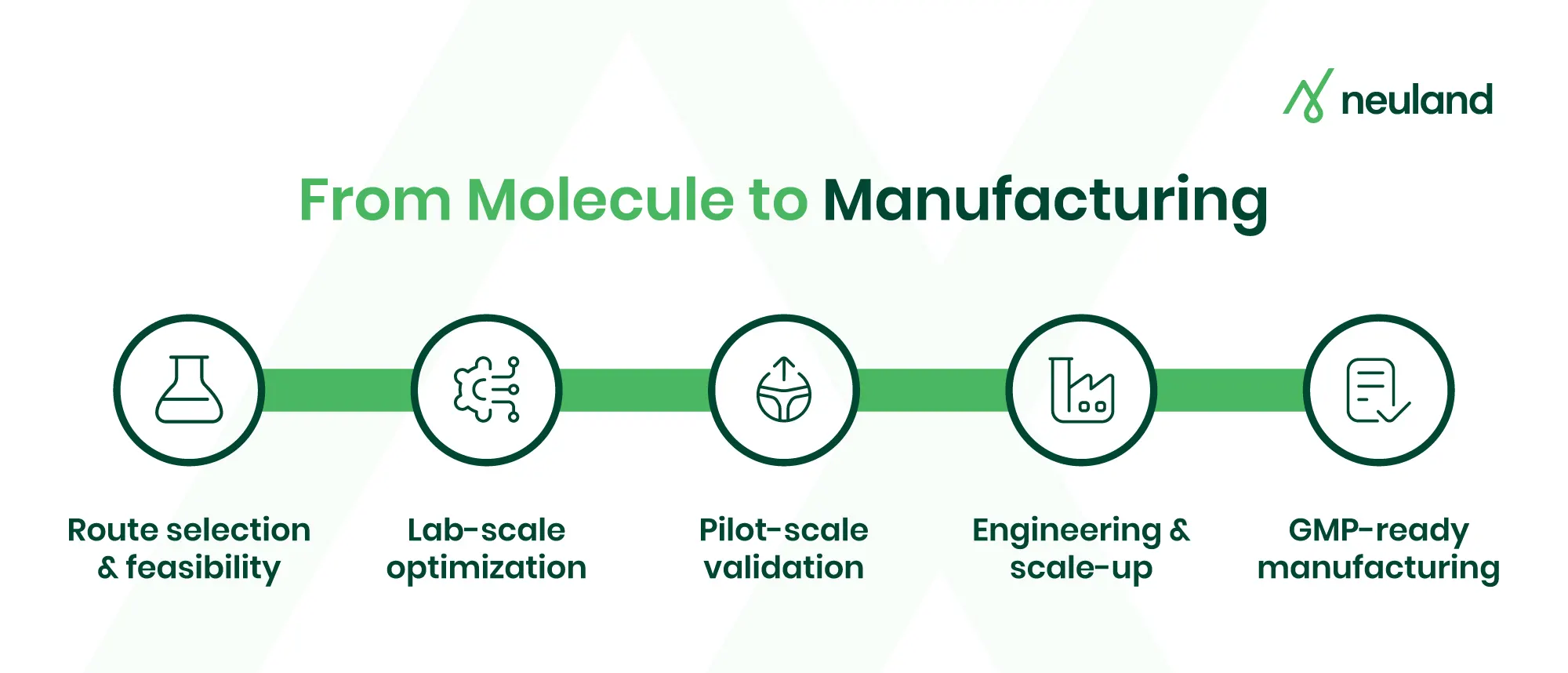
Projects progress through a series of well-defined stages, each building on the last to reduce risk and prepare for scale-up.
At each step, researchers refine the process to improve yield and ensure safety. The major steps in API process development typically include:
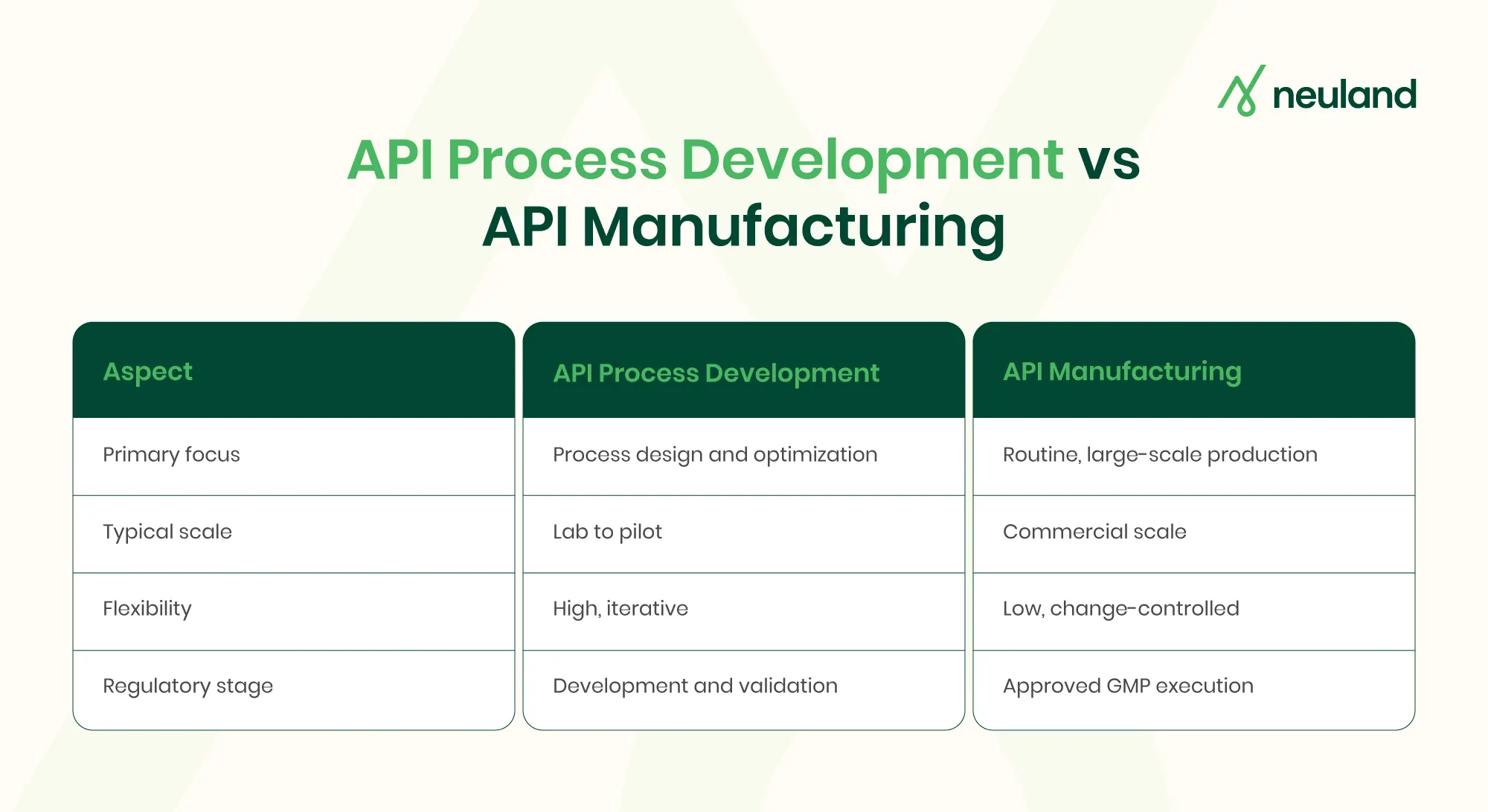
API process development is an R&D-driven phase focused on designing, refining, and proving a reliable process for making the API. It is iterative and exploratory, involving lab experiments and small-scale trials that gradually scale up. The outcome is a validated, regulatory-ready process.
API manufacturing, by contrast, is the execution of that established process at production scale under strict GMP conditions to produce the API in commercial quantities. Development allows optimization and adjustments, while manufacturing permits only tightly controlled changes to ensure consistency.
The two phases are closely linked. Knowledge flows from development to manufacturing through tech transfer, and early GMP batches are often produced while development is still ongoing.
Before launch, the process undergoes formal validation to demonstrate consistent performance at scale. Once validated, API manufacturing enters steady-state production, delivering the active pharmaceutical ingredient reliably and at volume.
API process development is rarely executed in isolation. As molecules progress from discovery to scale, pharma and biotech firms often depend on external partners for expertise, infrastructure, and support. The effectiveness of this partnership can directly influence timelines, cost control, and regulatory readiness.
The right partner combines scientific depth with practical scale-up experience, ensuring that early process decisions translate smoothly into a reliable API manufacturing process. This is especially critical as development progresses from laboratory optimization to pilot and GMP environments, where poor handoffs or knowledge gaps can introduce costly delays.
At a minimum, an effective API process development partner should demonstrate:
In practice, many organizations engage a CDMO at this stage because the role demands integrated development and manufacturing expertise.
Neuland Labs exemplifies this partner-led model. With more than four decades of experience, Neuland has supported the development of complex small molecules and peptides, guiding APIs from early-stage process design through commercial manufacturing.
At Neuland, API process development begins in the R&D laboratory, where processes are built using rigorous scientific and engineering methodologies.
Development teams apply Quality by Design (QbD) principles, structured risk management, and Design of Experiments (DoE) to systematically understand process behavior, identify critical parameters, and establish robust control strategies early.
This data-driven approach allows potential scale-up risks to be addressed upfront, rather than discovered during manufacturing. By integrating development, scale-up, and regulatory readiness from the outset, Neuland ensures that processes are not only efficient at lab scale but also reproducible, compliant, and commercially viable.
Check out how Neuland supports API process development, which leads to life-changing medicines reaching patients faster and more reliably.
API process development focuses on scaling, optimizing, and controlling a chosen synthesis for manufacturing, while route development concentrates on identifying and evaluating viable synthetic pathways at the laboratory discovery stage.
API process development should begin once a lead candidate is selected, typically during preclinical or early clinical stages, to ensure scalability, impurity control, and regulatory readiness as the API drug development advances.
API process development typically takes several months to a few years, depending on molecular complexity, process maturity, scale-up challenges, and regulatory requirements across clinical and commercial phases.
Regulatory guidelines for API process development include ICH Q8–Q11, GMP requirements, and expectations from agencies such as the US FDA, EMA, and PMDA to ensure consistent quality, safety, and process control.