
Stability Testing for Pharmaceutical APIs: Methods, Guidelines, and Challenges
Every API degrades. The question is how fast, under what conditions, and what it turns into.
Stability testing answers that question. It determines storage conditions, retest periods, and shelf life for active pharmaceutical ingredients. It also feeds directly into regulatory filings, impurity specifications, and commercial viability via analytical validation.
Without reliable stability data, you cannot file a DMF, set a retest date, or confidently ship product across climate zones.
This guide covers the methods, current stability testing guidelines, and the practical challenges that matter most for pharmaceutical stability testing today.
What Is Stability Testing and Why Does It Matter for APIs?
In simple terms, it is the process of evaluating how an API's quality changes over time under controlled conditions like temperature, humidity, and light.
That sounds routine. In practice, it shapes nearly every downstream decision.
If your API degrades faster than expected, your approved shelf life gets shorter. Shorter shelf life means tighter inventory, higher waste, and a weaker commercial position.
This is not a theoretical risk. In 2024, the FDA issued a warning letter to an API manufacturer for failing to conduct ongoing stability studies and failing to investigate out-of-specification results.
What Changed With ICH Stability Testing Guidelines in 2025
In April 2025, the ICH released a consolidated draft of the new Q1 guideline, marking the first major revision to global ICH stability testing standards in over twenty years.
Here is what changed:
- One unified guideline: The new ICH Q1 replaces the entire Q1A through Q1F series plus Q5C. No more bouncing between six separate documents.
- Risk-driven study design: The previous framework was prescriptive. The revised one encourages flexible designs grounded in product knowledge and risk assessment.
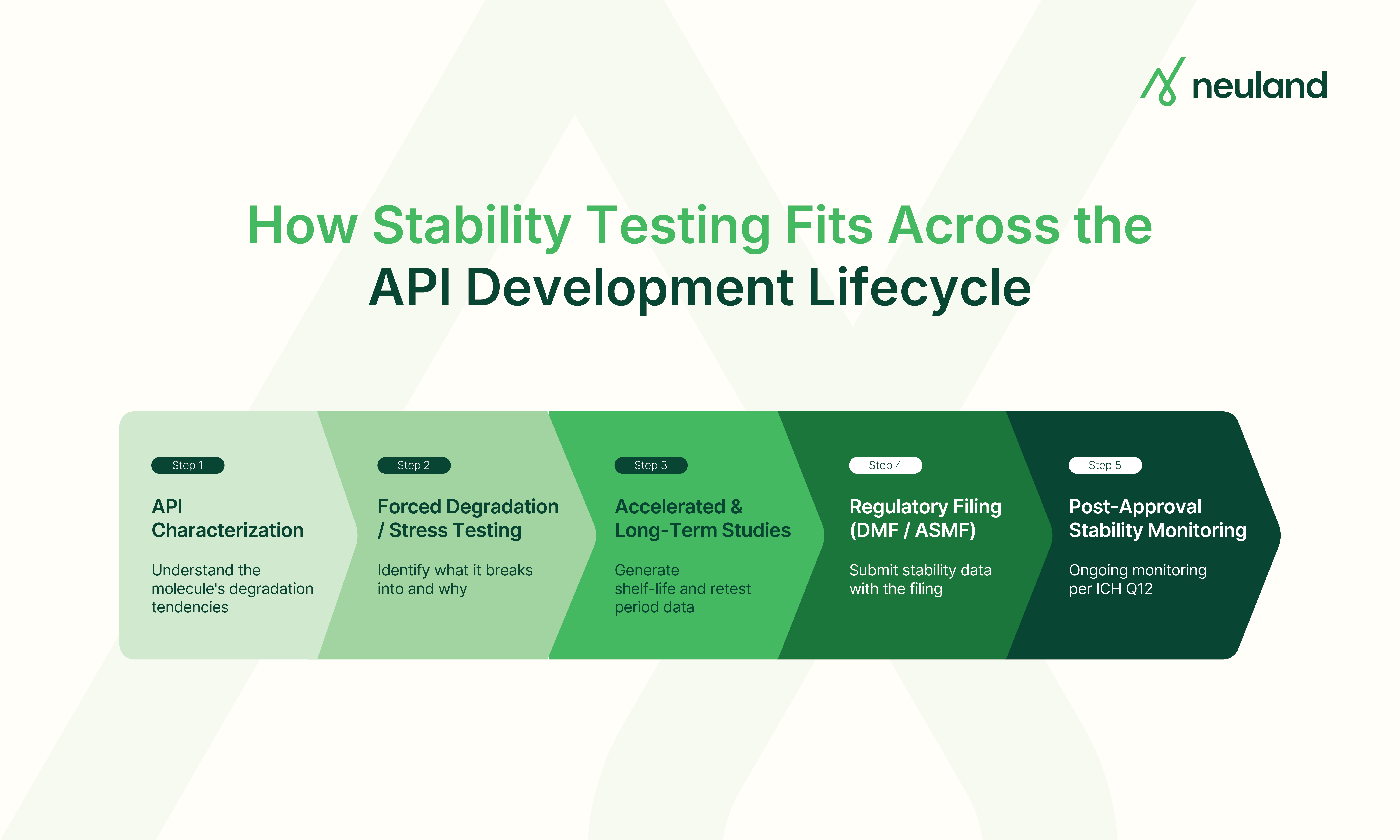
- Lifecycle integration: Stability is now aligned with ICH Q12 for post-approval changes. It is no longer just a pre-filing exercise.
- Broader scope: The guideline now covers biologics, vaccines, gene therapies, and combination products under one framework.
The FDA published this draft for public comment in June 2025 under docket FDA-2025-D-1106.
One thing worth flagging. For over three decades, the previous Q1 series rewarded a compliance-first mindset where predefined timepoints mattered more than actually understanding degradation behavior. The 2025 revision deliberately moves away from that pattern.
Key Methods in Pharmaceutical Stability Testing
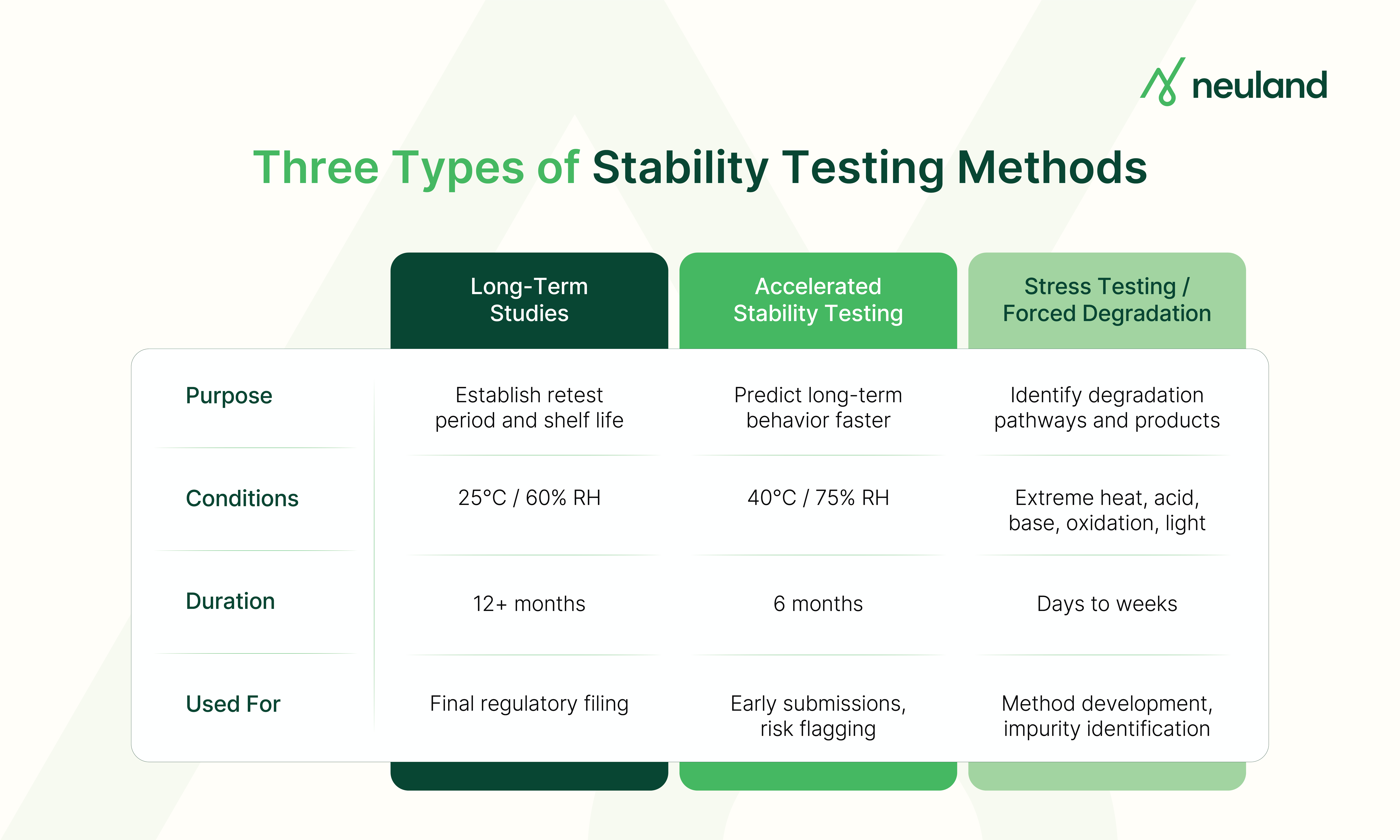
Stability studies pharma teams run typically fall into three categories:
Long-Term Studies
Conducted at standard storage conditions (usually 25°C/60% RH) over 12 months or longer. This provides the definitive data regulators need to approve retest periods.
Accelerated Stability Testing
Uses elevated conditions, typically 40°C/75% RH for six months, to predict long-term behavior faster. Useful for supporting early regulatory submissions and flagging degradation pathways before long-term data matures.
Stress Testing and Forced Degradation
Exposes the API to extreme heat, humidity, light, acid, base, and oxidation. The goal is not to simulate real-world storage. It is to deliberately break the molecule and identify what it degrades into.
Did you know? A 2025 study found that many forced degradation programs focus heavily on hydrolysis but skip photostability entirely, missing a critical pathway. An open-source scoring tool called STABLE was built to close that exact gap.
Impurity Profiling, API Characterization, and Scale-Up Risks
This is where stability work collides with some of the most expensive surprises in drug development.
Impurity profiling during stability studies identifies degradation products that form over time. If any impurity crosses the ICH identification threshold, it must be structurally characterized using LC-MS, NMR, or preparative HPLC. That work is time-intensive and costly.
Early API characterization, covering polymorphism, hygroscopicity, and degradation tendencies, reduces the chance of unexpected findings during formal studies later. The analytical methods built during characterization feed directly into your stability-indicating methods.
New impurities can emerge during process development and scale-up that never appeared in the lab. Changes in mixing, heat transfer, and reaction kinetics at larger volumes can shift the impurity profile. When that happens, studies may need to be repeated on batches representative of the updated commercial process.
How CDMOs Support Long-Term Stability Programs
For biotech and mid-size pharma without dedicated stability infrastructure, a CDMO provides the analytical services pharma teams need: method development, validation, forced degradation studies, and ongoing GMP monitoring.
The deeper value is strategic. FDA, EMA, PMDA, and CDSCO each have different expectations for stability data. A CDMO with multi-market experience helps you avoid protocol gaps that delay filings.
CDMOs that house process development and analytical capabilities together also reduce technology transfer risk. If the team running your synthesis also developed your stability-indicating methods, you avoid the rework that comes with mid-program partner changes.
If you are evaluating CDMO partners, Neuland Laboratories' CDMO services support API programs from early development through commercial scale, including analytical development and stability support.
Need support with your API stability program? Connect with Neuland's team to build a strategy that holds up from filing through commercial supply.
FAQs
1. What is stability testing in pharmaceuticals?
It evaluates how an API's quality changes over time under controlled conditions to establish storage requirements and retest periods.
2. Why is stability testing important for APIs?
It determines shelf life, surfaces degradation products, and generates the data regulators require before approving a drug substance for commercial use.
3. What are ICH stability testing guidelines?
ICH Q1 sets global standards for study design, storage conditions, testing intervals, and data evaluation for drug substances and products [4].
4. What is accelerated stability testing?
A method using elevated temperature and humidity (40°C/75% RH for six months) to predict long-term API behavior faster than real-time studies allow.
5. How does stability testing affect API shelf life?
Directly. The approved retest period is derived from stability data. Weak studies lead to shorter timelines.
6. What analytical methods are used in stability testing?
HPLC, UPLC, Karl Fischer titration, dissolution testing, and spectroscopy, all validated as stability-indicating per ICH requirements.
7. What causes API degradation during stability studies?
Hydrolysis, oxidation, photolysis, or thermal stress, depending on the molecule's chemical structure and storage environment.
