Meet us at Tides Europe 2026, Stand No. 805, Nov 3-5, RAI Amsterdam, Netherlands Schedule a Meeting

Your API supplier shapes everything, including product quality, regulatory outcomes, and whether your drug reaches the market on schedule. Hence, choosing the right pharmaceutical API suppliers becomes a risk management decision.
The global API manufacturing market is expected to grow from $250.66 billion in 2025 to $347.49 billion by 2030. Meanwhile, the FDA issued 327 warning letters in 2025 with a 73% spike in the second half of the year alone. Regulatory pressure is climbing, and your supplier's compliance posture is directly tied to yours.
This guide gives you a practical qualification checklist, the right questions to ask API manufacturers, and a clear view of the sourcing risks shaping the CDMO industry right now.
Pharmaceutical API suppliers develop, manufacture, and supply the active ingredients that give drugs their therapeutic effect. The landscape includes several types of active pharmaceutical ingredient manufacturers:
Knowing which type fits your program's stage, molecule complexity, and target markets is the starting point of any solid sourcing strategy.
A weak supplier creates regulatory exposure, not just quality headaches.
In 2025, warning letters targeted facilities that failed GMP standards. Nearly all of them cited documentation and records management breakdowns, not bad chemistry.
If your pharmaceutical API manufacturers have gaps in data integrity or deviation management, those gaps become your problem the moment their product enters your supply chain.
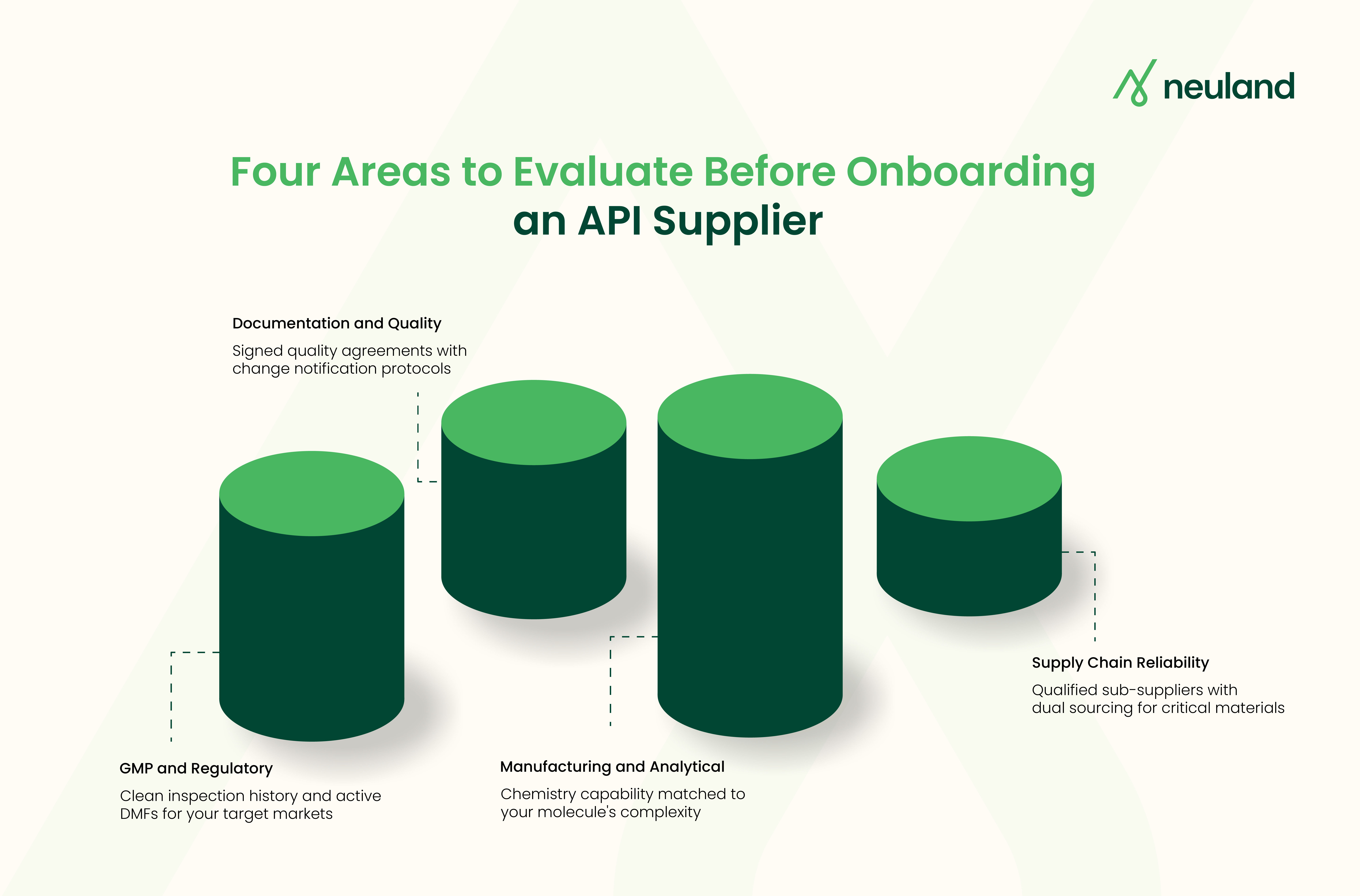
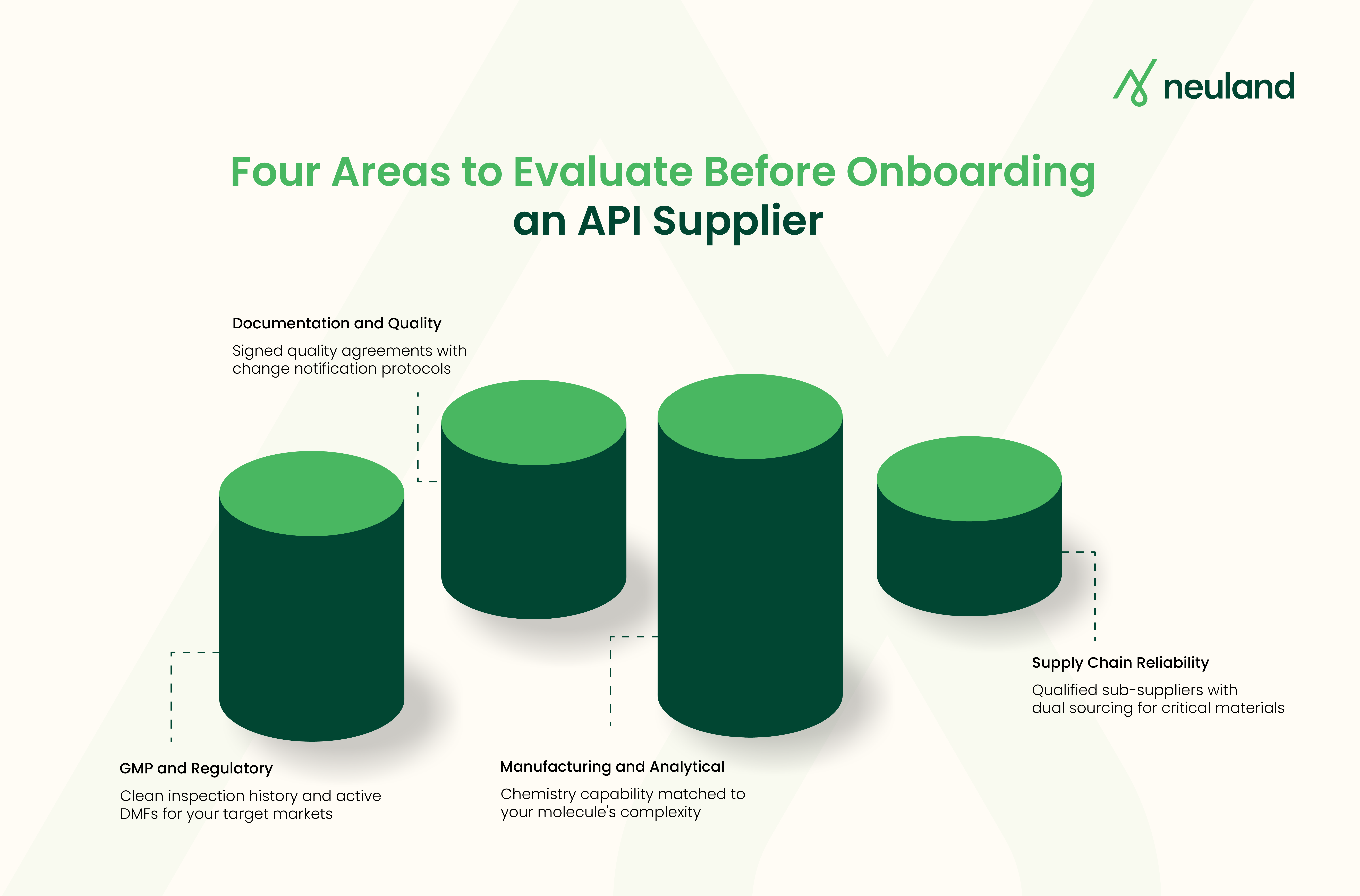
A structured API supplier qualification process protects your program from avoidable risk. Here are the key areas to evaluate before onboarding any supplier.
The right questions tell you whether a supplier's quality culture is real or performative. Here are the ones that experienced CMC and procurement teams prioritize:
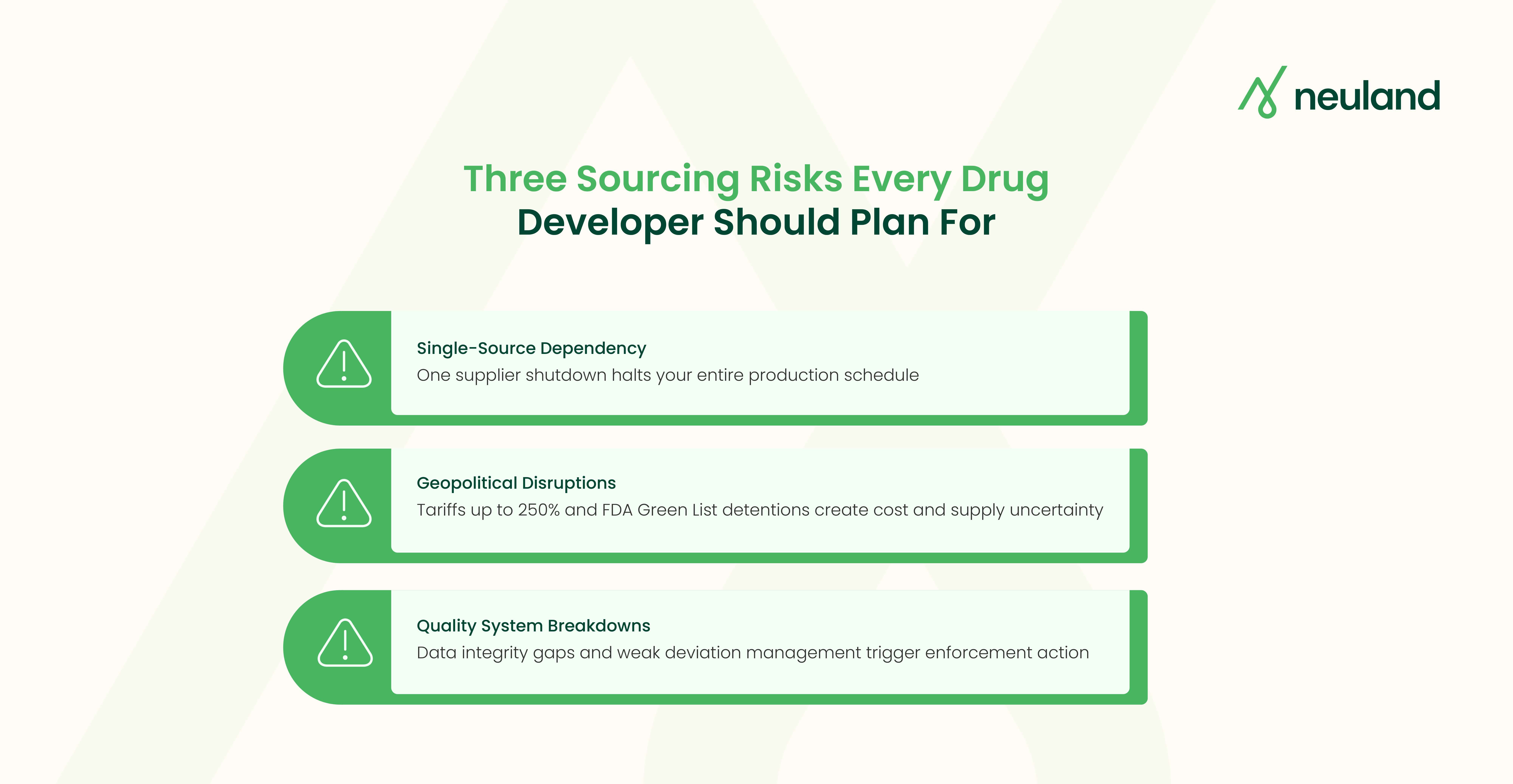
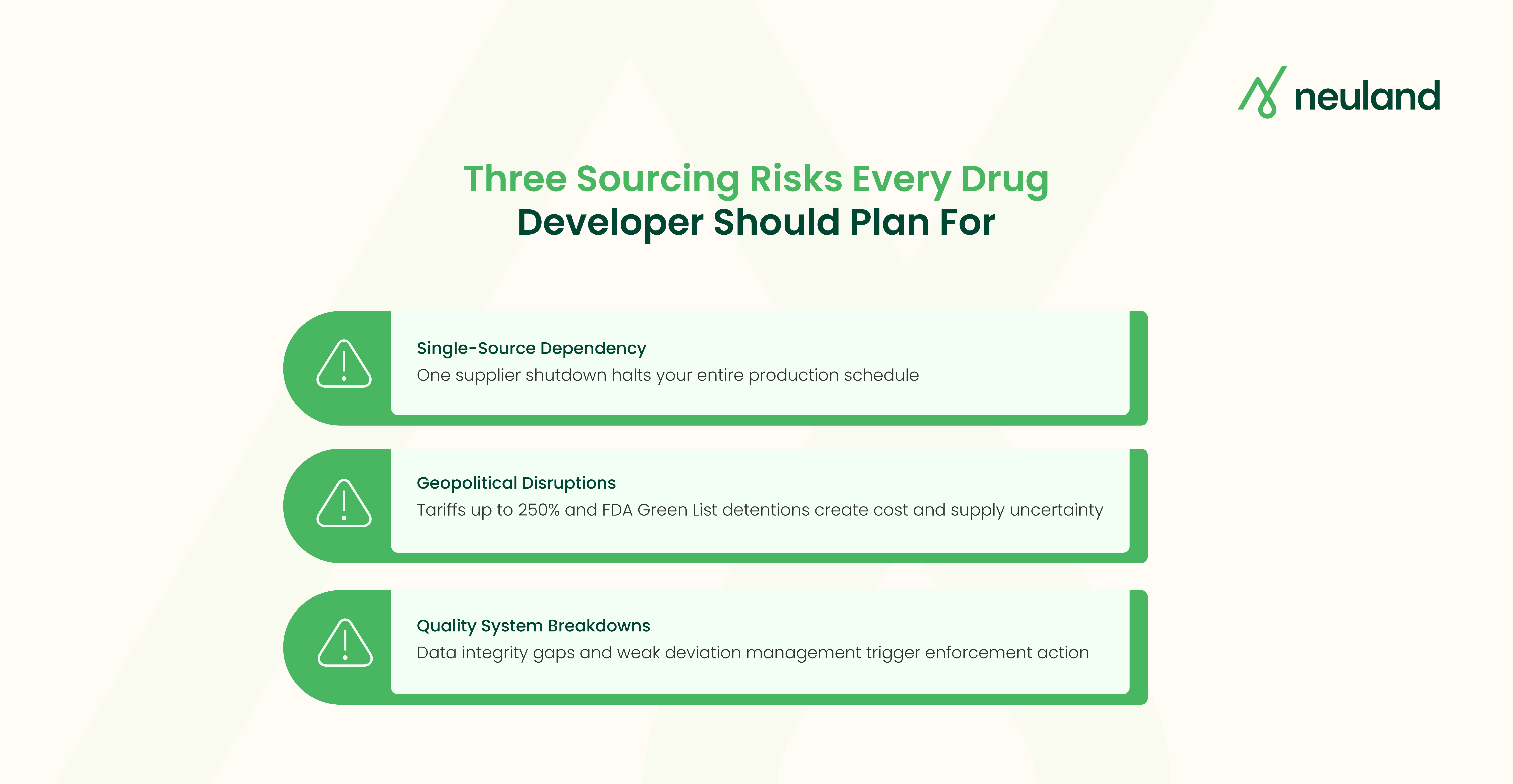
Even with a solid qualification process in place, API sourcing carries risks that drug developers need to plan around:
Single-source dependency
One supplier means one point of failure. If they face a shutdown or a warning letter, your production halts. Dual sourcing or at the very least, strategic safety stock is non-negotiable for critical molecules.
Geopolitical disruptions
U.S. tariffs on pharmaceutical imports announced in 2025 could reach as high as 250%. The FDA's new "Green List" now allows detention of APIs from unverified foreign sources without physical inspection.
Quality system breakdowns
Data integrity gaps, undocumented process changes, and weak deviation investigations remain the top triggers for enforcement action across both domestic and international facilities.
The sourcing playbook is evolving fast. Here are four trends that matter for drug developers evaluating API suppliers:
● Dual sourcing by design: Redundancy is no longer reactive. It's being built into supply strategies from day one.
● AI in quality and inspections: Both regulators and manufacturers are using AI for predictive maintenance, process optimization, and risk-based inspection targeting.
● Capability over cost: Procurement teams now prioritize regulatory readiness, specialty chemistry expertise, and supply resilience over price alone.
For biotech and mid-size pharma companies without in-house manufacturing, CDMOs are the operational backbone of API supply. Here is what a strong CDMO partnership brings to the table:
● End-to-end development support from early synthesis through commercial manufacturing and DMF filing.
● Multi-site manufacturing that enables dual sourcing without managing multiple independent suppliers.
● Upstream quality oversight, auditing their own raw material vendors across the supply chain.
● Regulatory depth across FDA, EMA, and PMDA requirements.
The best API manufacturing companies treat this as a long-term partnership, not a transactional arrangement.
Neuland Laboratories offers deep operational expertise in API supply, with custom development and manufacturing supported by decades of complex chemistry expertise and global regulatory compliance.
Ready to strengthen your API supply chain? Talk to Neuland's team about your next project.
1. What certifications should pharmaceutical API suppliers have? Pharmaceutical API suppliers should hold certifications aligned with the regulatory requirements of their target markets. At minimum, look for current cGMP compliance verified by the FDA or EMA, an active DMF or ASMF for your molecule, and, for European markets, a valid Certificate of Suitability (CEP) from the EDQM. |
2. How often should API suppliers be audited? API suppliers providing critical active ingredients should be audited on-site at least once a year. Between audits, use scorecards to track lot acceptance rates, CAPA closure times, and delivery metrics. If a supplier receives an FDA 483 or warning letter, an immediate reassessment audit is warranted. |
3. Can pharmaceutical companies work with multiple API suppliers? Yes, and dual sourcing is increasingly standard practice for managing supply chain risk. It does require maintaining validated processes and regulatory filings at each supplier site, which adds cost and complexity. For smaller-volume products, strategic safety stock is often a more practical alternative. |
4. How do geopolitical risks affect API sourcing decisions? Geopolitical risks affect API sourcing by disrupting supply continuity, inflating costs, and creating regulatory uncertainty. With roughly 70% of India's intermediates sourced from China, a single upstream disruption can cascade globally. U.S. tariffs and the FDA's Green List are accelerating the shift toward multi-source, multi-geography sourcing strategies. |