
Today’s small molecule and peptide manufacturing environment is defined by regulatory complexity, geopolitical volatility, digital transformation, and large-scale sustainability goals. It is in this challenging context that companies and CDMOs must operate, producing safe and effective APIs and drug products.
This environment introduces uncertainty and risk to most contract organizations’ operations. To mitigate these risks, companies employ enterprise risk management (ERM) frameworks to anticipate uncertainty, protect value, and support long-term growth. Instead of considering strategic, operational, compliance, financial, technology, and sustainability-related risks in isolation, ERM frameworks integrate them under a single governance umbrella. This creates organization-wide visibility, clear accountability, and structured decision-making to ensure risks are identified early and managed consistently across functions and geographies.
In the blog below, we discuss the core elements of ERM programs, how to create and nurture them, and Neuland Labs’ approach to internal and client-focused ERM.
The Core Elements of an Effective ERM Program
ERM programs vary from organization to organization, depending on industry and risk profile, but they all share some foundational elements.
1. Risk Identification and Ownership
Effective ERM begins with systematic risk identification across the value chain. Each risk is assigned a clearly defined risk owner, typically a senior leader accountable for oversight, along with one or more mitigation leads responsible for execution. This ownership model ensures accountability while embedding risk management into day-to-day operations rather than treating it as a standalone function.
2. ERM Oversight
Strong governance is essential to ensure ERM insights inform strategic and operational decisions. Initial ownership (as explained above) and continuous oversight are typically provided through a combination of executive leadership forums and board-level committees, including audit, risk, or sustainability committees. Periodic reviews of the enterprise risk profile allow leadership to assess trends, challenge assumptions, and evaluate the effectiveness of mitigation strategies.
3. Risk Rating
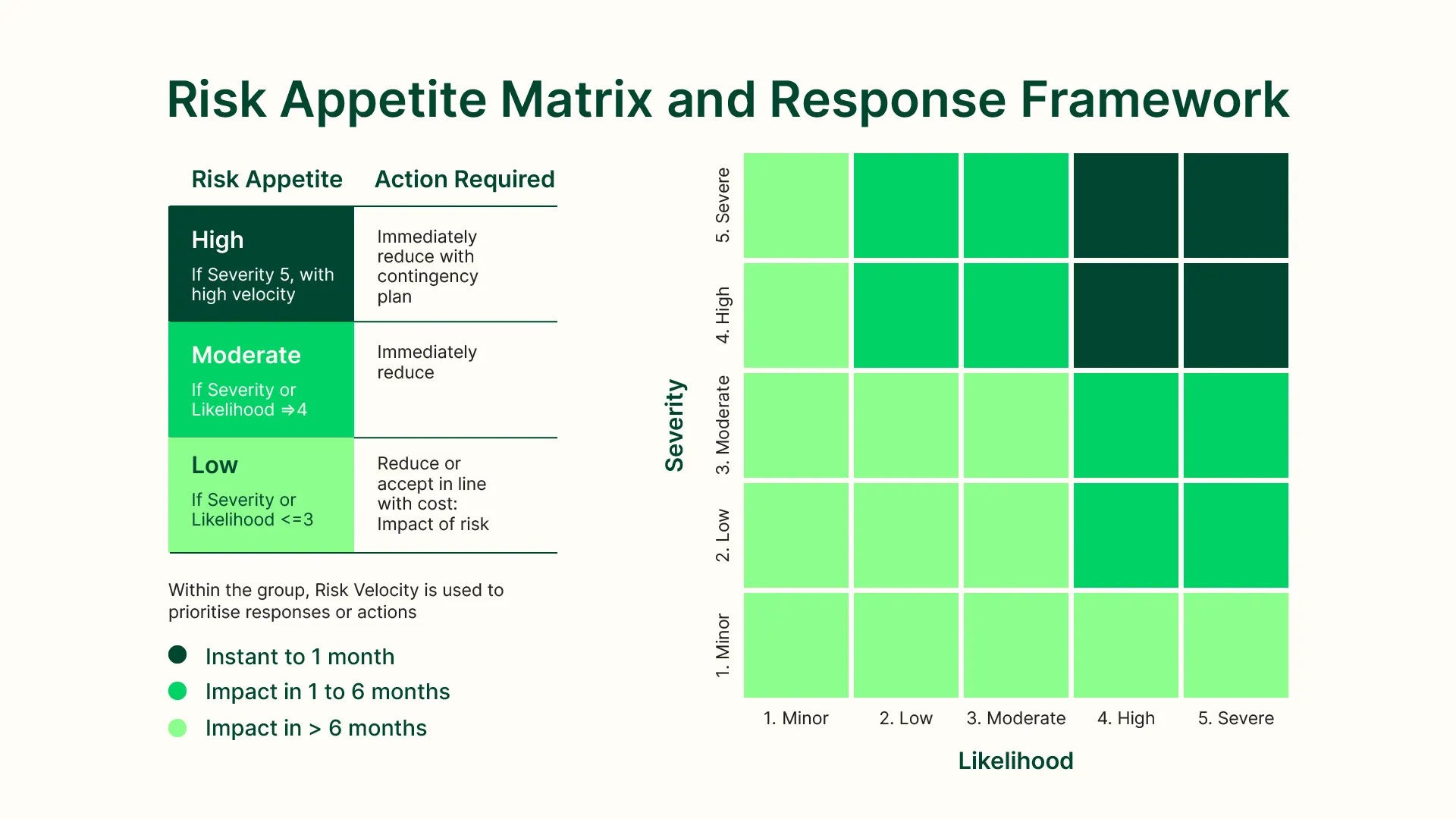
Risks are commonly assessed using a structured scoring methodology, such as a likelihood-by-severity matrix (Figure 1). These frameworks enable consistent prioritization and comparison across diverse risk categories. Many organizations also incorporate “velocity” or “speed of onset” indicators to distinguish between long- and short-term risks. Regular monitoring allows risk ratings to be updated continuously as internal controls mature or external conditions change.
4. Digital ERM Systems
Visualizing risk in real-time comes down to using a centralized digital ERM platform. These tools enable dynamic risk heatmaps, mitigation tracking, documentation control, and auditability. Digital systems also facilitate organization-wide collaboration and ensure risk information is accessible to decision-makers when it matters most.
Types of Risk Assessments Used in ERM
A robust ERM program relies on multiple assessment formats to address both ongoing and emerging risks. These different formats should include both quantitative and qualitative methods.
- Routine Health Checks: Periodic reviews evaluate the status of mitigation plans, confirm ownership, and track progress against defined milestones.
- Emerging Risk Workshops: Structured, cross-functional workshops help identify risks that may not yet be material (e.g., emerging vulnerabilities or threats) but could become significant over the medium- to long-term.
- Deep-Dive Reviews: Focused assessments are conducted for critical risk areas such as cybersecurity, regulatory change, data integrity, or occupational safety.
- Resilience and Stress Testing: Business continuity planning, IT disaster recovery testing, and crisis simulations assess organizational readiness for high-impact disruptions.
- Outside-In Validation: External risk events, peer disclosures, and industry incidents are analyzed to identify lessons learned and potential relevance to the organization.
Creating and Nurturing a Risk-Aware Culture
Having risk assessment tools and a foundational framework is great, but ERM effectiveness depends on engaged personnel who promote risk awareness. High-performing organizations actively cultivate a risk-aware culture in which employees at all levels understand their role in identifying and managing risk.
Key enablers include clearly defined responsibility frameworks, such as Responsible, Accountable, Consulted, Informed (RACI) models, that clarify who is responsible, accountable, consulted, and informed for each risk area. Many organizations integrate risk and ESG-related key performance indicators into leadership scorecards, reinforcing the link between risk management and performance outcomes.
Training and awareness programs play a critical role in getting everyone to think proactively about risk. These programs are often delivered through a mix of in-person sessions, digital learning platforms, and targeted communications. Periodic risk culture diagnostics or surveys can assess awareness, behaviors, and areas for improvement, providing actionable insights to strengthen the overall risk environment.
Monitoring and Anticipating Emerging Risks
Emerging risk management is a defining feature of modern ERM. Organizations that actively scan the external environment are better positioned to minimize blind spots and respond proactively to change.
Common practices include regular peer risk analysis, such as reviewing public disclosures, earnings calls, and sustainability reports to identify evolving risk themes and mitigation approaches. Global benchmarking against reputable external sources, such as international risk outlooks, economic intelligence reports, and sector-specific surveys, helps organizations align with leading practices.
Scenario planning further enhances preparedness by incorporating geopolitical, environmental, technological, and macroeconomic forecasts into the risk inventory. These forward-looking exercises enable leadership teams to test assumptions, evaluate resilience, and refine strategic responses under different future conditions.
From Identification to Action: Enabling Risk-Resilient CDMO Partnerships
Leading organizations increasingly recognize that ERM is not a static exercise. It’s not a once-a-year activity; instead, it is a continuous, iterative process that supports informed decision-making, operational resilience, and sustainable value creation. By integrating governance, digital analytics platforms, internal culture, and external intelligence, ERM becomes a strategic asset rather than a compliance obligation.
At Neuland, enterprise risk management is deeply embedded within our operating model. Our structured approach to identifying, assessing, and mitigating risk ensures that we proactively address both short- and long-term uncertainties across quality, regulatory compliance, supply chain continuity, and operational execution.
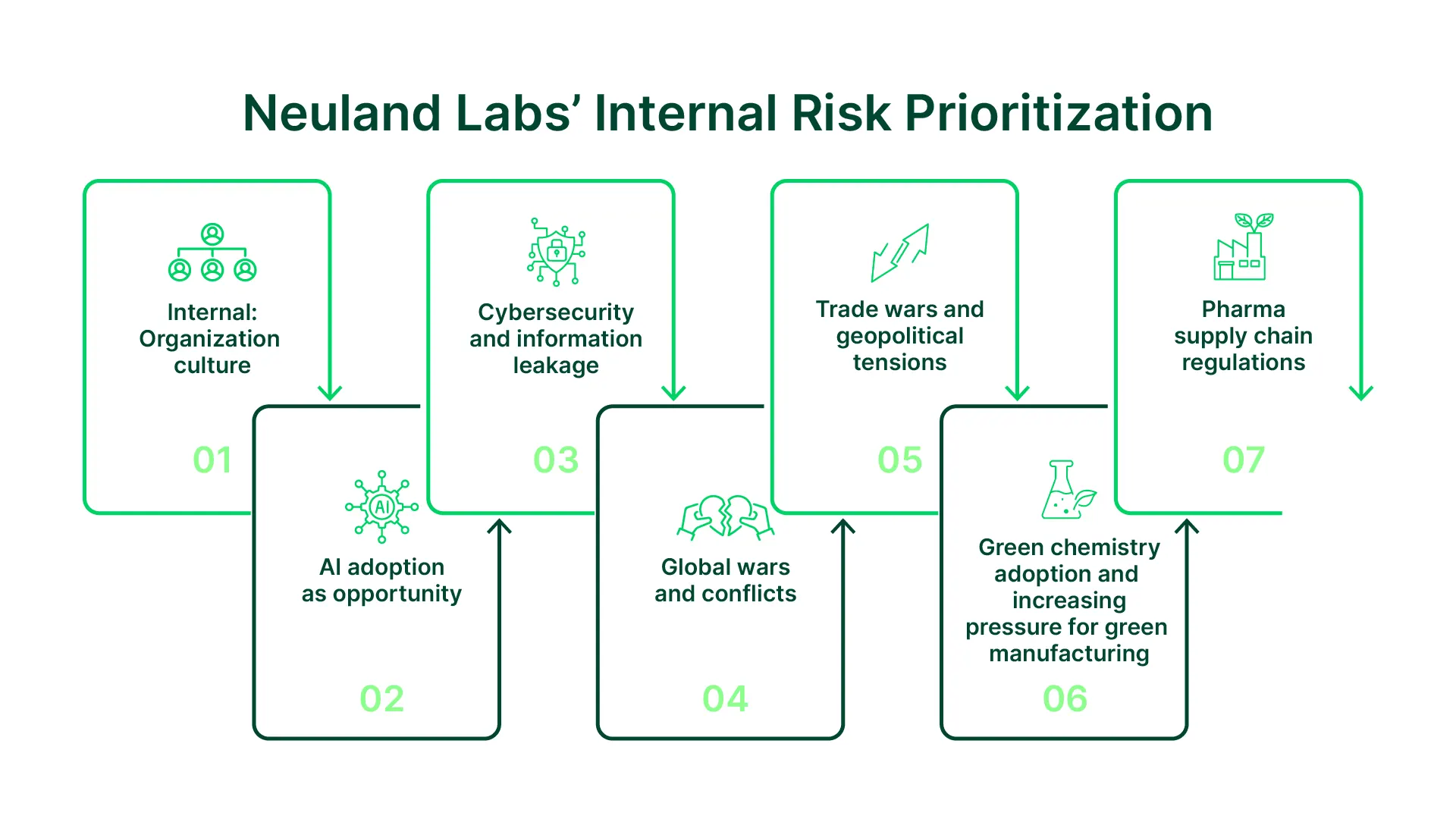
This translates directly into greater confidence for our customers. By maintaining strong internal risk visibility and governance, we are able to:
- Anticipate and mitigate potential disruptions early
- Ensure consistent quality and regulatory compliance
- Safeguard timelines across development and commercial programs
- Deliver reliable, predictable outcomes in complex manufacturing environments
In highly regulated and dynamic markets, a CDMO’s internal risk maturity becomes a critical enabler of client success. Neuland’s ERM-driven approach ensures that customer programs are supported by resilient systems, disciplined execution, and proactive decision-making.
Contact us to ensure your programs are backed by a risk-resilient CDMO partner.