
Liquid Phase Peptide Synthesis at Scale: How Neuland Produced a Cyclic 16 AA API at 100 Kg and 98% Purity
The peptide synthesis market was valued at $686 million in 2024. By 2034, it is projected to nearly triple, reaching $2.27 billion. That growth is being driven by GLP-1 therapies, oncology peptides, and an expanding clinical pipeline with over 2,750 active trials registered on ClinicalTrials.gov.
For pharma and biotech sponsors, the question is no longer whether a peptide can be made. The question now is whether it can be made at the right volume, the right purity, and the right cost. This is where complex peptide API manufacturing capability becomes the differentiator. Producing a short, linear peptide at gram scale is routine. Producing a cyclic 16 amino acid API at 100+ kilograms per year with 98%+ purity requires a fundamentally different level of process chemistry, analytical rigour, and manufacturing expertise.
This article walks through how Neuland Labs, a peptide CDMO with over 15 years of peptide expertise, achieved exactly that using liquid phase peptide synthesis at commercial scale.
A Brief History of Peptide Synthesis
Peptide synthesis technique selection directly impacts scalability, cost, and purity. Two milestones define the field.
In 1954, Vincent du Vigneaud reported the first liquid phase peptide synthesis of a peptide hormone, Oxytocin, a breakthrough that earned him the Nobel Prize. In 1963, Robert Bruce Merrifield introduced solid phase peptide synthesis (SPPS) using a tetrapeptide, revolutionizing laboratory-scale peptide production.
While SPPS is convenient for shorter sequences, liquid phase peptide synthesis remains the preferred method when:
- The target peptide is short to medium length (up to ~15–20 amino acids)
- Large-scale commercial manufacturing is the objective
- High purity is critical and intermediate purification adds value
- The molecule has structural complexity such as disulfide bonds or cyclic constraints
Why Liquid Phase Peptide Synthesis Is Gaining Ground Again
For years, SPPS dominated the conversation. The data tells a different story. Liquid phase peptide synthesis led the technology segment with a 44.04% revenue share in 2024, ahead of SPPS, driven by its scalability and cost-effectiveness for bulk peptide API production.
Scalability and Cost Advantages
LPPS allows each intermediate to be isolated, purified, and characterized using conventional separation techniques. This level of control is what makes liquid phase peptide synthesis viable for commercial scale peptide manufacturing, where batch consistency matters as much as purity.
Green Chemistry Alignment
SPPS's sustainability challenge is well documented. A single synthesis cycle can require ten or more washing steps, each consuming roughly ten volumes of solvent relative to the resin. LPPS protocols require significantly less solvent and fewer excess reagents, aligning with the green chemistry principles that procurement teams now weigh alongside price and purity.
New LPPS platforms are combining conventional batch reactors with continuous flow systems, further reducing solvent waste while maintaining scalability. For sponsors evaluating a peptide CDMO, this positions liquid phase peptide synthesis as both proven and forward-looking.
16 Amino Acids. 100 Kilograms. 98% Purity.
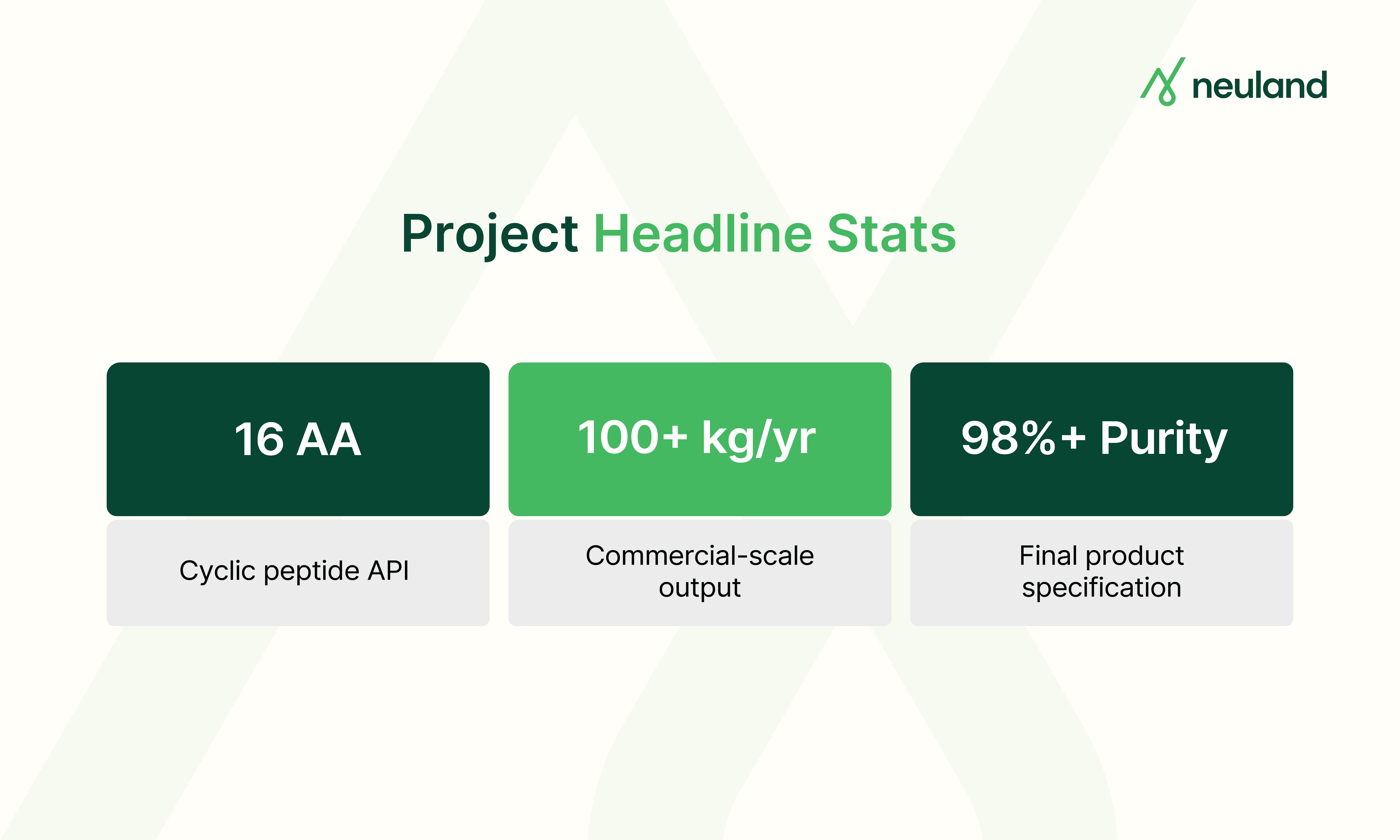
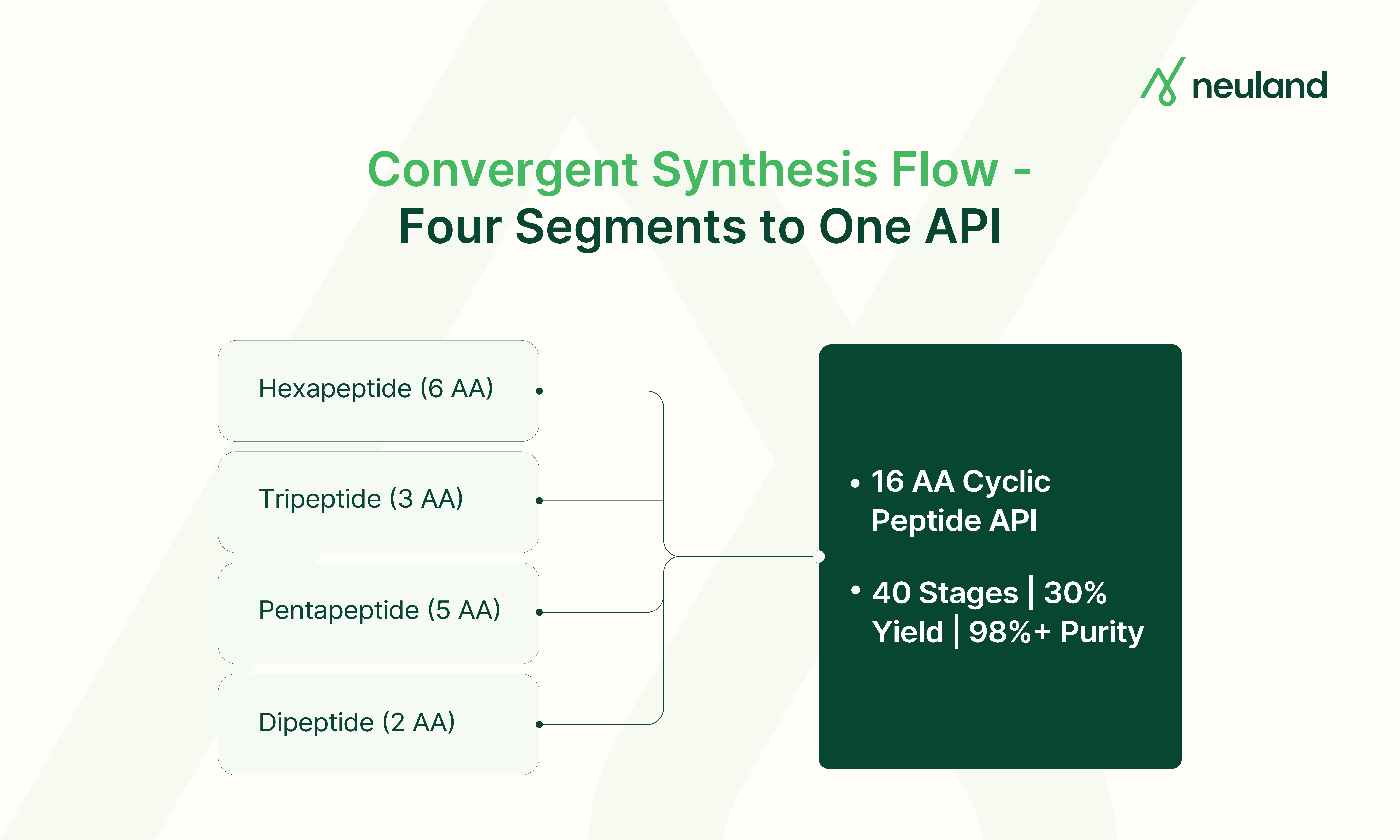
A client approached Neuland with a cyclic peptide synthesis challenge: a 16 amino acid API requiring 98%+ purity and scalability to 100+ kilograms per year. Neuland's team designed a convergent liquid phase peptide synthesis strategy, dividing the 16 AA sequence into four protected segments:
| Segment | Length |
|---|---|
| Segment 1 | Hexapeptide (6 AA) |
| Segment 2 | Tripeptide (3 AA) |
| Segment 3 | Pentapeptide (5 AA) |
| Segment 4 | Dipeptide (2 AA) |
40 Stages. Each One Individually Optimized.
The final process involved 40 isolated stages. That number is not incidental. Each stage required its own set of optimized reaction conditions, including temperature, reactant molar ratios, and pH. Specific analytical methods were developed per stage, and critical process parameters (CPPs) and critical quality attributes (CQAs) were established individually.
This is what separates experienced peptide process development from theoretical capability. Executing 40 sequential stages with bespoke conditions, maintaining purity above 95% at each segment, and achieving 30% overall yield at commercial scale requires a depth of process chemistry knowledge that takes years to build.
Scalability Validation
To confirm the process could hold at volume, Neuland prepared all four segments at several-hundred-gram quantities with purity exceeding 95%. Process consistency was demonstrated through three lab verification batches for each of the 40 stages.
What This Project Tells You About Choosing a Peptide CDMO
This project demonstrates three things about Neuland's complex peptide API manufacturing capability: the ability to design convergent synthesis strategies for longer peptide sequences, the discipline to maintain 40-step process consistency at commercial scale, and the analytical infrastructure to establish CPPs and CQAs at every stage.
If you are evaluating CDMOs for a peptide API program, here is what to pressure-test:
- Has the CDMO produced at the scale you need, or are they projecting?
- Do they have demonstrated experience with your synthesis method (LPPS, SPPS, or hybrid) at commercial volumes?
- Can they handle structural complexity, including cyclic peptide synthesis, disulfide bonds, or convergent strategies for sequences beyond 10 amino acids?
- Do their analytical development capabilities sit alongside their synthesis team, or is that a separate handoff?
Neuland's upcoming commercial peptide manufacturing facility, opening summer 2026 with 6,370 litres of SPPS and LPPS reactor capacity, extends this capability further.
Planning a complex peptide API project? Whether you are at early feasibility or approaching commercial scale-up, our peptide team can assess your molecule and outline a development pathway. Request a feasibility discussion.
FAQs
When is liquid phase peptide synthesis preferred over solid phase?
Liquid phase peptide synthesis is typically preferred for short to medium length peptides (up to ~20 amino acids) at commercial scale, where intermediate purification improves final purity and cost-efficiency outweighs the convenience of SPPS.
What makes cyclic peptide synthesis more challenging than linear?
Cyclic peptides require additional cyclisation steps, often involving macrolactamisation or disulfide bond formation, that introduce conformational constraints. These steps demand precise reaction control and add complexity to both the synthesis and the analytical program.
How does a peptide CDMO validate scalability for commercial manufacturing?
Through sequential scale-up from lab to pilot to commercial batches, with process consistency demonstrated via multiple verification batches at each stage. Critical process parameters and quality attributes must be established and held at every scale.
What should I look for in a CDMO for complex peptide API manufacturing?
Prioritise demonstrated experience at your target scale, not just lab capability. Key indicators include published case studies or DMF filings for peptide APIs, convergent synthesis experience for longer sequences, and integrated analytical development alongside the synthesis team.
