
From Route Scouting to Kilo Labs: The R&D Journey in Contract Drug Manufacturing
Key Takeaways
- Contract drug manufacturing gives pharma and biotech companies access to specialized R&D and production capabilities that are often too costly to build and maintain in-house.
- The R&D journey moves through distinct stages, from route scouting and process development to kilo lab production, each preparing the molecule for the next.
- The kilo lab is not the destination. It is the bridge between laboratory chemistry and larger-scale manufacturing, where a route first proves itself at meaningful quantities.
- Good contract R&D is about understanding the molecule, asking what happens to it at each stage, and how to make the process cleaner, safer, and more efficient.
- Choosing a partner with the full journey under one roof reduces handoffs, protects timelines, and shortens the path to supply.
Contract drug manufacturing is the outsourcing of drug development and production to a specialized external partner, typically a CDMO, that handles work a pharma or biotech company cannot or chooses not to do in-house. It spans early R&D through commercial-scale API supply.
The appeal is largely economic. Maintaining ready teams and niche capabilities for complex chemistry, specialized production, and scale-up is cost-prohibitive for many companies, especially those running diverse pipelines that each demand different expertise.
A contract partner spreads that capability across many programs. Companies gain access to established teams and infrastructure through CDMO services without carrying the fixed cost of building them alone.
How Is Contract R&D Different From In-House Research?
Contract R&D is broader and more diverse than typical in-house drug-company research, because a contract partner supports many molecules across many clients at once. That range builds a depth of process expertise that a single pipeline rarely develops.
Beyond early process development work, contract R&D teams are often dedicated to specialized problems: process efficiency, effluent reduction and elimination, impurity detection and reduction, and other custom synthesis, analytical, and commercialization tasks.
The orientation is practical rather than exploratory. The goal is to take a client's molecule and find the most efficient, scalable, and manufacturable way to produce it, not to discover new chemistry for its own sake.
What Does the R&D Journey Look Like?
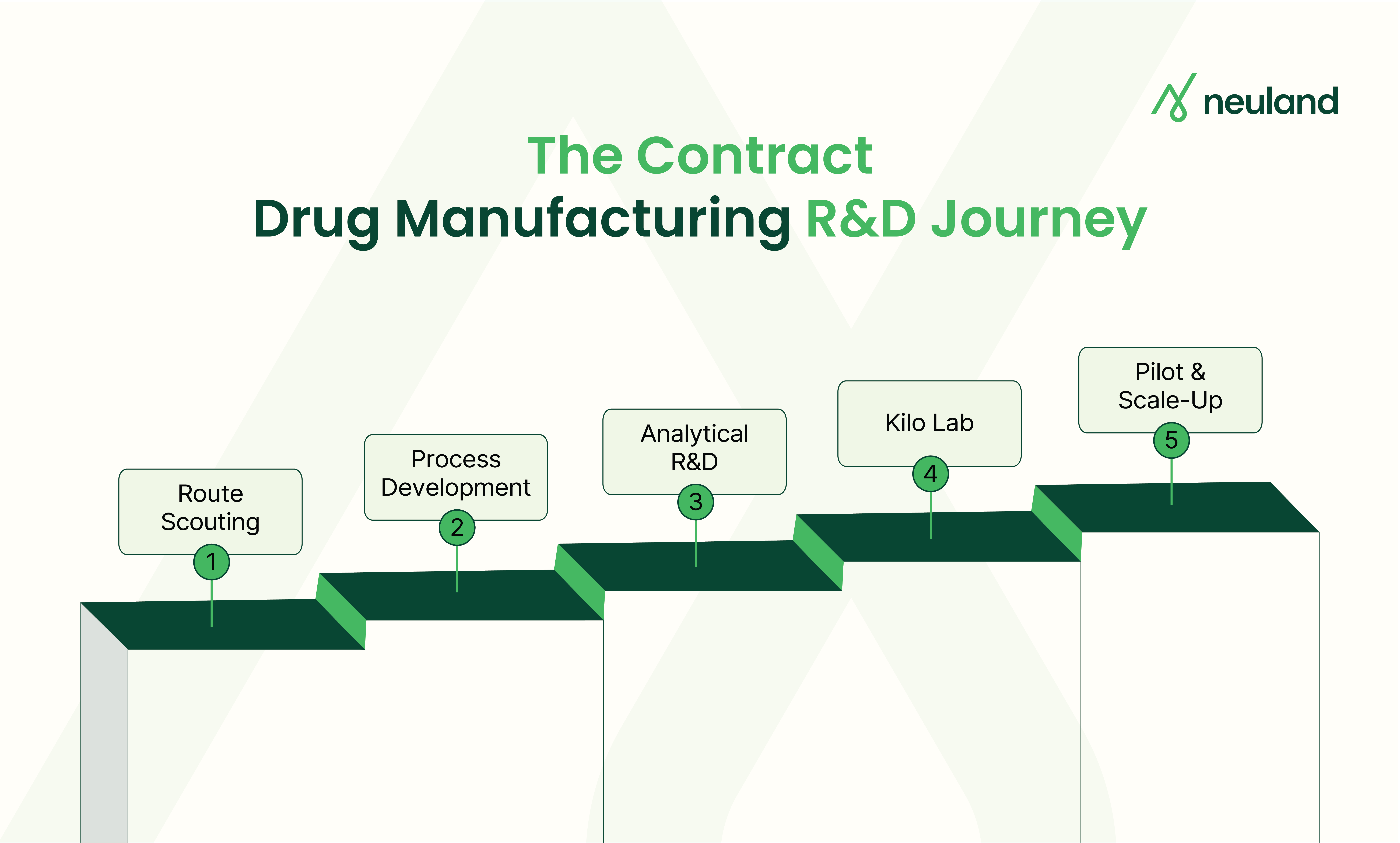
The R&D journey in contract drug manufacturing moves a molecule through a sequence of stages, each one reducing risk and adding scale before the next begins. The path runs from route selection to a production-ready process.
Here are the core stages of the journey:
- Route scouting: Evaluating alternative synthetic routes to find the one that is most efficient, scalable, and safe to manufacture.
- Process development: Refining the chosen route into a controlled, repeatable process with defined parameters.
- Analytical R&D: Building the methods that measure quality and track how the molecule behaves at each step.
- Kilo lab production: Making the molecule on a kilogram scale to confirm the process performs beyond the flask.
- Pilot and scale-up: Moving toward larger volumes as confidence in the process grows.
Each stage feeds the next. A weakness left unresolved in route scouting becomes a much more expensive problem once the process reaches the kilo lab or beyond.
Why Does Route Scouting Come First?
Route scouting comes first because the synthetic route chosen at the outset shapes the cost, safety, and manufacturability of the molecule for the rest of its life. Getting it right early avoids expensive corrections later.
The route discovered by a client's own chemists is usually designed to make small quantities and prove the science. It is rarely the route best suited to efficient, large-scale manufacturing.
Contract R&D teams match the molecule to established, proven synthesis routes wherever possible, streamlining the path to production. The deeper mechanics of route selection are their own subject, but the principle is simple: the earlier a better route is found, the cheaper it is to adopt.
What Happens During Process and Analytical R&D?
Process and analytical R&D turn a promising route into a controlled, measurable process. This is where the team develops a genuine understanding of the molecule and how it behaves under real manufacturing conditions.
A large part of the work is asking the right questions about the molecule at each stage.
- What is happening to it at this step?
- Where can solvents be reduced or eliminated in later stages?
- Where are genotoxic impurities appearing, and how can effluent be reduced in critical early synthesis stages?
Answering these questions is what makes a process cleaner, safer, and more economical. Alongside this, analytical work provides the measurement backbone that tracks quality across every stage of development.
What Is a Kilo Lab and Where Does It Fit?
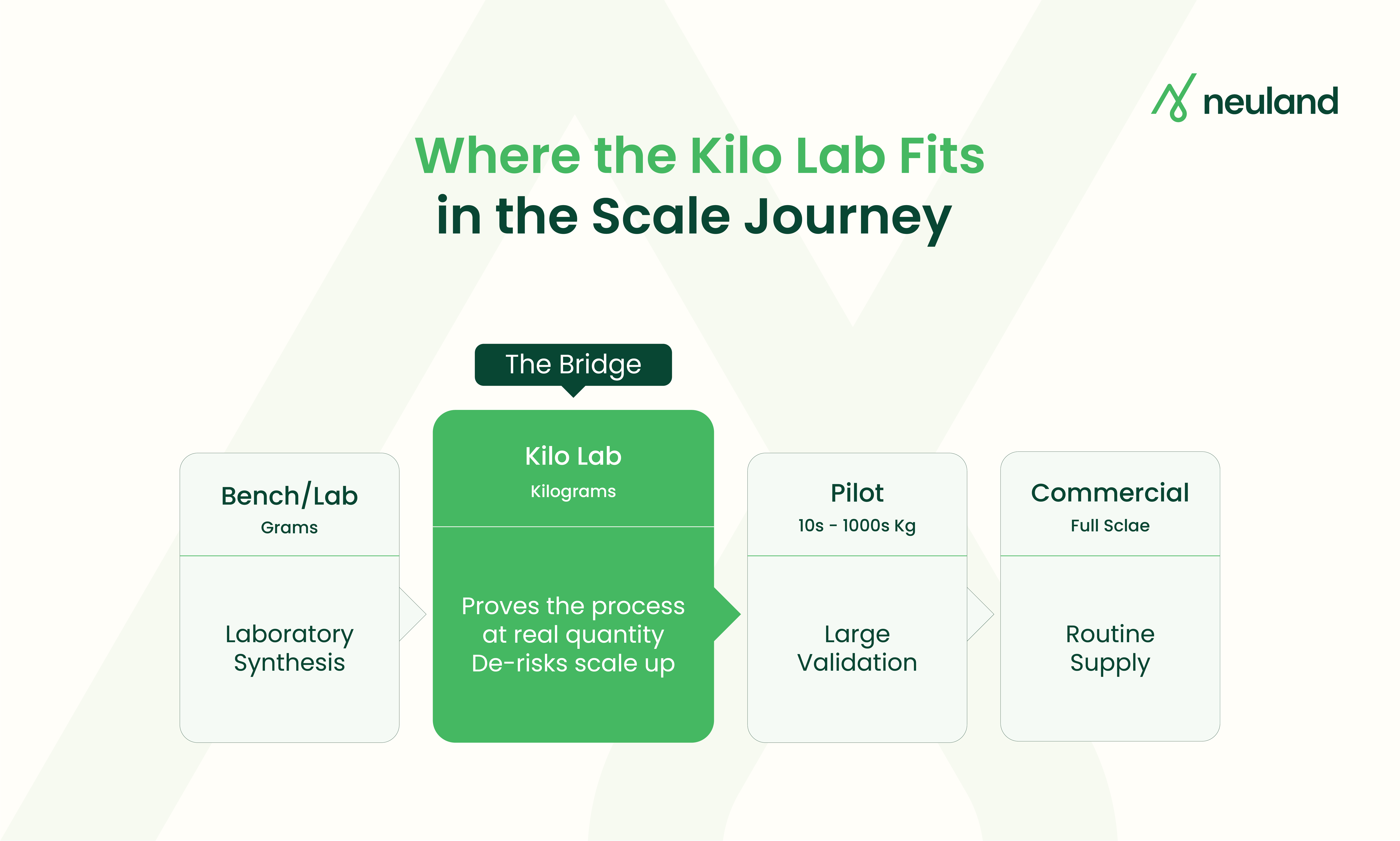
A kilo lab is a production facility that manufactures a molecule at a kilogram scale, bridging the gap between laboratory synthesis and larger pilot or commercial production. It is one stage in the journey, not the finish line.
The kilo lab is where a process first proves it can deliver a meaningful quantity while holding quality. It generates the material needed for early requirements and produces the real-world data that de-risks the next step up in scale.
Positioned between bench chemistry and full manufacturing, the kilo lab is where theory meets throughput. A process that looks elegant on paper either holds up here or reveals the problems that need solving before scale increases further.
Why Does an Integrated R&D Journey Matter?
An integrated R&D journey matters because every handoff between separate providers introduces delay, cost, and risk of information loss. Keeping the stages connected protects both the timeline and the molecule.
When route scouting, process development, analytical work, and kilo lab production sit within one coordinated operation, knowledge about the molecule travels with it. Nothing has to be rebuilt or re-explained at each transition.
Neuland's R&D organization is built around this continuity. More than 400 R&D scientists work in a dedicated R&D center alongside kilo lab and pilot plant teams, with custom synthesis projects geared toward bringing early products to market as quickly as possible while providing analytical support across every stage of commercialization.
Summary Points
- Contract drug manufacturing gives companies access to specialized R&D and production capability without the fixed cost of building it in-house.
- The R&D journey runs through connected stages, from route scouting and process development to kilo lab production and beyond.
- The kilo lab is a critical bridge between laboratory chemistry and larger-scale manufacturing, not the endpoint of the process.
- Strong contract R&D is grounded in understanding the molecule and continually making the process cleaner, safer, and more efficient.
- An integrated journey under one roof reduces handoffs and shortens the path from early R&D to reliable supply.
Ready to move your molecule from route scouting to scale?
Neuland Labs supports pharmaceutical and biotech companies across the full contract drug manufacturing R&D journey, from route scouting and process development through kilo lab production and commercial supply. Talk to our team about your program.
Frequently Asked Questions
What is contract drug manufacturing?
Contract drug manufacturing is the outsourcing of drug development and production to a specialized partner such as a CDMO. It lets pharma and biotech companies access complex chemistry, R&D, and scale-up capabilities without maintaining costly infrastructure and niche teams in-house.
What is a kilo lab used for?
A kilo lab produces a molecule at a kilogram scale, sitting between laboratory synthesis and larger pilot or commercial manufacturing. It confirms that a process performs at a meaningful quantity and generates the data needed to de-risk further scale-up.
What stages are involved in the contract drug manufacturing R&D journey?
The journey typically moves through route scouting, process development, analytical R&D, and kilo lab production, before progressing to pilot and larger-scale manufacturing. Each stage reduces risk and adds scale, preparing the molecule for the next step toward supply.
Why do companies outsource drug R&D to a CDMO?
Companies outsource drug R&D because maintaining specialized teams and equipment for complex chemistry, custom synthesis, and scale-up is expensive, particularly for diverse pipelines. A CDMO spreads that capability across many programs, giving access to expertise without the fixed cost.
What does R&D focus on in contract drug manufacturing?
Contract R&D focuses on understanding the molecule and improving the process around it, including reducing solvent use, detecting and reducing impurities, and lowering effluent in early synthesis stages. Neuland's custom manufacturing work applies this across client programs.
Is the kilo lab the final stage of manufacturing?
No. The kilo lab is an intermediate stage that proves a process on a kilogram scale. Larger pilot and commercial manufacturing follow once the process has demonstrated it can hold quality and yield at that level.
