

Key Takeaways
- API stability requires active management across every stage of a molecule's development.
- Phase-appropriate testing matches the depth of stability work to how far along a molecule is in development.
- Stability requirements grow stricter at each stage, from early development through commercial supply manufacturing.
- A late-stage stability miss can force repeat studies and shorten a product's approved shelf life.
- Strategies that connect process development with stability data avoid costly mismatches during scale-up.
An API that passes every specification at release might still fail months later on the shelf. Initial testing doesn’t tell the full story of how a molecule behaves in real-world storage. That shortfall is where API stability problems begin.
As a molecule moves from development to commercial supply, its stability testing has to keep pace. When that pace breaks down, the cost shows up fast, often as delayed filings or rejected batches. A shelf life that comes in too short can limit commercial distribution too. Protecting API stability, therefore, at every stage is what keeps a molecule dependable once it reaches patients.
What Is API Stability and Why Does It Matter Across the Product Lifecycle?
API stability is an active ingredient's ability to hold its chemical, physical, and microbiological quality within set limits over time. It determines how long an API stays safe and effective for use. This makes ingredient stability one of the most consequential quality attributes a testing plan tracks.
That single property shapes decisions at every stage of a molecule's development:
- Early development: Stability data shows process teams how a molecule reacts to heat or stress.
- Near commercial filing: Stability data defines the shelf life a molecule can realistically support once it reaches the market.
- Across scale-up and commercial supply: Stability stays a continuous requirement rather than a one-time check.
A molecule with strong early data can still run into new risks when manufacturing scales up. Larger batch sizes and new equipment can change how a molecule breaks down. A shift in raw material source adds one more variable to track. Left unaddressed, these shifts can lead to costly retesting. So, the teams that monitor API stability continuously catch these changes before they threaten a filing or delay a commercial launch.
What Is Phase-Appropriate Stability Testing?
Phase-appropriate stability testing means matching how much stability testing is done to the molecule's development stage. Early-stage testing stays exploratory and simply guides route and process decisions. As a molecule nears filing, testing grows more formal and follows ICH Q1A stability guidelines on batches that reflect the actual commercial process.
How Do API Stability Requirements Change From Early Development to Commercial Supply?
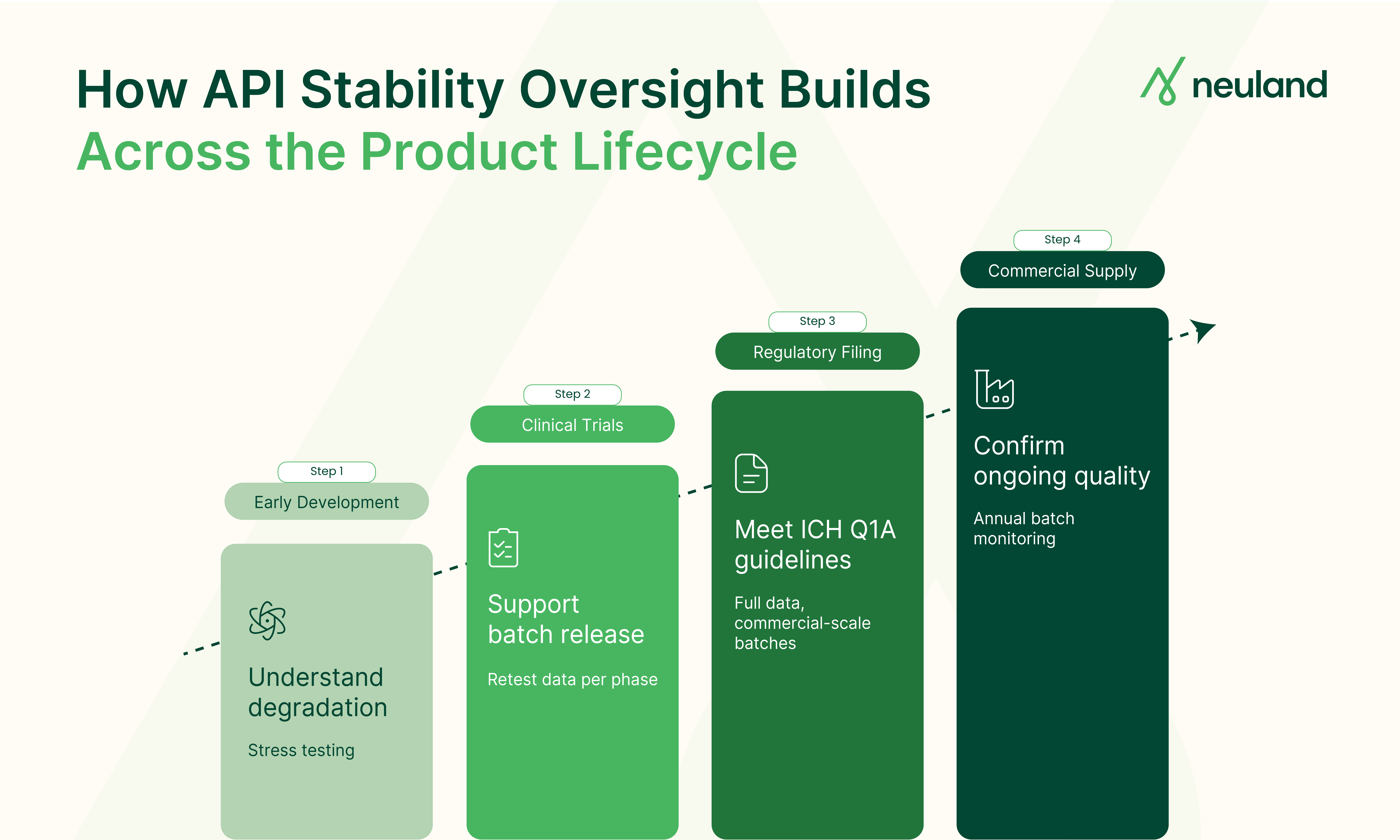
API stability requirements grow stricter as a molecule moves toward the market. Each stage in the lifecycle asks a different question, and each one demands more evidence than the last. Here is how that shift plays out at every stage:
Early Development: Understanding How the Molecule Behaves
At this stage, teams want to learn how a molecule reacts to light or moisture. They run simple stress tests to see how fast it breaks down and what it turns into. This early stability data guides synthesis route decisions before the bigger investments begin.
Clinical Development: Supporting Safe Batch Release
Once a molecule enters clinical trials, each batch needs a confirmed retest period before it can be used. This retest period comes from API stability data showing the batch still meets its specifications. Phase I, II, and III trials each use new batches, so this check repeats at every phase. Without current stability data, a batch cannot be released for dosing, and the trial timeline slips.
Regulatory Filing: Proving the Commercial Process Holds Up
Before an API can be approved, filings such as a DMF, NDA, or ANDA require full stability data. That data must come from batches made using the same process planned for commercial manufacturing. Regulators want proof that the approved shelf life reflects real production conditions. This is where API stability work aligns with the ICH Q1A stability guidelines.
Commercial Supply: Confirming Quality Continues to Hold
After approval, stability testing does not stop. Manufacturers test a sample from batches every year to confirm the product still meets its approved specifications. Any change to the process or scale gets checked against this ongoing data before it is approved. This final stage protects both shelf life and market supply.
What Happens When API Stability Is Overlooked at a Late Stage?
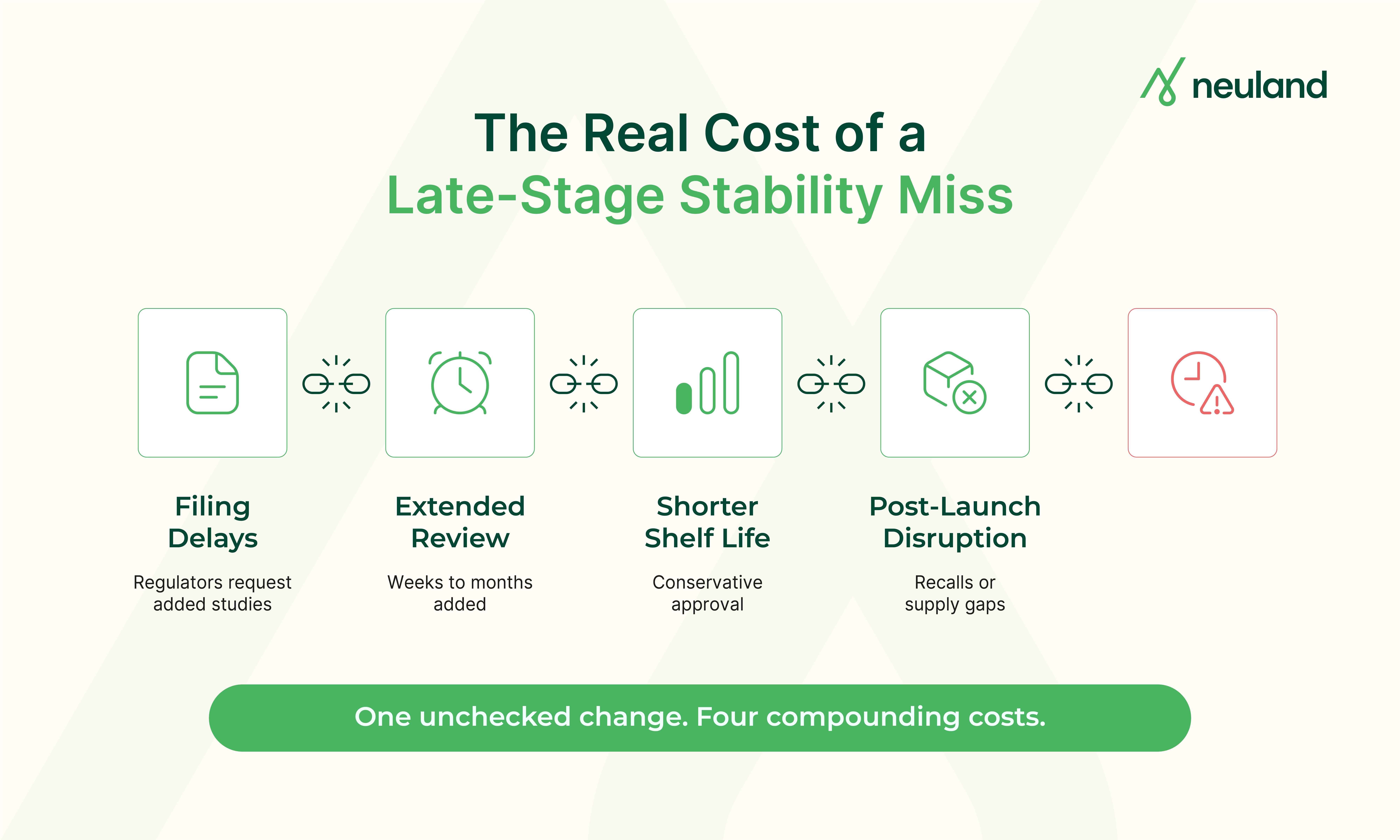
Overlooking the stability of an API at a late stage forces a project to repeat testing it had already completed. A scale-up or supplier change made without checking existing stability data can invalidate that data entirely. Since long-term studies take a year or more to complete, this invalidation resets the timeline for the affected batches.
The consequences extend well beyond that repeated study:
- Filing delays: If the data no longer reflects the commercial process, regulators ask for more studies before review can move forward.
- Extended review cycles: Every extra data request adds weeks or months to an already long approval timeline.
- Shorter shelf life: Thin or late-stage data often pushes regulators toward a shorter, more conservative shelf life.
- Post-launch disruption: Data that turns out to be unrepresentative after approval can trigger recalls or supply gaps.
Each of these outcomes traces back to the same root cause: a manufacturing change that outpaced its API stability monitoring. Closing that gap before it reaches regulators is what keeps a molecule's path to commercial supply on schedule.
What Should Pharma and Biotech Teams Look for in an API Stability Strategy?
A strong stability strategy treats stability as a continuous responsibility across the product's life. Five clear markers separate dependable testing from a weak one. These markers apply whether the work stays in-house or moves to an outside partner.
- Stage-matched testing: Testing depth should track the molecule's development stage at every step.
- Connected process and analytical teams: The scientists who develop the synthesis route should also manage the stability-indicating methods.
- Change control tied to data: Every process or supplier change should be checked against existing stability data before it is approved.
- Multi-market regulatory awareness: The testing should reflect how FDA, EMA, and PMDA read stability testing guidelines differently.
- Planning beyond approval: Stability commitments continue long after commercial launch.
Accelerated stability testing works as an early warning tool here, run before long-term data is available. It flags likely degradation risks months ahead of schedule. It should guide decisions early, without replacing the long-term data a filing needs.
At Neuland, our approach to API stability is built around this same continuity. Process development and analytical teams work under one roof. So stability data generated early carries forward accurately as the molecule scales toward commercial supply. With over four decades of experience, we offer companies one partner across that entire journey, reducing handoffs at each stage of development.
Summary Points
- API stability shapes shelf life and filing readiness along with supply reliability across a molecule's entire life.
- Testing depth should always match the development stage.
- Requirements tighten steadily from early development to commercial supply, with regulatory filing marking the most demanding shift.
- Catching a stability gap early costs far less than discovering it after a filing or a commercial launch.
- A strategy built on integrated process and analytical work protects quality through every stage of scale-up.
Looking for a partner who protects API stability at every stage?
Neuland Laboratories runs process development and analytical stability work within the same organization. It operates across three cGMP-certified facilities, with regulatory approvals from the FDA, EMA, and PMDA. That structure keeps stability data usable as a molecule moves from characterization through commercial supply. Talk to Neuland's team about building a stability strategy for your testing.
Frequently Asked Questions
No, they are related but distinct. API stability looks at the active ingredient on its own, while drug product stability accounts for how excipients, container systems, and processing affect the finished product's shelf life.
Packaging directly affects stability by controlling exposure to moisture, oxygen, and light during storage and transport. A container system mismatched to a molecule's sensitivities can shorten shelf life regardless of how strong the underlying data is.
Early indicators of poor ingredient stability usually show up before a batch fails specification outright. Teams should watch for:
- Color or physical changes in the API during routine storage checks
- A rising impurity trend across successive testing intervals, even if still within limits
- Assay values drifting downward faster than the historical pattern suggests
- Inconsistent results between analysts or testing sites using the same method
Catching these signals early allows corrective action before a formal failure occurs.
Yes, peptide APIs generally carry higher stability risk than small molecules. Their larger structures are more prone to hydrolysis and aggregation. It often calls for tighter storage controls and more conservative retest periods.
Commercial stability testing for pharmaceutical APIs includes annual monitoring batches, plus additional reviews whenever a process, supplier, or packaging change occurs. This keeps shelf life claims valid for as long as the product stays on the market.