
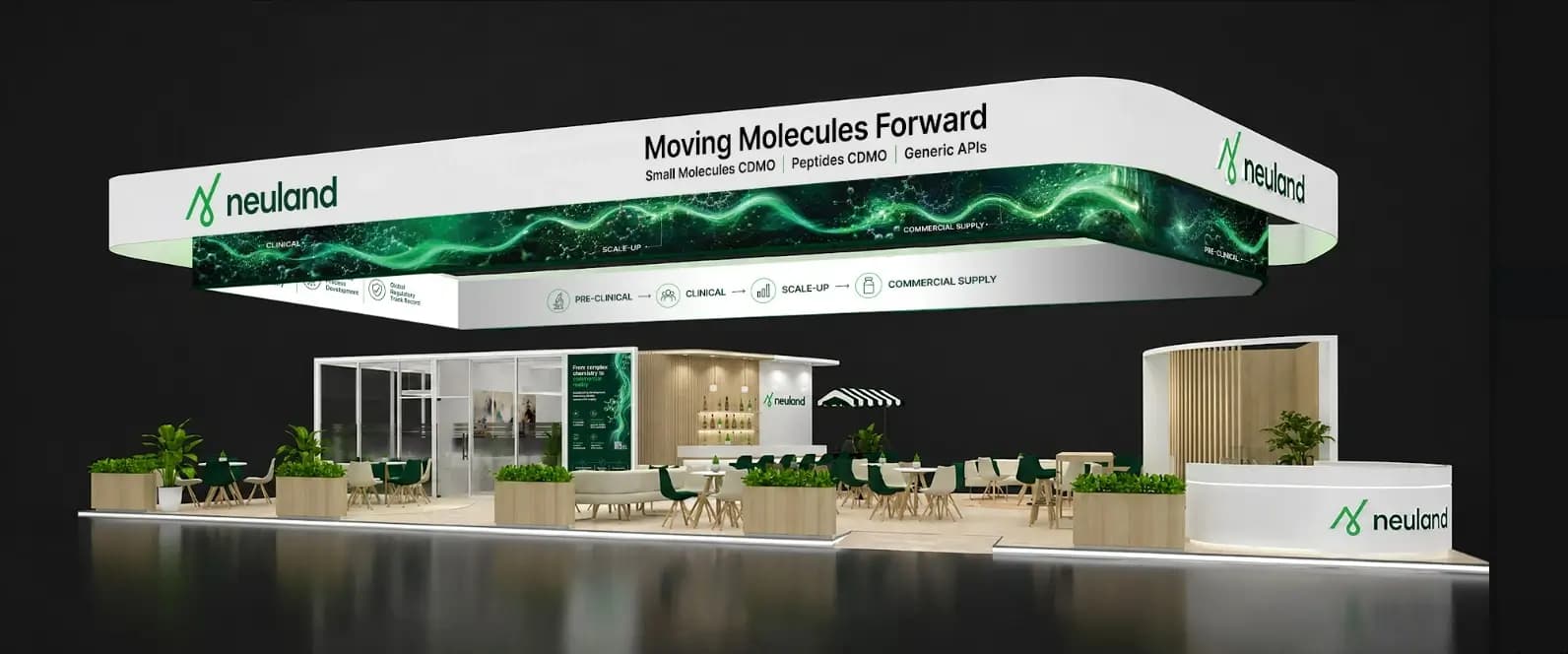
Key Takeaways
- Neuland exhibits at CPHI Milan 2026 at Booth #10H33, Fiera Milano, from 6 to 8 October.
- This year's booth theme, "Moving Molecules Forward," centers on faster development, lower scale-up risk, and reliable commercial supply.
- Visitors can review Neuland's new 140,000 sq. ft. peptide manufacturing block, built for SPPS, LPPS, and hybrid synthesis.
- The Neuland CMC Center for Process Research, in Genome Valley, pairs AI-enabled route scouting with integrated kilo labs.
- Meetings with Neuland's senior scientific leadership team can be scheduled ahead of CPHI Milan 2026.
CPHI Milan 2026 brings the global pharmaceutical supply chain together in one venue for three days. Neuland Laboratories will be there too, at Booth #10H33, Fiera Milano, from 6 to 8 October 2026. This year's booth theme, “Moving Molecules Forward,” sets the tone for what visitors can expect. It points to how a molecule moves from early chemistry through to reliable commercial supply. For teams evaluating a CDMO partner, CPHI Milan 2026 is a chance to test technical questions and meet the people who run peptide and small-molecule projects day-to-day.
What Is CPHI Milan 2026 and Why Does It Matter for API Development?
CPHI Milan 2026 is the Milan edition of CPHI, the pharmaceutical industry's largest ingredient and manufacturing trade show. It runs from 6 to 8 October 2026 at Fiera Milano in Milan, Italy. For API development, it matters because it puts sourcing decisions in front of the people who make them.
Pharmaceutical pipelines keep growing more complex, and fewer companies build every capability in-house. A molecule that needs cryogenic chemistry or high-potency handling usually needs a specialized partner with dedicated infrastructure. Peptide sequences raise the same question, since synthesis and purification demand equipment most general sites do not carry.
CPHI Milan brings that partner search into one room instead of a string of calls. Technical teams can ask directly about reactor capacity and analytical depth. Regulatory track record and technology transfer experience tend to come up in the same conversation. They shape how quickly a molecule can move toward commercial supply. A sourcing question that would normally take weeks to answer can start with one walkthrough at a booth. That is the value Neuland's CDMO services team brings to Booth #10H33 this year.
What Does "Moving Molecules Forward" Mean at This Year's Booth?
"Moving Molecules Forward" is Neuland's booth theme for CPHI Milan 2026. It describes how a molecule should move from early chemistry to commercial supply with less risk at each stage. The theme frames three outcomes that pharma and biotech teams care about most:
- Faster development: Route scouting compares alternative synthetic paths before one is locked in for manufacturing. Process understanding built early, in the CMC Centre's integrated kilo labs, catches design issues before they slow down a development timeline. Together, they shorten the path from lab to kilo scale.
- Lower scale-up risk: A reaction that behaves well in a flask does not always behave the same way in a commercial reactor. Heat transfer and mixing rarely scale in a straight line. A mild exotherm at bench scale can turn hazardous at volume. Neuland's kilo lab and DCS-automated peptide block are built to catch these shifts at kilogram scale, before they reach a commercial reactor.
- Reliable commercial supply: Purpose-built capacity, digital process controls, and in-process quality systems support consistent execution as a peptide program moves toward commercial supply. The peptide manufacturing block is built to support more than 100kg of annual output, backed by 21 CFR Part 11 compliant electronic data systems and in-process quality controls. That combination keeps a molecule in consistent supply once it reaches the market.
At Booth #10H33, these three outcomes are not abstract goals. They are why Neuland has invested in a Genome Valley process research center and a new peptide manufacturing block, at a moment when pharmaceutical pipelines are growing more complex and more of that complexity now moves through external manufacturing partners.
That shift is also visible in the size of CPHI Milan itself. The event's organizers expect more than 62,000 visitors and 2,900 exhibiting companies from over 166 countries at the Milan edition. That scale is why face-to-face technical conversation matters for a molecule moving toward scale, and why Neuland treats the booth as a working session rather than a display.
What New Peptide Manufacturing Capabilities Will Neuland Showcase at CPHI Milan?
Neuland will showcase its new peptide manufacturing block in Bonthapally, Telangana, at CPHI Milan 2026. The 140,000 sq. ft. facility adds 7kL of combined SPPS and LPPS reactor capacity. DCS-enabled automation and eBMR integration support purification and drying at commercial scale.
The block is purpose-built for complex peptide chemistry. It supports solid-phase and liquid-phase synthesis as its primary routes. A hybrid approach is also available for longer or more complex sequences. This gives process teams flexibility to match chemistry to molecule.
Here is what the block adds for a peptide molecule moving toward scale:
- 750L of solid-phase peptide synthesis (SPPS) capacity and 6,250L of liquid-phase peptide synthesis (LPPS) capacity
- Hybrid synthesis capability for longer and more complex peptide sequences
- More than 40 amino acid couplings, supported by a global deprotection system
- DAC chromatography columns in 45cm and 60cm formats
- Tangential flow filtration and ion exchange chromatography
- 100L and 200L lyophilizers, plus spray drying and Nutsche filter dryers
- Engineered output of more than 100kg per year, within 18,000L of scalable infrastructure
- 21 CFR Part 11 compliant data systems, segregated manufacturing suites, and in-process quality controls
The block draws on 17+ years of peptide chemistry experience at Neuland. Around 212 peptide specialists staff its chemistry and manufacturing teams. Across Neuland's operations, 19 successful USFDA audits back the quality systems built into this facility.
For a peptide project moving toward commercial supply, these specifics matter more than a broad capability claim. They describe what happens inside the reactor. CPHI Milan 2026 is where Neuland's team will walk through each one directly.
What Is the Neuland CMC Center for Process Research?
The Neuland CMC Centre for Process Research is a dedicated chemistry, manufacturing, and controls facility in Genome Valley, Hyderabad. It is built for early-stage process development. Process development labs sit alongside integrated kilo labs and advanced analytical instruments, all within the same operation.
A molecule's data stays with it, rather than moving across separate sites. AI-driven route scouting is also built into the center, helping chemists compare synthetic pathways before locking one in. This structure aims to flag scale-up challenges earlier, before they surface in a pilot or commercial reactor. At CPHI Milan 2026, Neuland's team will show how the center connects to the peptide manufacturing block.
What Scientific Conversations Can You Have at Neuland's Booth #10H33?
CPHI Milan 2026 gives visitors direct access to Neuland's senior scientific leadership team, rather than a sales desk alone. Conversations at Booth #10H33 often start with a specific development challenge, such as a difficult intermediate or a stubborn purification step. Scale-up strategy comes up just as often, including how a route behaves differently once it leaves a laboratory flask for a kilo lab. Manufacturing readiness rounds out most discussions, from technology transfer through capacity planning for commercial supply. The meetings are structured as focused technical discussions around the molecule’s development, scale-up, and manufacturing priorities. They are working conversations meant to surface the questions a molecule is facing right now.
Where and When Can You Meet Neuland at CPHI Milan 2026?
Neuland's team will be at Booth #10H33, Fiera Milano, for the full run of CPHI Milan 2026, from 6th to 8th October. The senior scientific leadership team stays on-site for all three days, ready to walk visitors through the peptide manufacturing block and the Neuland CMC Centre for Process Research, and how the two support one molecule's journey to scale. Meetings can be scheduled in advance through Neuland's CPHI Milan meeting request page, which helps visitors skip the queues that build up around popular booths once the show floor opens.
Summary
- Neuland exhibits at CPHI Milan 2026, Booth #10H33, Fiera Milano, from 6th to 8th October.
- The booth theme frames three outcomes: faster development, lower scale-up risk, and reliable commercial supply.
- The new 140,000 sq. ft. peptide manufacturing block adds SPPS, LPPS, and hybrid synthesis capacity.
- The Neuland CMC Center for Process Research, in Genome Valley, pairs AI-enabled route scouting with integrated kilo labs.
- Meetings with Neuland's senior scientific leadership team can be booked ahead of the show.
Planning to attend CPHI Milan 2026?
Schedule a meeting with Neuland's team at Booth #10H33 to discuss your molecule's development, scale-up, or commercial manufacturing needs.
FAQ
Neuland's booth at CPHI Milan 2026 is built for people who make CDMO decisions, not just browse. The conversations tend to suit:
- CMC heads and project scientists evaluating manufacturing readiness
- Supply chain and procurement leads assessing vendor capacity
- Senior leadership weighing partnership and sourcing decisions
Each group tends to arrive with different questions, and Neuland's scientific and commercial teams split time accordingly.
Neuland's conversations at CPHI Milan 2026 cover small molecule APIs as much as peptides. As a pure-play API CDMO, Neuland brings over four decades of complex chemistry experience to the booth. That experience includes:
- Cryogenic reactions, hydrogenation, and bromination chemistry
- Combined API reactor capacity beyond 1,22,6000L across three facilities
- Support for both clinical-scale development and commercial manufacturing
A meeting with Neuland at CPHI Milan 2026 goes further when a molecule's basic profile is ready beforehand. It helps to have on hand:
- The molecule class: small molecule, peptide, or intermediate
- Current development stage, from discovery through commercial
- Any known scale-up or purification challenges
- Rough timeline and volume expectations
This lets the technical conversation start at the right depth immediately.
A conversation with Neuland at CPHI Milan 2026 puts a molecule's chemistry in front of the scientists who would actually run it. Many booths route technical questions to a follow-up call. Neuland's senior scientific leadership team answers process and scale-up questions directly, on the floor, during the meeting itself.
A meeting with Neuland at CPHI Milan 2026 usually leads to a technical follow-up, not an immediate proposal. Where the fit looks right, Neuland's chemistry and process development team typically reviews the molecule in more depth. From there, the next steps depend on the development stage and scope.
CPHI Milan 2026 works well for a first meeting with Neuland, not just an existing relationship. First-time visitors can use the booth to gauge fit on chemistry, capacity, and regulatory track record before committing time to a formal review.
No formal agreement is required during a meeting with Neuland at CPHI Milan 2026. Initial conversations stay exploratory. Steps such as a confidentiality agreement or a request for proposal come later, once a program moves past the booth discussion.