
Deciding between peptide synthesis methods is one of the earliest decisions in any peptide drug program, and one of the most consequential. The method you pick affects yield, purity, cost per gram, scale-up complexity, and ultimately the regulatory filing strategy behind your molecule.
There are three established peptide synthesis methods in pharmaceutical manufacturing: solid phase peptide synthesis (SPPS), liquid phase peptide synthesis (LPPS), and hybrid approaches that combine both. Each serves a different purpose depending on your peptide's length, structural complexity, target scale, and development timeline.
This guide walks through when to use each method, where each one struggles, and how to match the right approach to your specific program.
Comparison Table: SPPS vs LPPS vs Hybrid at a Glance
Before diving into the detail, here's a practical comparison across the factors that matter most during selection between peptide synthesis methods:
| Factor | SPPS | LPPS | Hybrid |
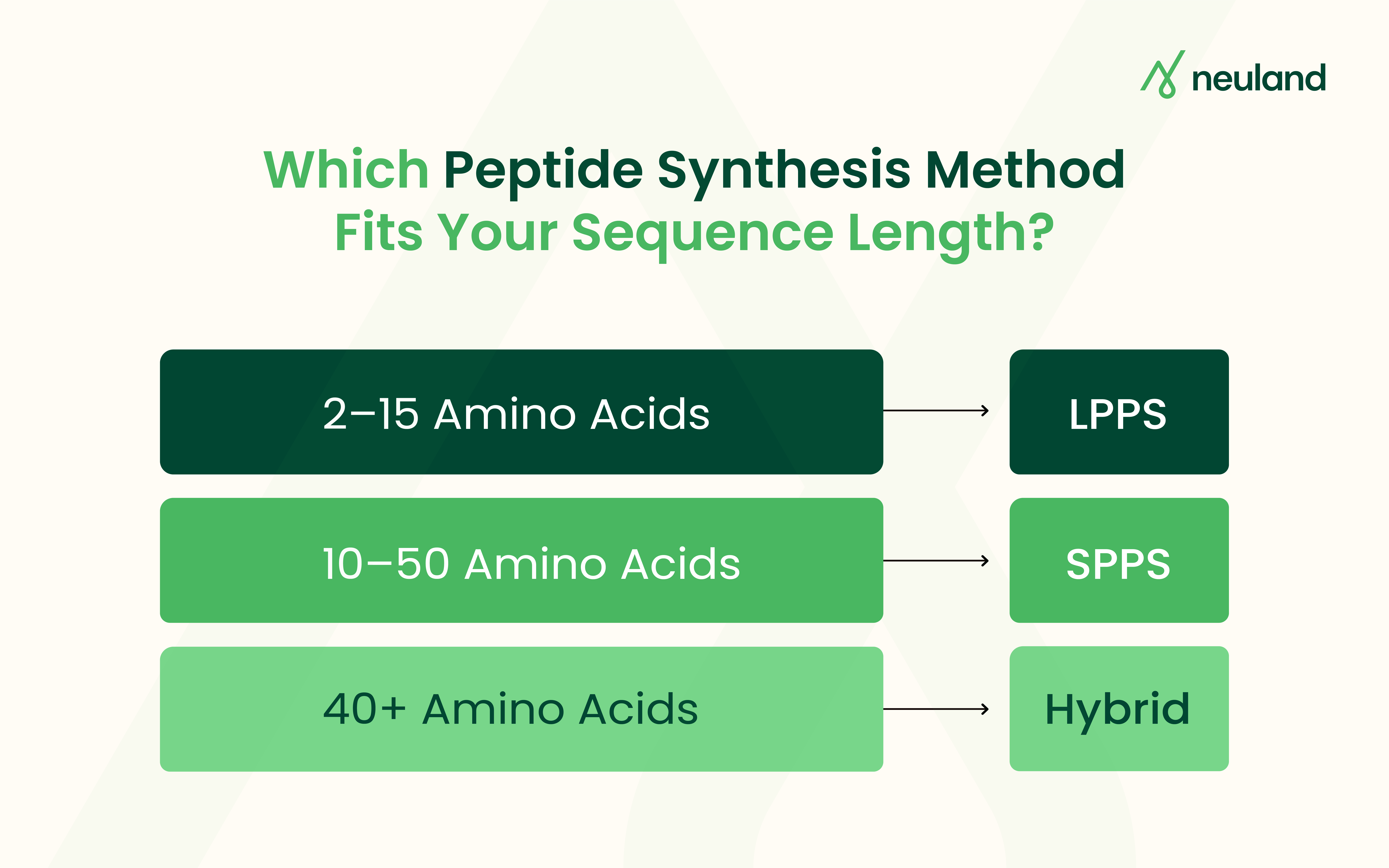
| Best for | 10–50 amino acids | 2–15 amino acids | 40+ amino acids |
| Automation | Fully automated | Manual or semi-automated | Partial (SPPS fragments, solution assembly) |
| Scale range | Milligrams to kilograms | Grams to multi-kilogram | Kilogram to multi-ton |
| Purification | End-stage prep HPLC | Intermediate crystallization/extraction | Intermediate + final HPLC |
| Cost driver | Solvents, resin, prep HPLC | Labor, stepwise isolation | Fragment development complexity |
| Impurity profile | Deletion sequences, aggregation products | Fewer sequence-related impurities | Depends on fragment design |
| Commercial examples | Semaglutide, octreotide, leuprolide | Short peptide APIs, Neuland's 35 kg decapeptide | Enfuvirtide (Fuzeon), tirzepatide |
This table gives a starting point. But the real decision depends on the specific characteristics of your molecule and program stage.
When to Choose Solid Phase Peptide Synthesis (SPPS)
Solid phase peptide synthesis is the default method for most peptide API manufacturing programs today. The peptide chain grows on an insoluble resin bead, with each amino acid added through repeated coupling and deprotection cycles. Fmoc SPPS is the dominant strategy in pharmaceutical production because it uses milder conditions than Boc chemistry and works well with automated synthesizers.
Among the three peptide synthesis methods, SPPS is the right choice when your peptide is between 10 and 50 amino acids, your primary goal is speed to clinic, and you need predictable scaling from R&D through commercial production."
Where SPPS Runs Into Trouble
The method's limitations become real as sequence length and hydrophobicity increase. Each coupling step carries a small yield loss that compounds across the full synthesis. Aggregation on the resin, where the growing chain folds into beta-sheet structures that block further coupling, makes this worse for hydrophobic sequences.
Preparative HPLC purification at commercial scale can account for 40 to 60% of total manufacturing cost, particularly for peptides with co-eluting deletion sequence impurities.
Secondary structure disruptors like pseudoproline dipeptides, isoacyl dipeptides, and backbone-protecting groups such as Dmb and Hmb amino acids have significantly extended the practical reach of SPPS. These building blocks prevent on-resin aggregation and have made sequences above 40 residues feasible at manufacturing scale.
When to Choose Liquid Phase Peptide Synthesis (LPPS)
Liquid phase peptide synthesis builds the peptide in solution rather than on a solid support. Each amino acid or fragment is added, and the intermediate is purified by crystallization or extraction before the next step. It's the oldest of the three peptide synthesis methods and is still the method of choice for specific program types.
LPPS works best for short peptides (2 to 15 amino acids) where the overhead of SPPS setup and resin costs isn't justified. It also plays a critical role in large-scale commercial production where intermediate purification at each step gives tighter impurity control than end-stage prep HPLC alone.
A strong real-world example: Neuland Laboratories delivered 35 kg of a decapeptide NCE under cGMP conditions to a US pharmaceutical company using solution phase synthesis. For this specific molecule, LPPS provided the purity control and scale that the program required.
Where LPPS Struggles
The method is labor-intensive. Every intermediate requires isolation, characterization, and purification before the next coupling. That makes LPPS slow for sequences longer than about 15 residues. For research-stage programs where speed matters, SPPS is almost always faster.
When to Choose Hybrid Peptide Synthesis
Hybrid synthesis combines SPPS fragment preparation with solution phase fragment assembly. Protected peptide fragments are built by SPPS, purified, and then coupled together in solution to form the full-length sequence. Of the three peptide synthesis methods, hybrid is the one that handles peptides neither SPPS nor LPPS can produce efficiently on its own.
The most instructive example in peptide manufacturing history is enfuvirtide (Fuzeon), a 36-amino acid HIV fusion inhibitor. Roche manufactured it on a multi-ton scale using a convergent hybrid strategy, splitting the sequence into three fragments built by SPPS and then assembling them in solution. Linear SPPS of the full 36-residue sequence produced unacceptable impurity levels at scale. The hybrid route solved this.
When Hybrid Isn't the Right Choice
Hybrid synthesis adds development complexity. Fragment design, protecting group strategy, and solution-phase coupling conditions all require optimization. For short peptides or early discovery work, the upfront investment isn't justified.
A Practical Framework for Choosing Between Peptide Synthesis Methods
When evaluating peptide synthesis methods for your program, four questions drive the decision:
1. How long is your peptide?
Under 15 residues often favors LPPS. Between 15 and 50 points to SPPS. Beyond 40 to 50 residues, hybrid approaches should be evaluated.
2. What scale do you need?
Clinical research favors SPPS for speed and automation. Large-scale commercial production may benefit from LPPS (for short peptides) or hybrid (for long/complex peptides) where intermediate purification controls costs better than end-stage prep HPLC.
3. What does your impurity profile look like?
If your molecule produces co-eluting deletion sequence impurities that standard prep HPLC can't resolve, LPPS or hybrid routes with intermediate purification may give better control.
Neuland's surrogate stationary phase (SSP) HPLC technology offers another approach, increasing preparative column loading capacity by 7 to 10 times through modified C18 chemistry.
4. What's your regulatory timeline?
SPPS delivers the fastest path from candidate selection to IND. But if your commercial manufacturing strategy requires a different method, planning for that transition early avoids costly process changes between clinical and commercial phases.
Why the Right Peptide CDMO Matters as Much as the Right Method
The synthesis method matters. But so does the partner executing it. A peptide CDMO that only operates one platform will default to that method regardless of whether it's optimal for your molecule. The strongest partners evaluate all three approaches and recommend based on your sequence, scale, and regulatory targets.
Neuland Laboratories offers this kind of flexibility across peptide synthesis methods. With capabilities in SPPS, LPPS, and hybrid synthesis, validated commercial-scale peptide API manufacturing, and a proprietary HPLC purification approach, Neuland supports peptide drug programs from early process development through cGMP production.
For teams evaluating their next peptide program, the method selection and the partner selection work together. Talk to Neuland's peptide team today.
Frequently Asked Questions
How do you decide between SPPS and LPPS for a specific peptide? The decision between SPPS and LPPS depends primarily on sequence length and production scale. SPPS is faster and more automated, making it the default for peptides between 10 and 50 residues. LPPS is better suited for short peptides (under 15 residues) at large commercial scale, where intermediate purification provides tighter impurity control than end-stage prep HPLC. |
What makes hybrid peptide synthesis methods more suitable for long sequences? Hybrid synthesis breaks a long peptide into shorter fragments that can each be built efficiently by SPPS. Assembling these fragments in solution avoids the compounding yield losses and aggregation problems that make linear SPPS unreliable beyond 40 to 50 residues. Enfuvirtide and tirzepatide are both manufactured using hybrid approaches for this reason. |
Can you switch synthesis methods mid-program without regulatory complications? Switching methods during late-stage development typically requires updated process validation, new impurity profiling, and amended CMC documentation. This can add 12 to 18 months to a program timeline. Selecting the right method early, with commercial scale in mind, avoids this disruption. |
How does purification strategy connect to synthesis method selection? The synthesis method determines what impurities you generate, and that shapes the purification strategy. SPPS produces deletion sequences and aggregation byproducts that often co-elute on standard reverse-phase HPLC. LPPS allows intermediate purification at each step, producing a cleaner crude product but at higher labor cost. Hybrid approaches offer a middle ground with fragment-level purification before final assembly. |
What role does a peptide CDMO play in method selection? A peptide CDMO with experience across SPPS, LPPS, and hybrid routes can evaluate your molecule objectively and recommend the method best suited to your sequence, scale, and timeline. CDMOs that only operate one platform will default to that method regardless of fit, which can create problems at scale-up or filing. |