

Key Takeaways
- Learning how to evaluate small molecule API partners in 2026 requires more scrutiny, driven by regulation and rising molecule complexity.
- This blog covers a seven-criteria framework to evaluate small molecule API manufacturing partners that spans these: technical fit, regulatory track record, quality systems, supply chain resilience, HPAPI capability, scalability, and IP protection.
- Prime APIs and specialty APIs call for different priorities during due diligence.
- Certain warning signs, like an undisclosed subcontracted test, should end a conversation before it reaches the contract stage.
- A weighted scoring matrix turns the process of how to evaluate small molecule API partners into a decision.
To evaluate small molecule API CDMOs means testing a CDMO against technical and regulatory demands before committing a molecule to them. That evaluation carries more weight now than it did a couple of years ago.
Sourcing teams are re-underwriting relationships they already have, as new legislation and rising molecule complexity raise the technical bar. The decision rarely stays contained to one function. Procurement weighs cost, and quality weighs compliance history. Similarly, R&D weighs technical fit, each bringing a different lens to the same shortlist.
A structured framework turns that shortlist conversation into a decision your whole team can stand behind.
What Criteria Should You Use to Evaluate a Small Molecule API Partner?
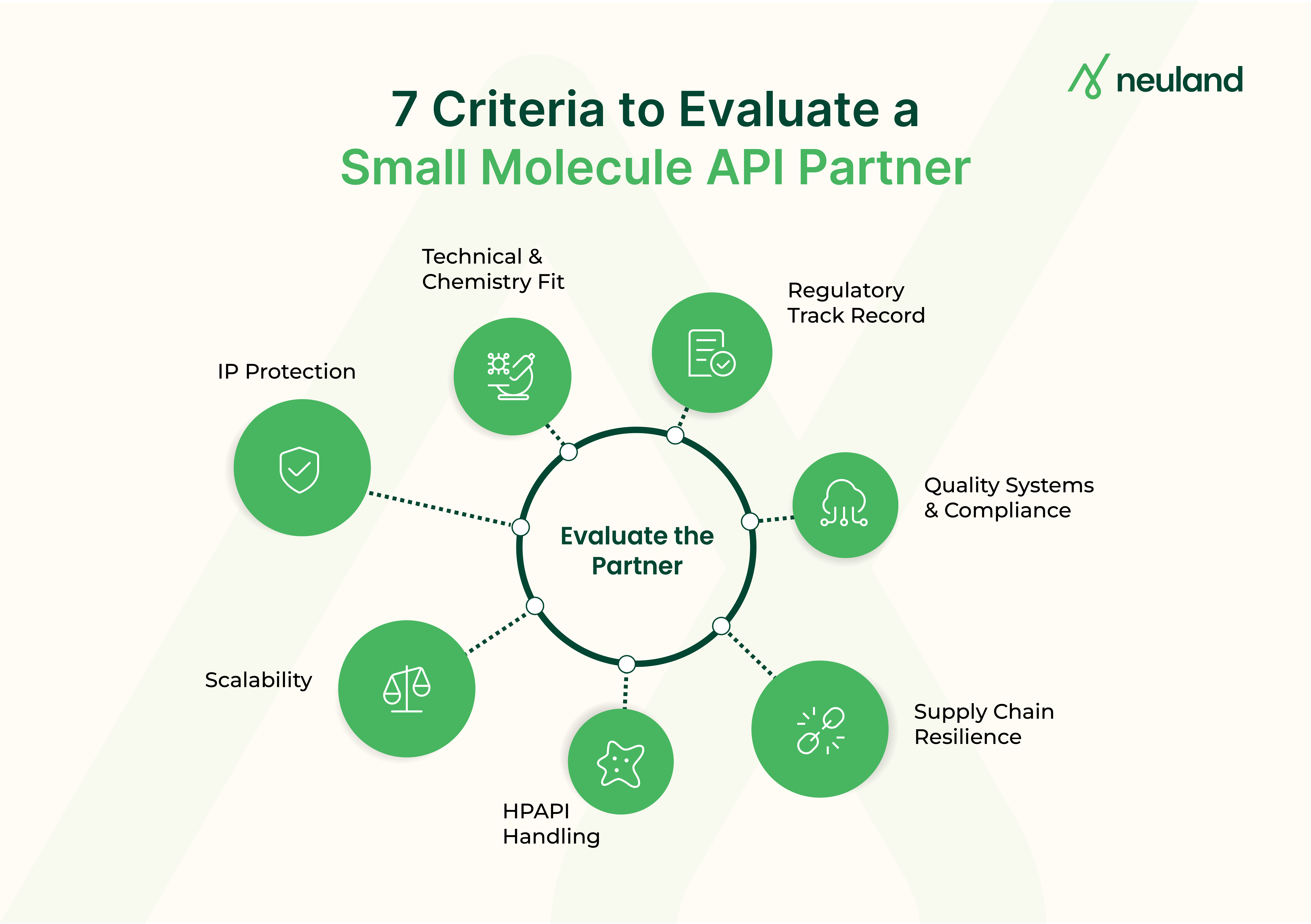
A reliable evaluation rests on seven core criteria. Here's how to evaluate small molecule API partners across the factors that matter most.
1. Technical and chemistry fit
Confirm the partner has direct experience with your molecule's specific chemistry. Cryogenic reactions demand different expertise than standard synthesis. So does hydrogenation, and a facility without this direct experience adds real risk once the process scales up.
2. Regulatory track record
Check the partner's inspection history and approval status with the FDA, EMA, and PMDA. A partner active across all three regulatory track records can usually support filings in your target markets without a separate qualification cycle.
3. Quality systems and compliance culture
A certification alone doesn't confirm a strong quality culture. Ask how deviations get investigated. Ask whether the quality unit holds real authority to stop a batch before release.
4. Supply chain resilience and geopolitical exposure
Ask where raw materials and intermediates truly originate, since concentrated sourcing is now a direct evaluation risk. The BIOSECURE Act, which became law on December 18, 2025, restricts federal procurement tied to certain Chinese biotechnology entities. That single provision has already accelerated a broader industry shift toward supplier diversification.
5. HPAPI handling capability
An HPAPI, or high-potency active pharmaceutical ingredient, is biologically active at very low doses. That potency is exactly why containment matters. If your pipeline includes oncology compounds, confirm the partner runs dedicated containment suites rather than shared space.
6. Scalability from clinical to commercial supply
A route that performs well at a kilogram scale doesn't always translate cleanly to a commercial reactor. Ask your API partner for real case studies of molecules they have carried through that exact transition.
7. IP protection and contract terms
Review how the contract handles intellectual property and process ownership, along with data rights, once the relationship ends. Weak language here can create disputes long after the molecule launches.
Weighing all seven together is what separates a rigorous evaluation of a small molecule API partner from a checklist exercise.
What Warnings Should Disqualify a Small Molecule API Partner Early?
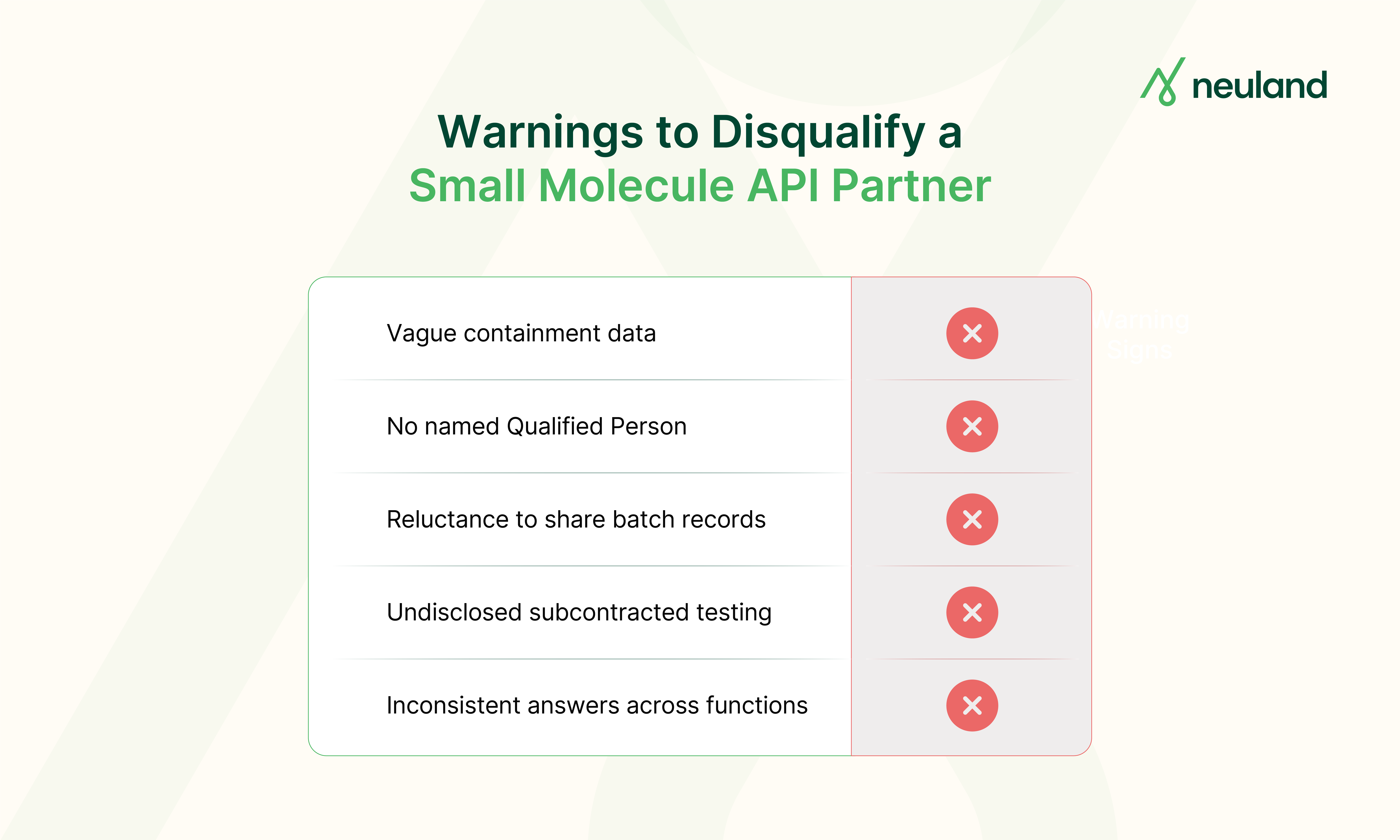
Certain warning signs should end a due-diligence conversation early, well before contract negotiation with small molecule API companies begins.
- Vague containment data: A partner who can't produce specific validation numbers for HPAPI handling likely hasn't done the work.
- No named Qualified Person: Batch release requires accountability tied to one specific, identifiable individual.
- Reluctance to share batch records: A credible partner shows redacted batch records on request. If they push back, even under the guise of confidentiality, that's worth pressing on.
- Undisclosed subcontracted testing: Sometimes analytical testing gets quietly handed off to a third party. If that isn't disclosed upfront, treat it as a real quality control gap.
- Inconsistent answers across functions: Ask the same question to different people at the company. If the answers don't match, it means the organization isn't aligned.
A single warning sign is worth noting, but it doesn't have to be disqualifying on its own. When two or more appear together, they're worth treating as a serious concern.
How Do You Score and Shortlist Small Molecule API CDMOs?
Scoring each candidate against weighted criteria turns a subjective shortlist into a decision your team can defend. It's a practical way to evaluate small molecule API CDMO options side by side.
| Criterion | Weight | What a Score of 5 Looks Like | Score (1–5) | Weighted Score |
|---|---|---|---|---|
| Technical and chemistry fit | 25% | Direct, documented experience with your exact reaction chemistry | ||
| Regulatory track record | 20% | Active FDA, EMA, and PMDA approvals with a clean recent inspection history | ||
| Quality systems and compliance | 15% | Quality unit has real authority to halt a batch; deviations are documented and closed | ||
| Supply chain resilience | 15% | Diversified raw material sourcing across more than one geography | ||
| HPAPI handling capability | 10% | Dedicated containment suites with validated exposure data | ||
| Scalability (clinical to commercial) | 10% | Verified examples of the same molecule class moved from kilo lab to commercial batch | ||
| IP protection and contract terms | 5% | Clear process ownership and data rights defined for post-relationship handling | ||
| Total | 100% | Sum of weighted scores |
Most sourcing teams get a strong signal from a shortlist of three to five candidates. A shorter list risks overlooking a stronger fit. A longer list slows things down, since a proper technical review takes real time per name. This is exactly why a structured way to evaluate small molecule API CDMOs matters before the shortlist gets too long to manage well.
Summary Points
- CDMOs take on more upstream development work than API manufacturers. Knowing which scope your molecule needs shapes how to evaluate small molecule API partners.
- Technical fit, regulatory history, along with quality culture carry the most weight in a sound partner evaluation.
- Supply chain resilience has become a formal evaluation criterion, not an afterthought, particularly after the BIOSECURE Act.
- A short, direct first call often reveals more about a partner than a polished written proposal ever will.
- A structured, weighted framework makes it easier to evaluate small molecule API CDMO options consistently.
Have a shortlist in progress? Put this framework to work on it.
Neuland Laboratories operates as a pure-play API manufacturer with three cGMP-certified facilities. It holds regulatory approvals from the FDA, EMA, and PMDA as well. Talk to Neuland's team to walk through how these criteria apply to your specific molecule.
Frequently Asked Questions
1. How much does it cost to switch API manufacturers?
The cost depends heavily on molecule complexity. But, expect to budget for tech transfer fees, revalidation batches, along with regulatory filing updates. For a commercial-stage product, the whole process can take six to twelve months. Given the time and money involved, it's cheaper to get the evaluation right the first time.
2. How long does technology transfer to a new API manufacturer typically take?
For a fairly straightforward small molecule, technology transfer takes three to six months. Complex chemistries or HPAPI handling tend to push that timeline out further. A lot comes down to how solid the documentation is and how smoothly analytical methods transfer. It also depends on how closely the new site's equipment matches the original process.
3. What makes a CDMO relationship "strategic" rather than transactional?
A CDMO relationship becomes strategic when the partner shapes process decisions instead of just executing instructions. A transactional partner simply runs a fixed batch to spec. A strategic partner flags process risks early and plans capacity around your long-term pipeline. That difference shows up in how deeply the partner invests in understanding your molecule.
4. How do companies de-risk single-source API dependency?
Companies de-risk single-source API dependency by qualifying a second manufacturer for the same molecule. This is known as dual sourcing. It spreads regulatory and supply risk across two approved sites instead of one. Many sponsors now pair their existing supplier with a backup in a different region. That way, one facility issue doesn't halt production entirely.
5. Is India a good alternative to Chinese API manufacturers in 2026?
India is a strong alternative for many small molecule APIs, backed by a large USFDA-compliant manufacturing base and years of experience serving Western markets. It isn't a complete decoupling, though. Many Indian manufacturers still source key starting materials from China. Companies should confirm where a partner's upstream inputs originate before assuming full independence.