
Key Takeaways
- The drug development pipeline runs through five connected stages, from discovery to commercial-scale manufacturing.
- Pace and complexity shift by modality, with some programs needing more specialized manufacturing support than others.
- Most programs take 10 to 15 years to complete the drug development pipeline, per 2025 University of Cincinnati data.
- A CDMO steps in once a molecule needs process development and scale-up support.
- Matching the right manufacturing partner to each stage helps programs avoid delays.
A molecule's path from laboratory bench to pharmacy shelf runs through five connected stages, together forming the drug development pipeline. That path shifts in pace and complexity depending on the modality involved. A peptide program at the preclinical stage, for instance, needs different manufacturing support than a small molecule nearing commercial launch.
Each stage in this drug development process carries its own scientific work and regulatory checkpoints. Progress at each stage also shapes what kind of manufacturing partner a program needs within the pipeline.
What Are the Stages of the Drug Development Pipeline?
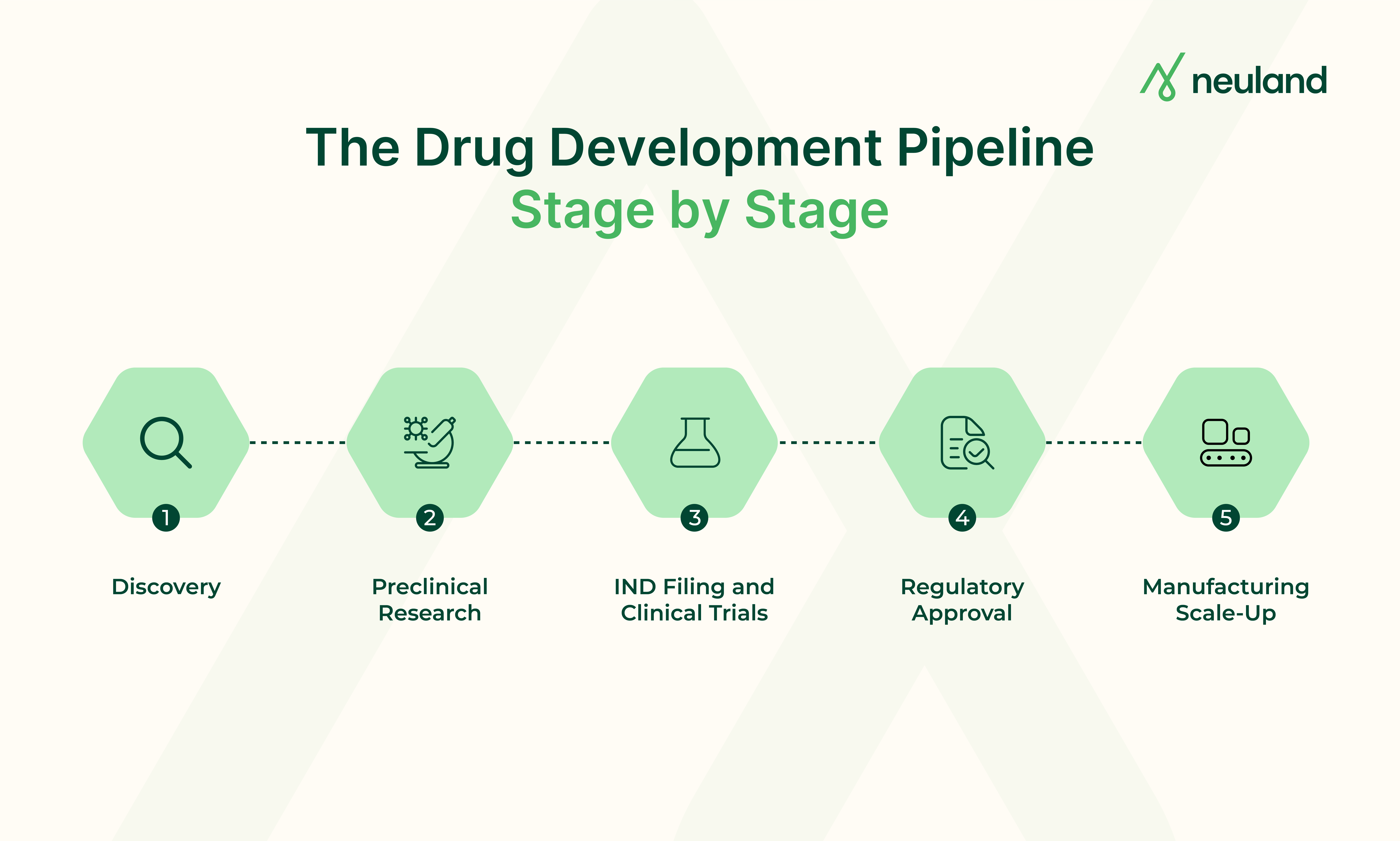
Here are the five stages of drug development that make up the pipeline:
- Drug Discovery: Drug discovery starts with identifying a biological target linked to a specific disease. It then involves testing compounds to see which ones act on it. Chemists compare how small changes to a molecule affect its strength and precision, and narrow the pool based on results. Out of the compounds tested, only a handful advance to preclinical testing.
- Preclinical Research: Here, the molecule moves into laboratory and animal models to see how it behaves inside a living system. Toxicology and dose-range studies show how much of the drug the body can safely handle. Only once these results clear a defined safety margin does the molecule move to human trials.
- IND Filing and Clinical Trials: Before testing begins in humans, developers file an IND (Investigational New Drug) application, laying out preclinical safety data and trial design. From there, clinical trials unfold across three phases. Each phase moves from small safety-focused groups to larger studies that confirm effectiveness. Of all five stages, this one usually takes the longest within the drug development pipeline.
- Regulatory Approval: Once trial data is complete, regulators step in to decide whether the drug is ready for patients. In the United States, that review falls to the FDA's Center for Drug Evaluation and Research. Whether a program follows standard or priority review often depends on the therapeutic area involved.
- Manufacturing Scale-Up: Once a drug is approved, manufacturing shifts from clinical-scale batches to full commercial production volumes. Process validation confirms the manufacturing method performs consistently at this larger scale. This stage covers both clinical-stage manufacturing and commercial-stage manufacturing, each governed by its own regulatory expectations.
How Does the Drug Development Pipeline Differ Across Modalities?
The drug development pipeline follows the same broad stages for every modality. What changes is manufacturing complexity and regulatory scrutiny at each stage. Small molecule programs follow established chemical synthesis routes.
Peptide programs use a distinct peptide synthesis approach. Biologic and cell and gene programs need more specialized manufacturing and closer regulatory review. This comparison is further summarized in the table below.
| Stage | Small Molecule | Peptide | Biologic | Cell and Gene |
|---|---|---|---|---|
| Discovery | Chemical synthesis and screening | Sequence design and optimization | Target and cell-line identification | Vector or cell-source selection |
| Preclinical | Standard toxicology models | Stability and degradation testing | Immunogenicity and stability testing | Specialized safety models |
| Clinical Trials | Established trial frameworks | Dose-ranging, growing trial base | Longer trials, immune monitoring | Small, closely monitored groups |
| Regulatory Approval | Well-defined regulatory pathway | Established but still evolving | Biologics-specific review pathway | Often uses specialized designations |
| Manufacturing | Batch or continuous production | Solid or liquid phase synthesis | Cell culture-based bioproduction | Patient-specific or vector-based production |
These differences determine which manufacturing partner a program needs, and how early to bring one in. Programs following the small molecule development process can often use established, high-volume manufacturing routes already common across the industry.
Peptide and biologic programs need specialized process expertise earlier in development. Cell and gene programs add further requirements around handling and facility design. Matching a program to the right expertise at each stage helps avoid delays later in the pipeline.
How Long Does the Drug Development Pipeline Take From Discovery to Launch?
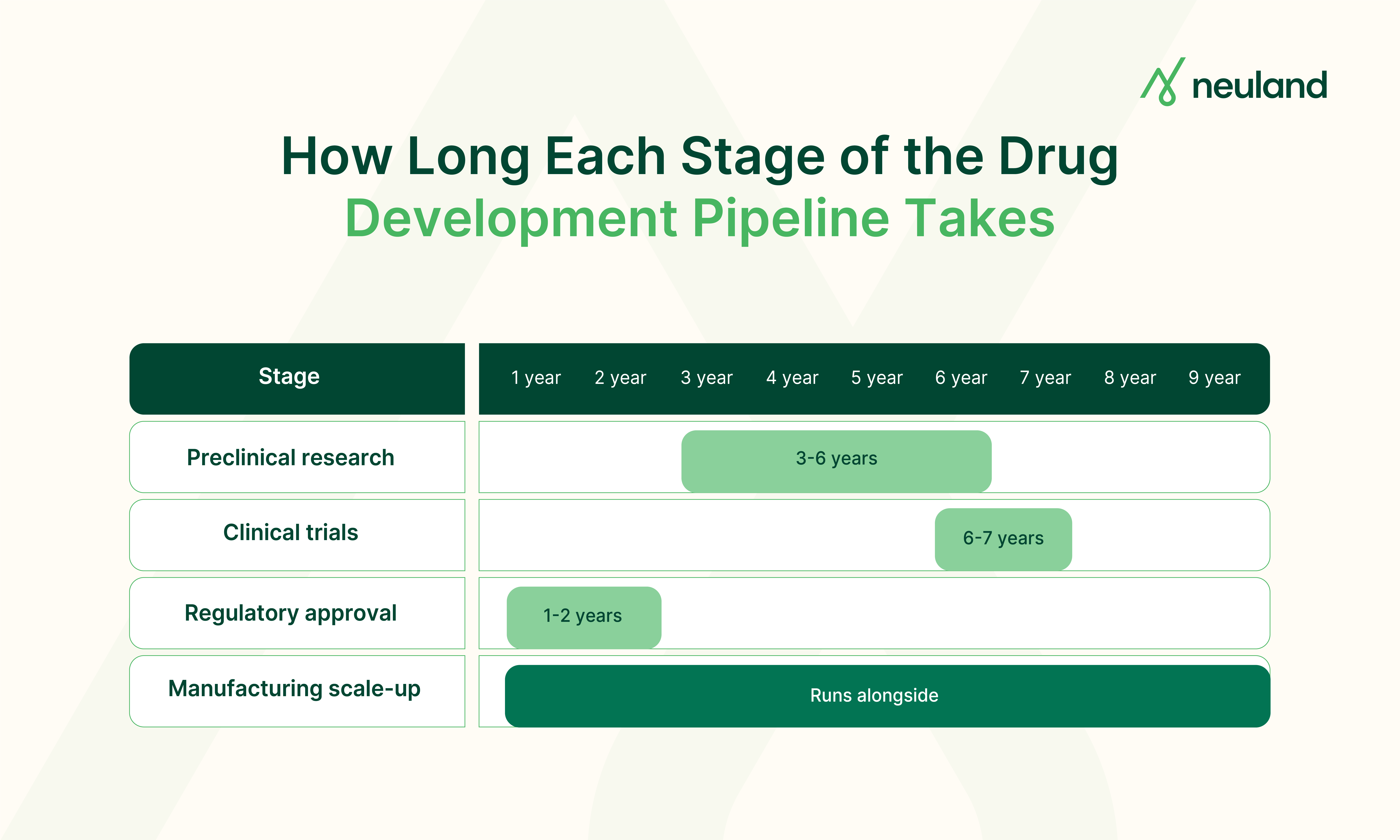
A drug development pipeline spans 10 to 15 years, from discovery to launch, as per a 2025 analysis by the University of Cincinnati. This is how that time breaks down across the pipeline:
- Discovery and preclinical research: Three to six years
- Clinical trials, across all three phases: Six to seven years
- Regulatory review: One to two years before launch
Manufacturing scale-up runs alongside the later part of this window, rather than adding a separate block of time on its own.
At What Point in This Timeline Does a CDMO Get Involved?
A CDMO enters once a molecule needs dedicated process development and scale-up support. Within the 10 to 15 year pipeline, this point usually falls after discovery and early screening are complete. Those earlier stages need deep familiarity with the specific molecule. This is why they stay with internal research teams.
Bringing in CDMO services at this point changes what a company can access:
- Specialized chemistry and equipment for complex synthesis routes
- Faster movement from lab scale to clinical or commercial batches
- Regulatory and quality systems already built for GMP manufacturing
- Reduced capital spending on facilities a company would otherwise need to build
At Neuland we support this transition through process development and API manufacturing. This work draws on over four decades of industry experience and more than 400 R&D scientists. Our facilities and regulatory approvals let companies move a molecule forward without building that infrastructure themselves.
Choosing the right time to bring in a CDMO depends on a molecule's stage and a company's internal capacity. A CDMO partner guide can help teams weigh that decision further.
Summary Points
- The drug development pipeline connects early discovery all the way through commercial-scale manufacturing.
- Modality decides how much specialized manufacturing and regulatory support a program needs.
- Most programs still take over 10 years to move from discovery to launch.
- Bringing in a CDMO earlier can avoid delays during process development and scale-up.
- Choosing a manufacturing partner works best when modality and stage are weighed together.
Not sure which stage of the pipeline your molecule needs support at?
Neuland's API and peptide manufacturing teams support pharmaceutical and biotech partners from process development through commercial supply. Talk to Neuland's team to map out what your program needs next.
FAQs
Most drugs fail due to safety concerns or weak efficacy in clinical trials. These problems mostly surface once a molecule is tested in larger patient groups. A smaller share fail later, during regulatory review or manufacturing scale-up.
Companies prioritize molecules in their pipeline based on several factors weighed together. These typically include: Molecules that score poorly on these factors are often deprioritized or shelved altogether. That frees up resources for programs with a clearer path to approval.
The number of drugs depends heavily on company size and therapeutic focus. A large pharmaceutical company might manage dozens of molecules across different stages simultaneously. A smaller biotech, on the other hand, may focus on just one or two programs at a time.
Drug discovery and drug development are related but distinct terms. Discovery covers the early search for a molecule that acts on a disease target. Development covers everything that follows, including clinical trials and manufacturing.
Delays in a drug development pipeline can happen at almost any stage, though certain causes come up repeatedly. Common causes include: Most delays compound rather than stay contained within one stage. A late step often pushes back everything that follows.