

Key Takeaways
- Batch consistency is engineered during development, not inspected in at the end. By the time a batch fails release testing, the decision that caused it was made much earlier.
- Quality by Design (QbD) links critical quality attributes to critical process parameters, so the process is understood rather than merely repeated.
- Process validation is a lifecycle, not a one-time exercise. It runs from process design through qualification into ongoing verification across the commercial life of the product.
- Scale-up is where consistency most often breaks, because heat transfer, mixing, and reaction kinetics do not behave the same way at 5,000 litres as they do at 5,000 mL.
- Raw material variability is a leading and frequently underestimated cause of batch-to-batch variation in commercial API production.
Batch consistency in clinical manufacturing means producing every batch of an API within the same defined quality specifications. It means identical purity, impurity profile, particle size, polymorphic form, and yield within accepted ranges.
Two batches that both pass specification are not necessarily consistent. If one sits at the top of the impurity range and the next sits at the bottom, the process is drifting even though nothing has technically failed.
That distinction matters commercially. Regulators and the companies that depend on the API are looking for a process that is predictable, not merely one that has so far avoided rejection.
Why Does Batch Consistency Matter in Commercial API Production?
Batch consistency in commercial API production matters because inconsistency propagates. A variable API produces a variable drug product, which risks patient safety, regulatory action, and supply interruption.
The consequences stack in a predictable order. A batch outside specification is rejected, which costs raw material, reactor time, and schedule. Repeated deviations trigger investigations, which consume quality resources and attract regulatory attention. Persistent variability can put a product on the drug shortage list.
Manufacturing and quality problems, rather than demand spikes, are a leading documented cause of drug shortages. Consistency is therefore not a quality department preoccupation. It is a supply reliability issue, and it directly affects whether a company can meet its commitments to patients.
Building that reliability starts upstream, in process development, long before the first commercial batch is ever charged.
What Causes Batch-to-Batch Variation?
.webp)
Batch-to-batch variation is caused by uncontrolled sources of variability across materials, processes, equipment, and people. Most variation traces back to a small number of recurring causes.
Here are the most common sources of variability in commercial API manufacturing:
- Raw material variability: Different supplier, different lot, different impurity profile. The starting material carries its history into your process.
- Process parameter drift: Temperature, pressure, addition rate, agitation, or reaction time creep outside the validated range.
- Scale effects: Heat and mass transfer behave differently in a large reactor than in a lab flask, changing reaction kinetics and impurity formation.
- Equipment differences: Reactor geometry, agitator design, and heat transfer surface area vary between vessels and between sites.
- Analytical variability: Sometimes the batch has not changed. The method measures it differently.
- Human variability: Manual operations are executed differently by different operators across different shifts.
The pattern across all six is the same. Each is a variable that was either not identified, not measured, or not controlled.
How Does Quality by Design Improve Batch Consistency?
Quality by Design (QbD) improves batch consistency by building quality into the process rather than testing for it afterward. It systematically links what matters in the product to what must be controlled in the process.
The logic runs in a chain. Critical Quality Attributes (CQAs) define what the API must be, such as purity, impurity limits, and polymorphic form. Critical Process Parameters (CPPs) are the process variables that influence those attributes. The design space is the multidimensional range of parameter values within which the CQAs are reliably met.
Once that relationship is characterized, consistency stops being a matter of hoping the process behaves. It becomes a matter of holding parameters inside a range you have already demonstrated to be safe.
ICH Q8 and ICH Q11 set out the expectations for this approach, and ICH Q9 governs the quality risk management that identifies which parameters warrant control in the first place.
What Is Process Validation and How Does It Work?
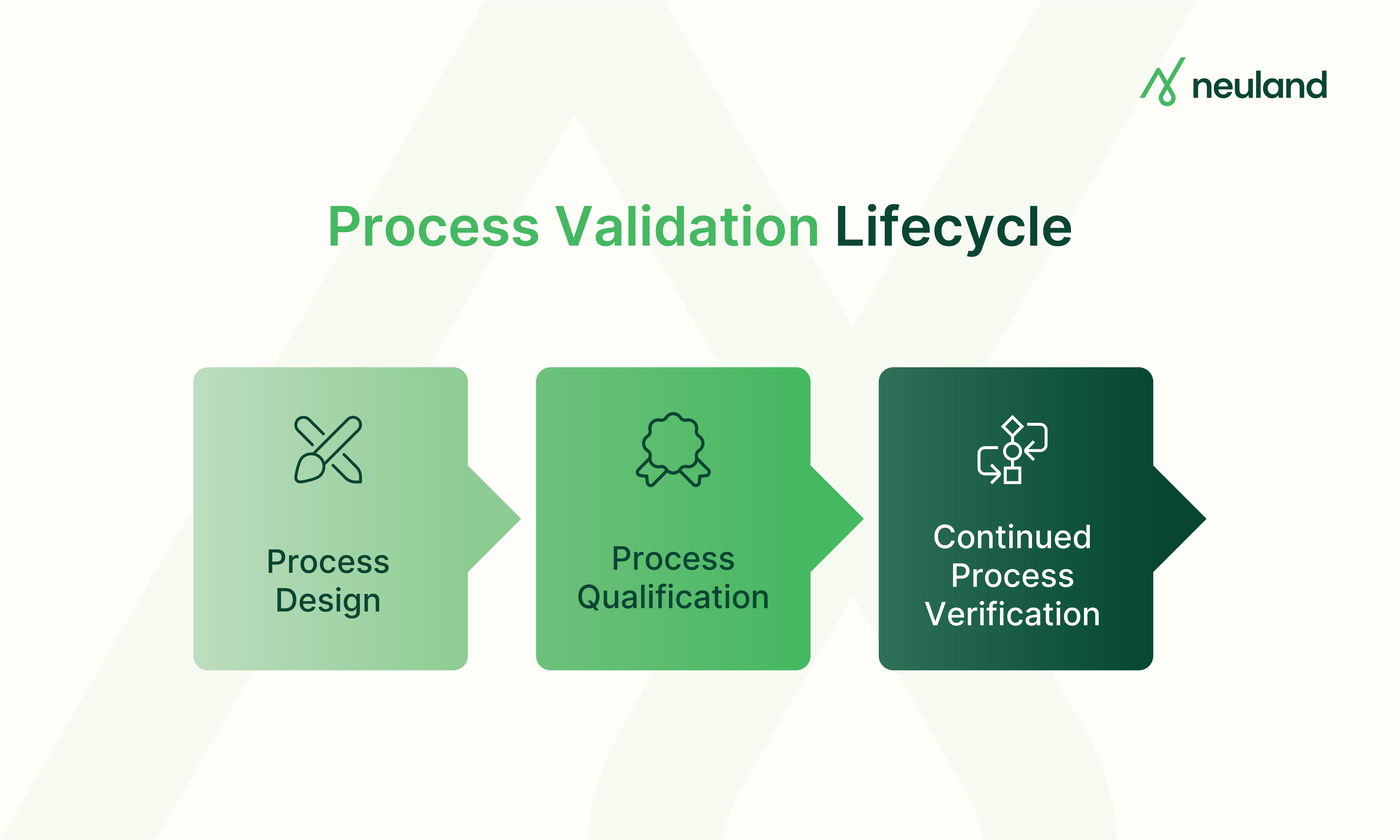
Process validation is documented evidence that a manufacturing process consistently produces an API meeting its predetermined specifications. It is structured as a lifecycle across three stages rather than a single event.
Follow these three stages:
- Process design: Define the commercial process based on development knowledge, QbD studies, and scale-up data. This is where the control strategy is established.
- Process qualification: Confirm that the designed process performs as expected at commercial scale, in the actual facility, with the actual equipment and personnel. This is where the process is proven, not assumed.
- Continued process verification: Monitor the process across routine commercial production to confirm it stays in a state of control. Trend the data. Detect drift before it becomes a deviation.
Stage three is where most organizations underinvest. Validation is treated as a milestone that gets cleared, rather than a state that has to be actively maintained. ICH Q7 sets the GMP expectations for active pharmaceutical ingredients across the lifecycle.
How Do You Maintain Consistency During Scale-Up?
Consistency during scale-up is maintained by understanding which process parameters scale and which do not, then designing the commercial process around that reality rather than simply multiplying the lab recipe.
Take these steps to protect consistency as volumes increase:
- Characterize the process on a small scale first. Map the design space and identify CPPs before scale is added as a variable.
- Model the scale-dependent parameters. Heat transfer, mixing efficiency, and addition rates change with vessel size and must be recalculated, not scaled linearly.
- Use intermediate-scale runs. Kilo lab and pilot batches surface scale effects while they are still cheap to fix.
- Generate scale-up data in parallel with optimization. Waiting until the process is "finished" before testing it at scale means finding problems when they are most expensive.
- Qualify the specific equipment. A validated process is validated on defined equipment, not on the concept of a reactor.
- Assess process safety at scale. Exotherms that are trivial in a flask are not trivial in a 5,000-liter vessel.
What Role Does Analytical Testing Play?
Analytical testing confirms batch consistency and generates the data that proves the process is in control. Its role is evidentiary, but it only works if the method itself is reliable.
Three functions matter most:
- Method validation: A method that drifts will report variation that does not exist, and conceal variation that does exist.
- In-process controls: Testing during synthesis catches deviation while intervention is still possible, rather than after the batch is committed.
- Trend analysis: Individual results confirm a batch. Trended results across batches reveal whether the process is stable or slowly moving.
The last point is the one that separates a compliant operation from a consistent one. A process that has passed every release test can still be drifting steadily toward the edge of specification.
Summary Points
- Batch consistency is an outcome of process understanding. It is designed during development and maintained through control, not achieved through testing.
- QbD provides the framework, linking critical quality attributes to the critical process parameters that must be held within a defined design space.
- Process validation is a three-stage lifecycle, and continued process verification is the stage most often neglected.
- Scale-up is the highest-risk transition for consistency because several key parameters do not scale linearly from the lab to the commercial reactor.
- Raw material variability, parameter drift, and analytical method variability account for a large share of batch-to-batch variation.
- Consistency is ultimately a supply reliability commitment, not a quality department metric.
Ready to bring consistency to your commercial API supply?
Neuland Labs supports pharmaceutical and biotech companies with complex API development, scale-up, and commercial manufacturing. Talk to our team about your process.
Frequently Asked Questions
What is batch consistency in API manufacturing?
Batch consistency in API manufacturing is the reliable reproduction of the same quality profile across every commercial batch, including purity, impurity levels, particle size, and polymorphic form. It reflects a controlled and well-understood process rather than a fortunate one.
How is batch-to-batch consistency measured?
Batch-to-batch consistency is measured by trending critical quality attributes across batches rather than by assessing each batch in isolation. Statistical process control tools track whether results are stable within a defined range or drifting toward a specification limit, which is the signal that the process is losing control.
What is the difference between process validation and continued process verification?
Process validation establishes that a process can consistently produce conforming material and includes the initial qualification at commercial scale. Continued process verification is the ongoing stage that monitors routine production to confirm the process remains in a state of control over time. Validation proves it once. Verification proves it continues.
Can raw material changes affect batch consistency?
Yes, and they are one of the most common causes of unexpected variation. A different supplier or lot can carry a different impurity profile into the process, altering the impurity profile of the final API. This is why supplier changes require comparability assessment rather than a simple substitution.
How does a CDMO ensure batch-to-batch consistency?
A CDMO ensures batch-to-batch consistency through process characterization during development, a defined control strategy, GMP-compliant manufacturing, validated analytical methods, and ongoing trend monitoring across commercial batches. Neuland's quality control and assurance function supports this across the product lifecycle.
How long does process validation take for a commercial API?
Timelines vary with process complexity and regulatory pathway, but process qualification typically requires a minimum of three consecutive successful commercial-scale batches, preceded by the process design work and followed by continued verification for as long as the product is manufactured.