

Key Takeaways
- The API supply chain covers every stage from raw material sourcing through to the finished active pharmaceutical ingredient, and a single weak link can halt a drug program.
- Resilience is built through supply-base de-risking, qualified alternate sources, and early supplier collaboration, not through reactive firefighting after a disruption.
- Regulatory compliance is a supply chain function, not just a quality function. GMP, ICH, US FDA, and EMA expectations extend to your suppliers' suppliers.
- Backward integration into key starting materials and intermediates reduces exposure to single-source and single-geography risk.
- Geopolitics, China Plus One, and regionalization have moved supply chain strategy from procurement's remit into the boardroom.
An API supply chain is the end-to-end network that takes raw materials and key starting materials through different stages. The stages include chemical synthesis, purification, quality testing, and release to deliver a finished API (active pharmaceutical ingredient).
It sits upstream of drug product manufacturing and covers sourcing, process development, scale-up, GMP (good manufacturing practices) production, analytical release, and logistics.
The pharmaceutical API supply chain is unusually fragile compared with other industrial supply chains. A single intermediate may have only a handful of qualified global suppliers. Requalifying a replacement can take months of analytical work and regulatory filing.
That structural concentration is why API supply chain management has become a board-level concern rather than a procurement footnote.
.webp)
Why Is a Resilient API Supply Chain Critical?
A resilient API supply chain protects four things simultaneously: product quality, regulatory compliance, patient safety, and business continuity. Failure in one usually cascades into the others.
- Product quality depends on raw material consistency. Variability in a starting material changes the impurity profile of the final API, which can push a batch outside specification and force rejection.
- Regulatory compliance extends across the supplier network. Regulators expect manufacturers to demonstrate control over their suppliers, and gaps in that control surface during inspection.
- Patient safety is the direct consequence. Drug shortages caused by API supply failures are a documented and persistent problem. The US FDA has consistently identified manufacturing and quality problems, rather than raw demand spikes, as a leading cause of drug shortages in the United States.
- Business continuity is the commercial dimension. When a clinical program stalls because an intermediate is unavailable, the cost is measured in lost development time on a patent clock that keeps running.
What Are the Biggest Risks in the Pharmaceutical Supply Chain?
The pharmaceutical supply chain carries a defined set of recurring risks. Understanding them is the precondition for designing around them.
Here are the risks that most often disrupt API supply:
- Single-source dependency: One qualified supplier for a critical intermediate means one point of failure with no fallback.
- Geographic concentration: Heavy reliance on a single country or region exposes the chain to trade policy, export restrictions, and regional shutdowns.
- Regulatory non-conformance upstream: A supplier's inspection failure becomes your supply failure.
- Quality drift: Gradual variation in an incoming material that only becomes visible when a batch fails.
- Capacity constraints: A supplier who cannot scale from clinical to commercial volumes creates a cliff edge at exactly the wrong moment.
- Logistics and lead-time volatility: Freight disruption, customs delays, and cold-chain handling failures for sensitive materials.
Saharsh Davuluri, CEO and MD at Neuland Labs, frames the current environment directly:
"It's a very interesting time for a company like Neuland to be in the CDMO space. There are a few interesting trends. One, we see the geopolitical factors at play. There is talk of regionalization. There has been China Plus One. Also, the recent Middle Eastern crisis again pointing out supply chain risks [and] the vulnerabilities around supply chain disruptions."
The pattern is consistent. Disruption is no longer episodic. It is a standing condition that the supply chain design has to absorb.
How Do You Build Resilience Into API Sourcing?
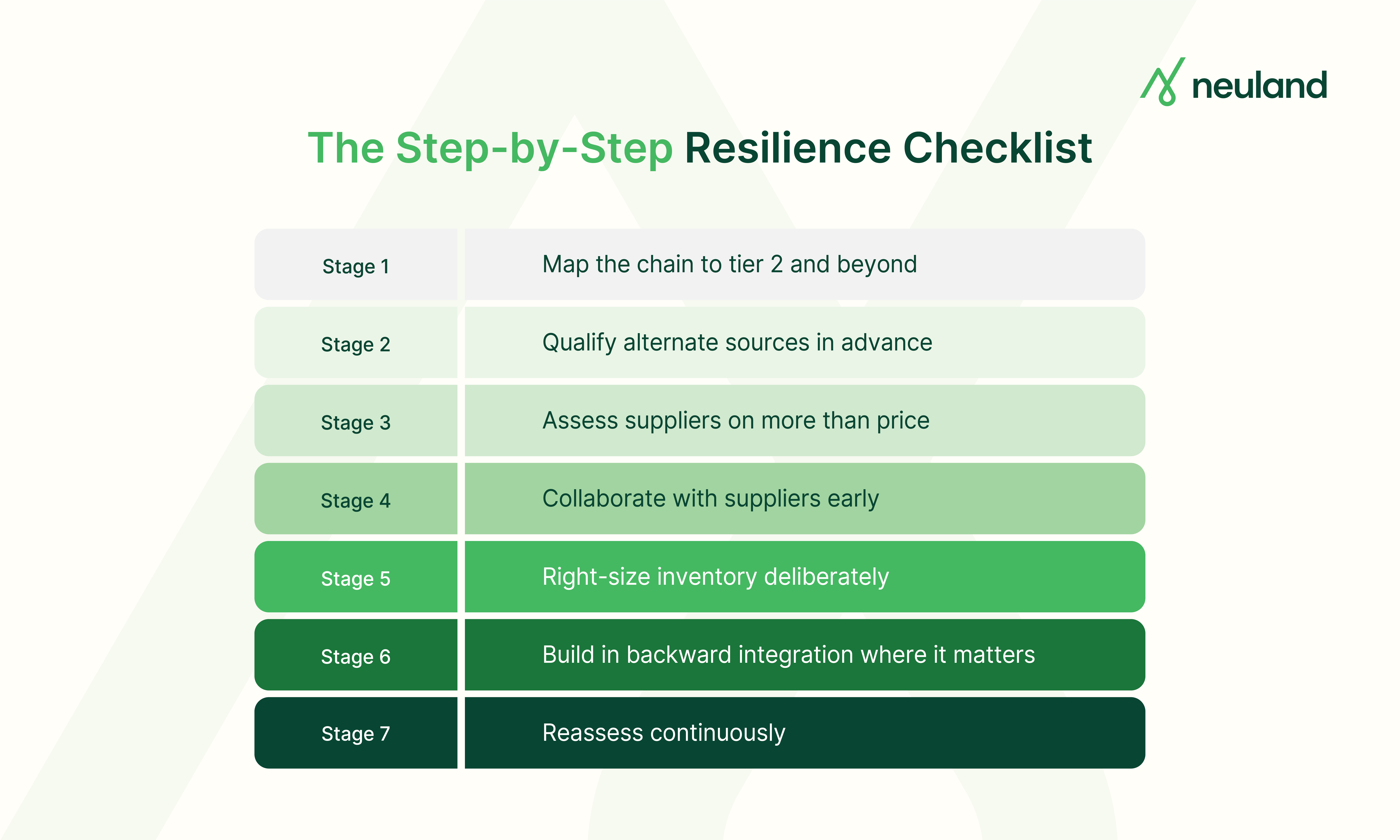
Resilience in API sourcing is built before a disruption occurs, through supplier qualification, redundancy, and inventory strategy. It cannot be retrofitted during a crisis because qualifying a new source of a regulated material takes months.
Follow these steps to build a more resilient sourcing position:
- Map the chain to Tier 2 and beyond. Knowing your direct supplier is not enough. Concentration risk usually hides one or two levels upstream, where multiple Tier 1 suppliers turn out to draw on the same source.
- Qualify alternate sources in advance. Scout, audit, and analytically qualify a second source for every critical material while supply is stable.
- Assess suppliers on more than price. Evaluate GMP compliance history, inspection record, financial stability, and capacity headroom.
- Collaborate with suppliers early. Bringing raw material suppliers into the development process, rather than at the point of order, reduces the risk of late-stage substitution.
- Right-size inventory deliberately. Strategic safety stock for long-lead, high-risk materials, balanced against working capital and material stability.
- Build in backward integration where it matters. In-house production of key starting materials removes an external dependency entirely.
- Reassess continuously. A supplier qualified three years ago may no longer be a low-risk supplier today.
Neuland's own supply chain function is built on this logic. Its teams work across supplier onboarding, supply-base de-risking, alternate source scouting, and securing supplies, with early collaboration with raw material suppliers to keep supply conforming and uninterrupted.
All Tier 1 suppliers are evaluated against defined vendor evaluation parameters and a supplier code of conduct requiring ISO 9001, ISO 14001, and ISO 45001 compliance alongside labor law and statutory adherence.
How Does Quality Assurance Protect the API Supply Chain?
API quality assurance protects the supply chain by catching variation before it reaches the batch. It operates as a continuous control system across incoming materials, in-process checks, and final release, rather than as a single gate at the end.
The core mechanisms are consistent across well-run operations:
- Incoming material testing against defined specifications, so supplier variation is caught at the door.
- In-process controls that monitor critical quality attributes during synthesis rather than after it.
- Analytical method validation ensures that the test itself is trustworthy across sites and over time.
- Deviation and CAPA management so that a failure is investigated to root cause and does not recur.
- Stability programmes that confirm the material behaves predictably across its shelf life.
- Change control so that a supplier-side process change is assessed before it reaches production.
The link back to sourcing is direct. A qualified alternate supplier is only genuinely qualified once its material has passed through this system and demonstrated equivalence.
What Role Does Regulatory Compliance Play?
Regulatory compliance sets the floor for the active pharmaceutical ingredient supply chain, because every material, process, and site in the chain is subject to inspection and filing obligations.
The frameworks that govern it are well established:
- GMP requirements define manufacturing conditions and documentation standards
- ICH guidelines, particularly Q7 for active pharmaceutical ingredients and Q9 for quality risk management, set expectations for process control and risk-based decision-making
- US FDA and EMA inspections verify that the documented system matches the operating reality
- DMF filings document the manufacturing process and give regulators a controlled reference for a given API
The practical consequence for supply chain design is that changes are not free. Switching a supplier of a registered starting material may require analytical comparability work and a regulatory filing. This is precisely why alternate sources need to be qualified during periods of stability, not during a shortage.
How Should Companies Evaluate a CDMO's Supply Chain?
Companies evaluating a CDMO's supply chain should look past capability claims and examine structural evidence: chemistry depth, capacity headroom, regulatory track record, and control over key inputs.
Use this checklist when assessing CDMO API manufacturing partners:
- Chemistry breadth. Can they handle the specific chemistry your molecule requires, including complex reactions such as cryogenics, hydrogenation, and bromination?
- Scale continuity. Can the same partner take the molecule from grams to commercial tonnage without a technology transfer to a third party?
- Development-to-manufacturing integration. Does process development happen in an environment that reflects manufacturing reality, or does the scale-up story only get tested at scale?
- Regulatory filing experience. Has the partner supported filings before, and does it hold the regulatory CMC capability to support yours?
- Control over key inputs. Does the partner rely wholly on external sourcing, or does it build key materials in-house?
- Capacity headroom. Is there enough spare reactor capacity to absorb your growth without displacing another program?
Neuland's own position against these criteria is grounded in specifics rather than claims.
Its dedicated development laboratories run automated jacketed reactors from 100 to 5,000 mL, generating 100 to 200 grams of final product with the required critical quality attributes. API scale-up capacity runs from 50 to 150 kg, with non-GMP through to cGMP production units.
Total installed reactor capacity stands at approximately 1,174,000 litres, giving genuine headroom across development and commercial supply.
On the CDMO side, Neuland provides customized small molecule API development and manufacturing for innovator companies and has supported 25 IND filings and 4 NDA filings.
Its generic API business runs a portfolio of over 50 value-added APIs in the specialty segment, built on complex and niche chemistry rather than commodity volume. That specialty depth is what makes the same chemistry expertise transferable to custom development work.
Recent News:
The company is also expanding its development infrastructure. A 135,000 sq. ft. dedicated process development facility at its Genome Valley campus in Hyderabad, with a $20m specialist fit-out, is being operationalized in phases, with full completion expected by October 2026.
It integrates non-GMP kilo labs, allowing scale-up data to be generated in parallel with process optimization rather than after it, and includes dedicated zones for process engineering, polymorph studies, process safety, and flow chemistry.
Neuland Labs partners with pharmaceutical and biotech companies on complex API development, from route scouting and process development through to commercial supply. Connect with our process development team to discuss your project.
What Is the China Plus One Strategy in Pharma?
China Plus One is a sourcing strategy in which companies retain their existing supply base in China while qualifying at least one additional source in another country to reduce concentration risk. In pharmaceuticals, the additional source is most often in India, Europe, or North America.
The rationale is structural rather than political. A supply chain with a single geographic center of gravity is exposed to any disruption affecting that geography, whether it originates in trade policy, regulatory action, or logistics. Adding a qualified second geography converts a single point of failure into redundancy.
The execution is the hard part. Qualifying a second source means audits, analytical comparability, and regulatory filings. It is a multi-year program, which is why companies that started it before disruption arrived are in a materially better position than those starting now.
Summary Points
- The API supply chain runs from raw material sourcing through synthesis, quality release, and delivery of the finished active pharmaceutical ingredient.
- Resilience is designed in advance through supplier mapping, alternate source qualification, early supplier collaboration, and deliberate inventory strategy.
- Quality assurance functions as a continuous control system across incoming materials, in-process checks, and release, not as a final gate.
- Regulatory frameworks, including GMP, ICH Q7, US FDA, EMA, and DMF obligations, shape what can be changed in the chain and how quickly.
- Backward integration into key starting materials and geographic diversification through strategies like China Plus One reduce structural exposure.
- When evaluating a CDMO, look for chemistry depth, scale continuity, regulatory filing experience, and genuine capacity headroom.
Frequently Asked Questions
What is API supply chain management?
API supply chain management is the coordination of sourcing, manufacturing, quality, and logistics activities required to deliver an active pharmaceutical ingredient reliably and in compliance with regulatory requirements. It covers supplier qualification, risk assessment, inventory planning, and the regulatory obligations attached to any change in the chain.
What is the difference between an API and a key starting material?
An API is the biologically active component of a drug. A key starting material is an input used in the synthesis of that API, typically one that is incorporated as a significant structural fragment of the final molecule. Regulators pay particular attention to key starting materials because control over them determines control over the API's impurity profile.
Why are API supply chains vulnerable to disruption?
API supply chains are vulnerable because critical intermediates often have very few qualified global suppliers, and substituting a supplier requires analytical work and regulatory filing rather than a simple purchase order. That combination of concentration and switching friction makes recovery from a disruption slow.
How long does it take to qualify a new API supplier?
Qualification timelines vary with the material and its regulatory status, but the process routinely takes several months to over a year. It involves supplier audit, analytical comparability testing, stability assessment, and, where the material is registered, a regulatory filing. This is why alternate sources should be qualified before they are needed.
What is backward integration in API manufacturing?
Backward integration is the in-house production of upstream inputs such as intermediates and key starting materials, rather than buying them from third parties. It removes an external dependency, improves control over quality and impurity profiles, and reduces exposure to supplier or geographic concentration risk. Neuland's supply chain management approach combines this with active de-risking of its external supply base.
Does a CDMO handle the API supply chain, or does the company?
Both, but the division of responsibility should be explicit from the outset. The company typically owns the overall supply strategy and regulatory filings, while the CDMO owns the operational supply chain for the API it manufactures, including its own raw material sourcing and supplier qualification. Ambiguity here is a common source of failure.
Ready to build a more resilient API supply chain?
Neuland Labs partners with pharmaceutical and biotech companies on complex API development and manufacturing, from process development through to commercial supply. Talk to our team about your molecule.