
Quick Summary
- The peptide drug development market reached $49.68 billion in 2026 and is growing at 7.16% annually
- Over 110 peptide drugs are now approved globally, with 170+ in active clinical trials
- Secondary structure disruptors like pseudoproline dipeptides, isoacyl dipeptides, and Dmb amino acids have made previously "unsynthesizable" sequences routine
- Oral peptide delivery is no longer a barrier, with FDA-approved oral semaglutide (Rybelsus) on the market
- Tirzepatide's hybrid SPPS/LPPS manufacturing proved that advanced synthesis methods translate directly to blockbuster commercial outcomes
Why Peptide Drug Development Matters More in 2026 Than Ever Before
Peptide drug development has moved from a niche research interest to one of the largest growth areas in pharma. The peptide therapeutics market reached $49.68 billion in 2026, with projections pointing toward $70.20 billion by 2031. Over 110 peptide drugs have received regulatory approval globally, and more than 170 peptides are in active clinical trials right now.
What changed? GLP-1 receptor agonists like semaglutide and tirzepatide proved that peptides can become the best-selling drugs on the planet. But the story goes deeper than one drug class.
Why Peptides? Advantages Over Small Molecules and Biologics
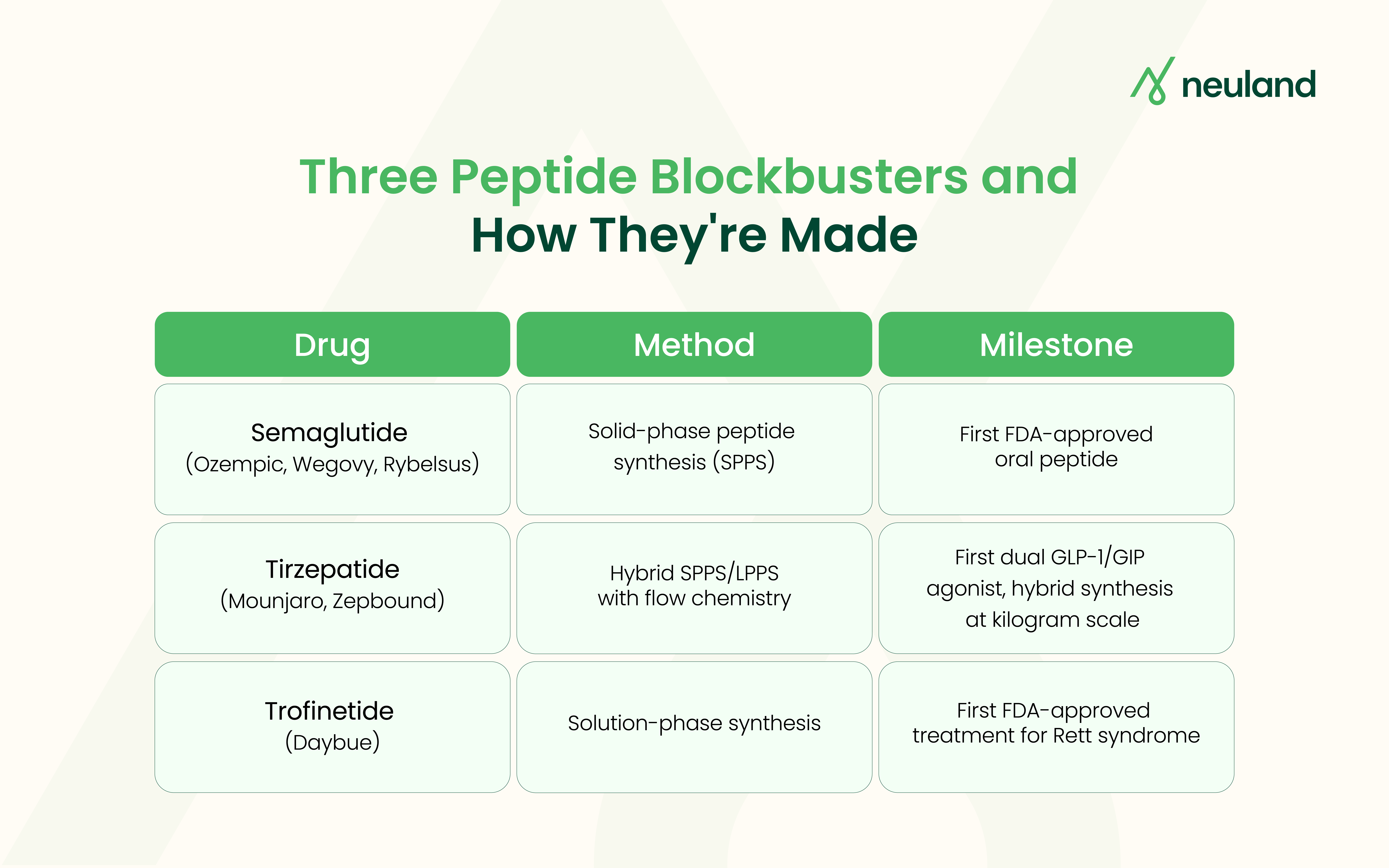
Peptides sit in a pharmacological sweet spot between small molecules and large biologics. They combine the target specificity of antibodies with manufacturing approaches closer to traditional chemistry. That makes them attractive across a growing range of therapeutic areas.
Key advantages include:
- High target specificity with fewer off-target effects than most small molecules
- Lower immunogenicity than monoclonal antibodies and other large biologics
- More druggable targets than small molecules can reach, including protein-protein interactions
- Scalable synthesis through established solid phase peptide synthesis (SPPS) and hybrid methods
- Predictable metabolism into natural amino acids, reducing toxicity concerns
These properties explain why peptide drug development pipelines now span metabolic disease, oncology, rare disorders, cardiovascular disease, and neurology.
How Secondary Structure Disruptors Solved Key Peptide Synthesis Challenges
One of the biggest peptide synthesis challenges has always been aggregation. As a peptide chain grows on the resin during Fmoc SPPS, it can fold into beta-sheet structures that block further coupling. The result: incomplete sequences, rising impurity loads, and failed batches.
Three classes of building blocks have changed the peptide drug development picture dramatically.
Pseudoproline Dipeptides
Pseudoproline dipeptides act as temporary structure disruptors. They introduce a kink in the peptide backbone that prevents beta-sheet formation during synthesis. Once cleavage happens, the pseudoproline reverts to the native serine or threonine residue.
This technology has enabled the synthesis of peptides that were previously considered too difficult for standard SPPS, including sequences exceeding 50 amino acids.
Isoacyl Dipeptides
Isoacyl dipeptides take a different approach. They temporarily replace the native amide bond with an ester bond, which disrupts aggregation on the resin. After cleavage, the ester shifts back to the native amide under mildly basic conditions.
This approach is particularly useful for sequences rich in hydrophobic amino acids, where aggregation is most severe.
Fmoc-(Dmb) and Fmoc-(Hmb) Amino Acids
Fmoc-Dmb and Fmoc-Hmb amino acids use backbone protection to prevent aggregation. A removable group on the nitrogen disrupts chain-chain interactions during synthesis. It's removed during the final cleavage step without affecting the target sequence.
Neuland's manufacturing team demonstrated the impact of these tools directly. Neuland has delivered 35 kg of a Decapeptide NCE (cGMP) produced by solution phase synthesis to a US company.
| Feature | Pseudoproline Dipeptides | Isoacyl Dipeptides | Dmb/Hmb Amino Acids |
| Mechanism | Backbone kink via oxazolidine ring | Ester bond replaces amide | Backbone nitrogen protection |
| Best for | Ser/Thr-containing sequences | Hydrophobic aggregation-prone peptides | Racemization-sensitive couplings |
| Reversion | Automatic during TFA cleavage | O-to-N acyl shift post-cleavage | Removed during global deprotection |
| Scale proven | Research through commercial | Research through commercial | Commercial |
Real-World Peptide Drug Examples That Prove the Science Works
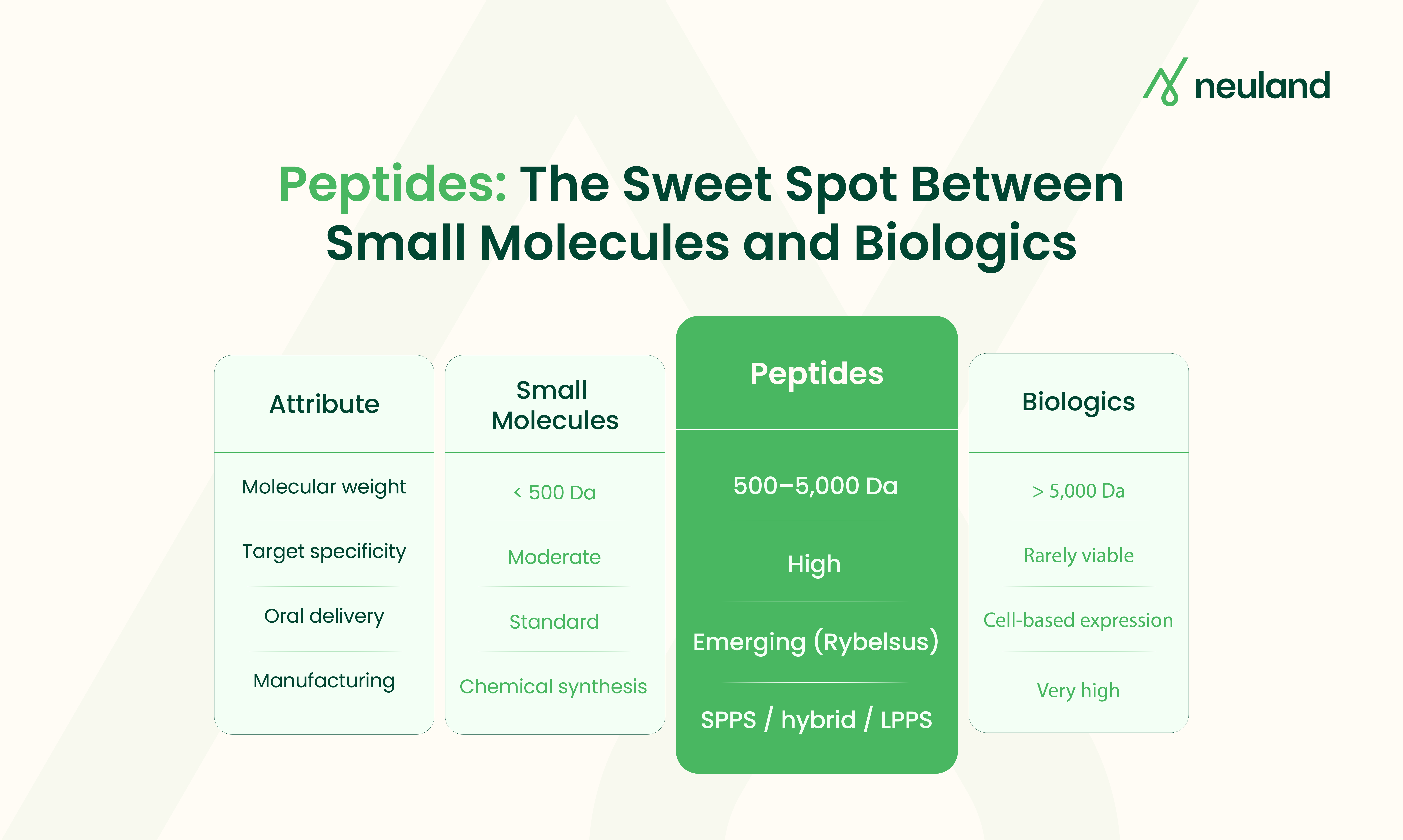
The synthesis advances described above aren't academic. They're behind some of the most commercially successful drugs in the world right now.
Semaglutide (Ozempic, Wegovy, Rybelsus) is a GLP-1 receptor agonist manufactured via SPPS. Rybelsus, approved by the FDA as an oral formulation, proved that oral peptide delivery is commercially viable.
Tirzepatide (Mounjaro, Zepbound) is a dual GLP-1/GIP receptor agonist. Scientists developed a hybrid SPPS/LPPS synthesis to manufacture it at kilogram scale, combining fragment-based solid phase synthesis with solution-phase assembly and flow chemistry.
Trofinetide (Daybue) became the first FDA-approved treatment for Rett syndrome in 2023, opening a new therapeutic area for peptide-based drugs.
These examples show that peptide drug development is no longer limited by synthesis capability. The manufacturing tools exist. The question is whether companies and their CDMO partners apply them correctly.
What's Changed Since 2016: Barriers That Are No Longer Barriers
When this article was first published in 2016, several challenges seemed fundamental. Most have since been addressed.
Oral delivery was considered the biggest limitation. Peptides degrade in the gut. But absorption enhancer formulations, enteric coatings, and prodrug strategies have changed the picture. Oral semaglutide proved the concept at scale. Icotrokinra, an oral cyclic peptide for psoriasis, is expected to reach FDA review in 2026.
Enzymatic degradation and short half-life were seen as inherent weaknesses. Lipidation (as in semaglutide), PEGylation, and albumin-binding strategies now routinely extend peptide half-lives from minutes to days or weeks.
Regulatory uncertainty around synthetic peptides is closing. The EMA's dedicated guideline for synthetic peptides becomes legally effective on June 1, 2026, covering manufacturing routes, impurity classification, and comparability requirements.
Antigenicity remains a consideration for longer peptides and certain modifications, but improved sequence design and computational screening have reduced immunogenic risk significantly.
What's Next for Peptide Drug Development
The peptide pipeline is expanding faster than at any point in the modality's history. Multi-agonist programs like retatrutide (triple GLP-1/GIP/glucagon agonist) are pushing toward even greater metabolic efficacy. Peptide-drug conjugates are entering late-stage oncology trials. And AI-driven peptide design platforms are compressing discovery timelines from years to months.
For companies developing peptide APIs, the synthesis and manufacturing decisions made early in the program shape everything downstream, from impurity profiles to regulatory outcomes. Working with a CDMO that brings expertise across solid phase peptide synthesis, solution phase, and hybrid methods is increasingly the difference between a clean filing and a costly delay.
Neuland Laboratories supports peptide drug development programs from early process scouting through commercial-scale GMP manufacturing. With a dedicated peptide services, three cGMP-certified facilities, and a growing commercial-scale capacity coming online in 2026, Neuland brings the synthesis depth and regulatory experience that complex peptide programs demand. Talk to Neuland's team about your peptide program.
Frequently Asked Questions
What is solid phase peptide synthesis (SPPS)? Solid phase peptide synthesis is a method of building peptide chains by anchoring the first amino acid to a solid resin and adding subsequent residues one at a time through repeated coupling and deprotection cycles. Fmoc SPPS is the most widely used strategy in pharmaceutical manufacturing because it operates under mild conditions and supports automation. |
What are pseudoproline dipeptides and why are they used in peptide synthesis? Pseudoproline dipeptides are building blocks that temporarily introduce a structural kink in the peptide backbone during synthesis. This prevents the growing chain from aggregating on the resin, which would otherwise block further coupling. They revert to native serine or threonine residues during cleavage. |
What are the main challenges in peptide drug development? The main challenges in peptide drug development include:
Secondary structure disruptors and hybrid synthesis methods address the first two. Experienced CDMO partners help with all four. |
Can peptide drugs be taken orally? Yes. Oral peptide delivery was once considered impractical, but absorption enhancer technology has made it viable. Oral semaglutide (Rybelsus) is FDA-approved and commercially available. Icotrokinra, an oral cyclic peptide targeting IL-23 for psoriasis, is expected to reach FDA review in 2026. |
How does Neuland support peptide API manufacturing? Neuland supports peptide API manufacturing across SPPS, LPPS, and hybrid synthesis routes. Their capabilities include process development, analytical method validation, impurity profiling, and commercial-scale GMP production. The company's experience with secondary structure disruptors, including pseudoprolines and Dmb/Hmb amino acids, gives them depth in handling complex and aggregation-prone sequences. |