
How to Source Peptide APIs in 2026: A Buyer's Guide to Evaluating Suppliers, Capacity, and Risk
The peptide API market is not what it was even two years ago. Roughly 100 peptide therapeutics have FDA approval today. GLP-1 receptor agonists alone are consuming a disproportionate share of global manufacturing capacity, and the BIOSECURE Act, signed into US law in December 2025, is forcing an industry-wide rethink of sourcing strategy.
If you are responsible for procuring peptide API for a clinical or commercial program, the decisions you make this year about suppliers, capacity, and geography will define your program's timeline for years to come. This guide covers the sourcing landscape as it stands today, the evaluation criteria that matter, and what to look for in a peptide API supplier that can deliver at the scale, purity, and regulatory standard your program requires.
Why Peptide API Sourcing Looks Different in 2026
Two macro forces have reshaped the sourcing conversation for peptide API manufacturers and their clients.
The GLP-1 Capacity Crunch
Semaglutide (Ozempic, Wegovy) and tirzepatide (Mounjaro, Zepbound) have created unprecedented demand for peptide synthesis and injectable fill-finish capacity. GLP-1 prescriptions grew between 2022 and 2024, with total GLP-1 sales forecast to exceed $100 billion by 2030.
The practical consequence: commercial GLP-1 programs now require metric-ton production volumes, far beyond historical peptide manufacturing scales. Lead times at major peptide CDMOs have extended to 18–24 months. Even if your molecule is not a GLP-1, its capacity footprint is affecting your access to manufacturing slots, intermediates, and qualified analytical resources.
Counterfeit risk has also escalated. Both the WHO and FDA have issued alerts about falsified semaglutide entering regulated supply chains, making vendor qualification and traceability more critical than ever.
The BIOSECURE Act and Supply Chain Diversification
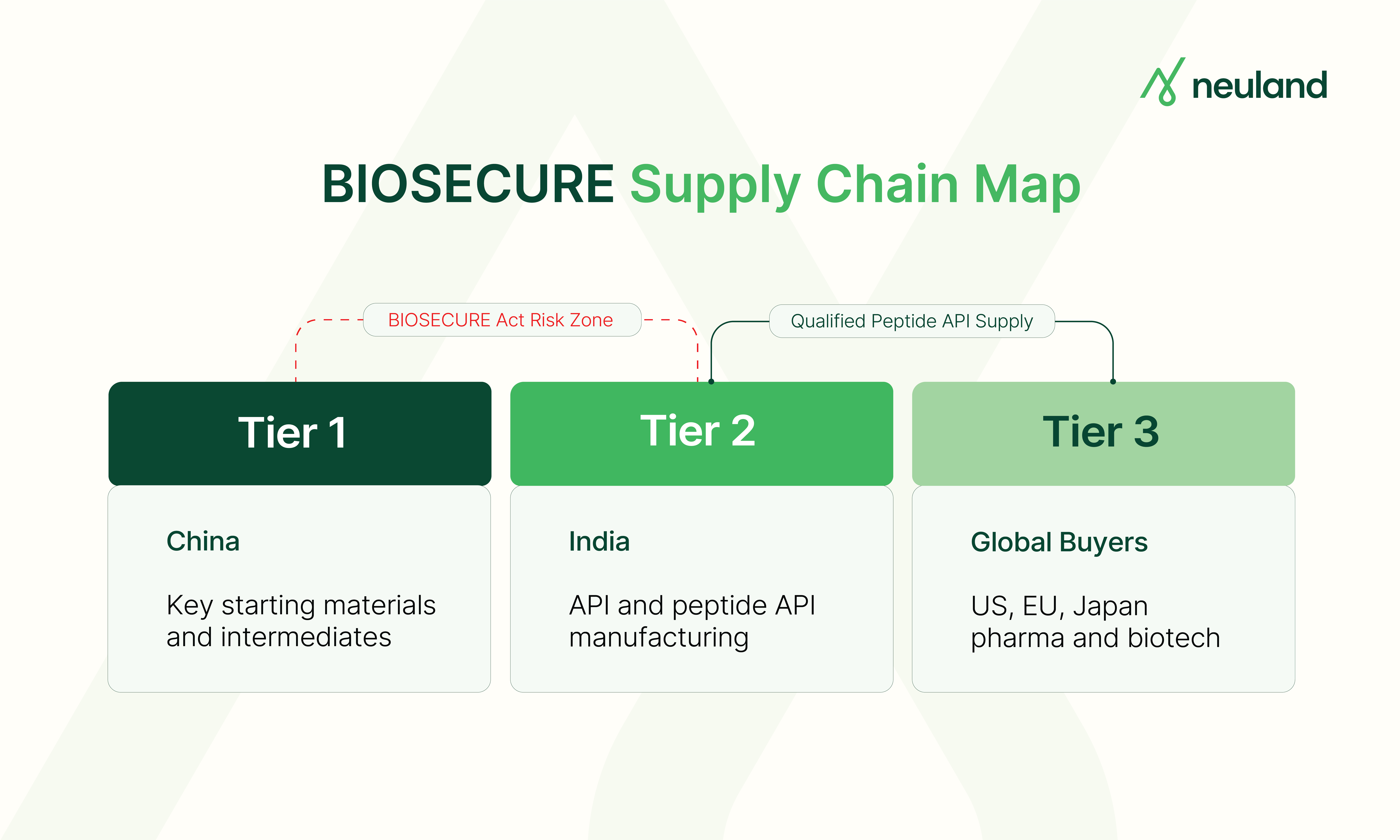
The BIOSECURE Act restricts US federal contracts with five named Chinese "biotechnology companies of concern," including WuXi AppTec and WuXi Biologics. Affected companies have until 2032 to transition.
The exposure is significant. A BIO survey found that 79% of biopharma companies have at least one contract with a Chinese CDMO. Roughly 75% of the intermediates used to manufacture APIs in India are sourced from China, creating a cascading dependency that procurement teams can no longer afford to overlook.
For an Indian peptide CDMO like Neuland, which operates its own intermediate synthesis and maintains LPPS capabilities for building blocks and fragments, this represents a structural advantage in supply chain resilience. But the broader message applies to every buyer: your peptide API sourcing strategy must now account for geopolitical risk as a core variable, not an edge case.
Exploring your peptide API sourcing options? Download Neuland's peptide capabilities brochure for a detailed look at synthesis methods, reactor capacities, and regulatory credentials.
What to Look for When Evaluating a Peptide API Supplier
Here is what experienced procurement, CMC, and R&D teams evaluate before committing to a partner.
Synthesis Capability and Method Flexibility
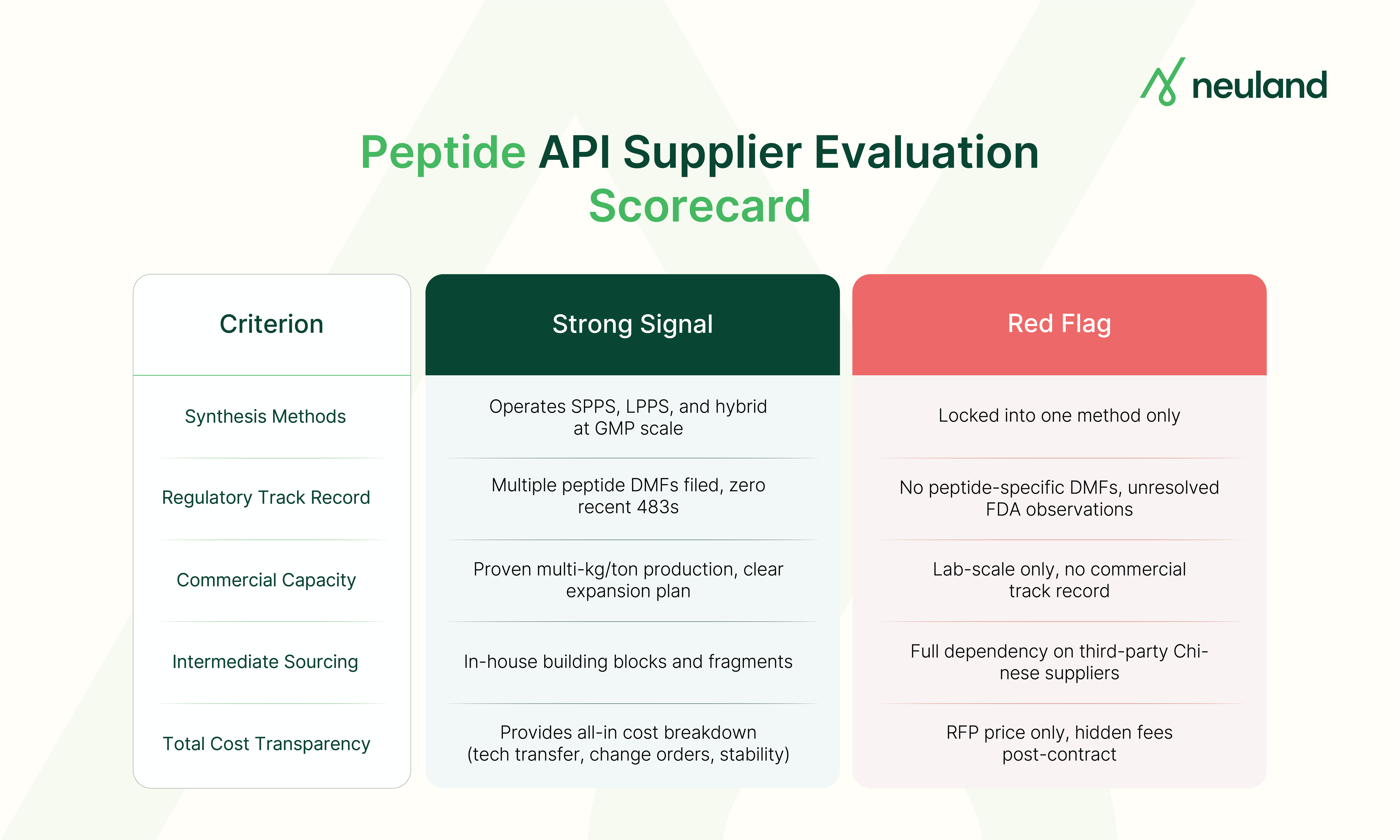
Peptide APIs are produced through three primary methods: solid phase peptide synthesis (SPPS), liquid phase peptide synthesis (LPPS), and hybrid approaches that combine both. The right method depends on sequence length, structural complexity, target purity, and required commercial volumes.
Key questions to ask:
- Does the supplier operate both SPPS and LPPS at the GMP peptide manufacturing scale?
- Can they handle cyclic peptides, disulfide bonds, and convergent synthesis strategies for longer sequences?
- Do they offer hybrid synthesis for peptides where neither SPPS nor LPPS alone is optimal?
A peptide API supplier locked into a single synthesis method is a limitation you will outgrow.
Regulatory Track Record and Filing Readiness
Your supplier's regulatory history directly affects your filing risk. Evaluate:
- How many DMFs have they filed for peptide APIs, and with which agencies?
- What is their FDA inspection record? Zero 483 observations in recent inspections is materially different from a facility with outstanding citations.
- Can they provide CMC documentation and regulatory support for IND, NDA, and DMF submissions across multiple markets (FDA, EMA, PMDA)?
Scale-Up Track Record and Commercial Capacity
The ability to synthesise a peptide at gram scale in a lab does not guarantee success at multi-kilogram or multi-ton volumes. Ask:
- What reactor capacities does the supplier operate for SPPS and LPPS?
- Have they demonstrated commercial-scale production for a peptide API, or are they projecting?
- What is their expansion roadmap if your program needs more capacity than what is currently available?
Supply Chain Transparency and Resilience
In a post-BIOSECURE landscape, supply chain visibility is non-negotiable:
- Where does the supplier source starting materials, amino acids, and intermediates?
- Do they manufacture peptide building blocks and fragments in-house, or depend on third-party suppliers?
- Can they document their supply chain map and demonstrate contingency plans for upstream disruptions?
How Neuland Supports Peptide API Programs
Neuland Laboratories brings 15+ years of peptide expertise across SPPS, LPPS, and hybrid synthesis, supporting sequences from 5 to 120 amino acids. Here is what that looks like in practice.
Commercial-Scale Capacity Coming Online
Neuland's new commercial peptide facility opens at its 17-acre Bonthapally campus in summer 2026. Module 1 provides 6,370 litres of combined SPPS and LPPS reactor capacity, with LPPS reactors from 250 L to 3,000 L and SPPS reactors up to 500 L. Three additional modules are planned as demand grows, with space designed for 2,000 L SPPS synthesisers and 5,000 L LPPS reactors in future phases.
This complements Neuland's existing 1,174,000 litres of API manufacturing capacity across three US FDA-approved facilities, supported by a dedicated R&D centre that enables seamless scale-up and rapid tech transfer.
Regulatory and Filing Track Record
Neuland has filed 846+ DMFs globally, supported 25 IND filings and 4 NDA filings on behalf of clients, with several more expected over the next two years. All three manufacturing facilities are inspected by the USFDA, EDQM, PMDA, and German Health Authorities. Neuland has filed its first US DMF for a peptide API (Difelikefalin), with a GLP-1 analog DMF in the pipeline.
Proprietary Technology Differentiators
Two innovations strengthen Neuland's peptide contract manufacturing proposition:
- Molecular Hiving™ (developed with Jitsubo Co.): Uses patented hydrophobic tags to control peptide solubility during synthesis. Coupling and deprotection reactions occur in homogeneous solution, followed by precipitation and filtration to remove excess reagents. The result: high yields and high purity without column chromatography at every step.
- Preparative RP-HPLC: Neuland's proprietary reversed-phase HPLC purification technique enables cGMP-grade purification of complex peptide APIs that cannot be purified through conventional crystallisation.
Supply Chain Resilience
Neuland's LPPS capabilities extend to the in-house production of peptide building blocks, fragments, and intermediates. This vertical integration reduces dependency on third-party suppliers and strengthens supply chain resilience for complex peptide programs, a differentiator that matters significantly in the BIOSECURE era.
Five Questions Every Buyer Should Ask a Peptide API Manufacturer
Before you sign, pressure-test your shortlisted suppliers with these five questions:
- What synthesis methods do you operate at commercial scale? A supplier offering SPPS, LPPS, and hybrid approaches gives you optionality. One locked into a single method limits your program.
- How many peptide API DMFs have you filed, and with which agencies? Filing history is the strongest proxy for regulatory readiness. Multi-agency filings (FDA, EMA, PMDA) reduce friction when you file across markets.
- What is your current reactor capacity, and what does your expansion plan look like? In a capacity-constrained market, knowing the supplier's roadmap is as important as knowing their current state.
- Do you manufacture intermediates and building blocks in-house? In-house intermediate capability reduces upstream supply risk and gives you more control over your peptide API supply chain.
- What is your total cost of ownership beyond the RFP price? Factor in tech transfer fees, analytical development charges, change orders, and stability storage costs. Industry estimates suggest the RFP price covers only 60–70% of the actual relationship cost.
FAQs
What is a peptide API?
A peptide API is the active pharmaceutical ingredient in a peptide-based drug. It is the compound responsible for the therapeutic effect, typically consisting of 2 to 50+ amino acids synthesised through chemical methods (SPPS, LPPS, or hybrid) rather than recombinant production.
How do I evaluate a peptide API supplier for GMP manufacturing?
Start with regulatory credentials: FDA inspection history, DMF filings for peptide APIs, and multi-agency approvals. Then evaluate synthesis capabilities (SPPS, LPPS, hybrid), commercial-scale reactor capacity, and their track record in taking peptide programs from development through validated commercial production.
How is the BIOSECURE Act affecting peptide API sourcing?
The BIOSECURE Act restricts US-funded companies from contracting with five named Chinese biotech entities by 2032. Since roughly 75% of Indian API intermediates come from China, buyers are now prioritising peptide API suppliers with in-house intermediate manufacturing and transparent, well-mapped supply chains.
What is the difference between custom peptide synthesis and catalogue peptide supply?
Custom peptide synthesis involves developing a bespoke manufacturing process for a specific peptide API, including route development, process optimisation, analytical method validation, and regulatory filing support. Catalogue supply provides standard, off-the-shelf peptides for research use. Clinical and commercial programs require custom synthesis.
How long does it take to source and qualify a new peptide API supplier?
Qualification timelines vary, but for a GMP peptide manufacturing partner supporting clinical or commercial supply, expect 6–12 months. This covers initial assessment, site audit, technical evaluation, quality agreement negotiation, and potentially a technology transfer if switching from an existing supplier.
Planning a peptide API program? Neuland works with pharma and biotech companies worldwide, from early feasibility through commercial-scale peptide manufacturing. Request a capability discussion with our peptide team.
