
Why Global Pharma Chooses Neuland for Complex API Manufacturing
Your molecule made it through discovery. The chemistry works at bench scale. Now you need a manufacturing partner who can take it from milligrams to metric tons without compromising purity, yield, or regulatory standing. That is where most complex API manufacturing programs run into trouble. Multi-step synthesis, chiral intermediates, highly potent compounds, peptide APIs requiring solid-phase peptide synthesis: these molecules demand infrastructure, containment, and process chemistry depth that few organizations can build in-house.
The small molecule API CDMO market was valued at $46.59 billion in 2025 and is projected to nearly double by 2033. Outsourcing is a given. The real question is whether your partner has the technical range and regulatory credibility to de-risk your program from pre-IND through commercial supply. Here is what that partnership looks like in practice.
What Makes API Manufacturing "Complex"
Not every molecule needs the same level of manufacturing sophistication. Complexity typically shows up in one or more of the following ways:
1. Hazardous or sensitive chemistry
Molecules requiring cryogenic reactions, high-pressure hydrogenation, bromination, or multi-step synthesis with reactive intermediates need both specialized equipment and deep process chemistry experience to execute safely at scale.
2. High-potency compounds
HPAPIs require engineered containment at every stage of synthesis, drying, milling, and analysis. Occupational exposure limits can go as low as 5 ng/m³, making an HPAPI CDMO's containment infrastructure a non-negotiable selection criterion.
3. Peptide APIs
Whether produced through SPPS, LPPS, or hybrid methods, peptides introduce distinct challenges around sequence length, coupling efficiency, purification, and scale-up behavior that standard small-molecule facilities cannot address.
4. NCE APIs in early development
New chemical entities often arrive with evolving process parameters. The CDMO must handle ambiguity, iterating on the route while maintaining GMP compliance and building the data package regulators expect.
When a molecule falls into any of these categories, your manufacturing partner's capability becomes a direct variable in your program's timeline and commercial outcome.
Did you know? The BIOSECURE Act, passed in the US in September 2024, is accelerating the shift away from Chinese CDMO partnerships. Transferring a complex manufacturing process to an alternative site takes 18–36 months under optimistic conditions. Companies that have not started planning are now operating on a compressed timeline.
6 Reasons Pharma and Biotech Companies Choose Neuland
Process Development Built for Difficult Molecules
Complex API manufacturing needs more than reactor infrastructure. They need chemists who have solved similar problems before and API process development teams who can optimize routes for yield, purity, and impurity control at increasing scale.
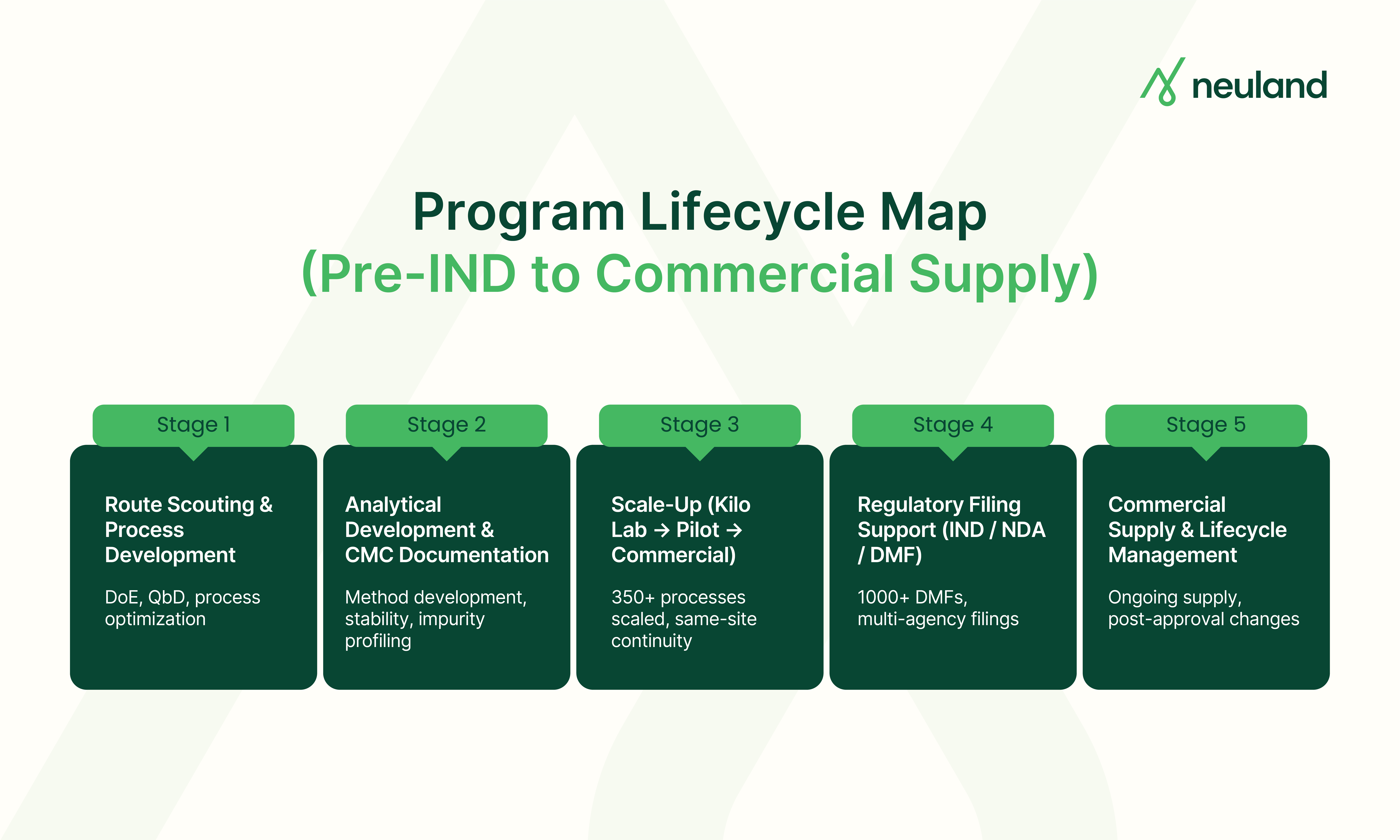
Neuland's process development capabilities span route scouting, optimization through Design of Experiments (DoE) and Quality by Design (QbD), and sequential scale-up from kilo lab to commercial production. The team has demonstrated expertise across advanced chemistries including cryogenic reactions, hydrogenation, and bromination.
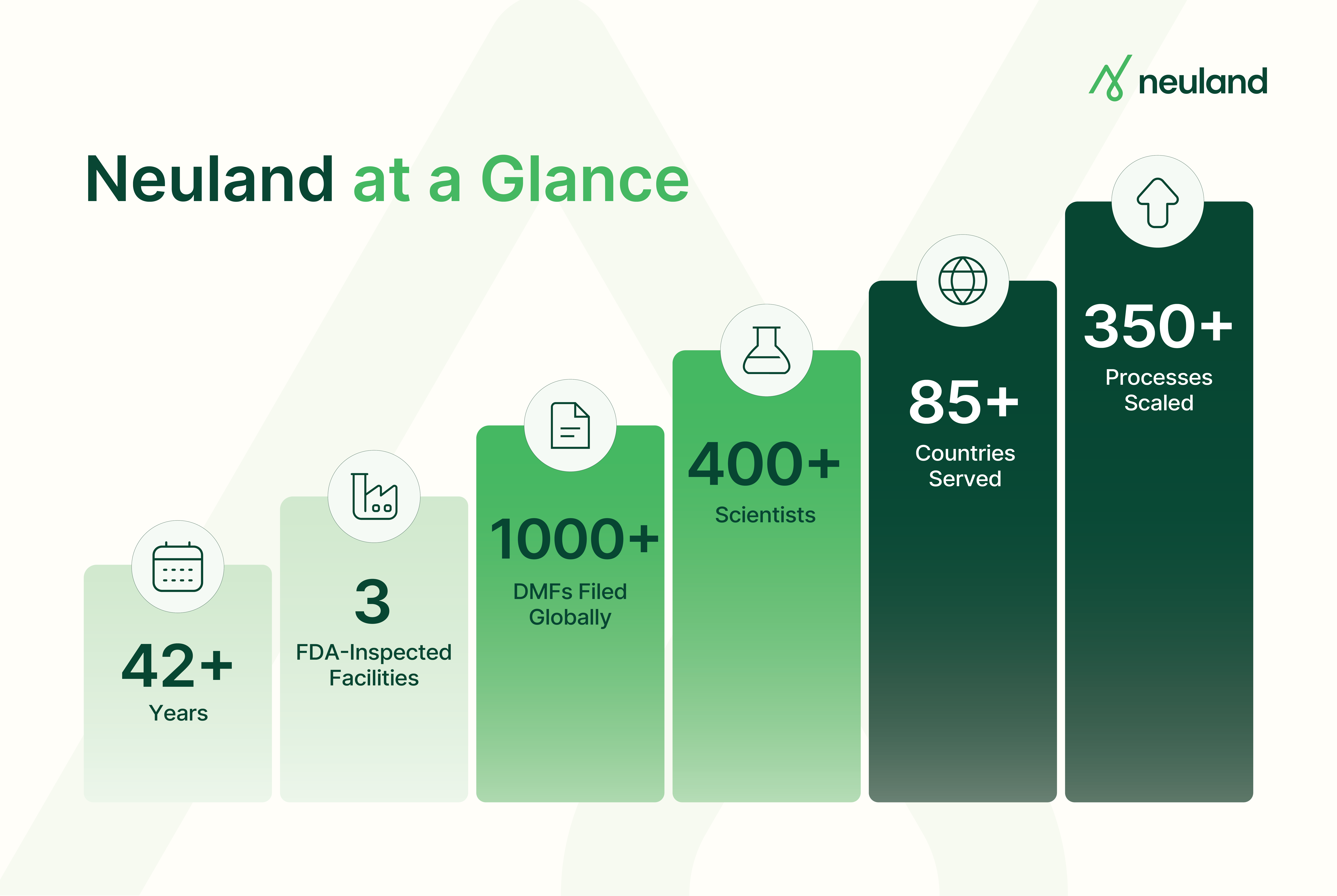
Neuland has scaled up over 350 processes from gram to commercial volumes, supporting 75+ APIs across 10+ therapeutic areas.
Peptide API Manufacturing from Clinical to Commercial Scale
GLP-1 receptor agonists have reshaped global demand for peptide capacity. Prescriptions for GLP-1 therapies have grown at roughly 38% annually, and the pressure on SPPS infrastructure has pushed lead times at major peptide API manufacturers to 18–24 months.
Neuland's new commercial peptide facility opens in summer 2026 at its Bonthapally campus. Module 1 provides 6,370 litres of combined SPPS and LPPS reactor capacity, with LPPS reactors from 250 L to 3,000 L and SPPS reactors up to 500 L scale.
The facility features DCS-based automation with eBMR integration, multi-column prep-HPLC systems, and commercial-scale lyophilizers. Three additional modules are planned as demand grows, with Module 1 already securing approximately $30 million in firm commitments.
This builds on 15+ years of peptide expertise spanning 5 to 120 amino acid sequences using solution-phase, solid-phase, and hybrid synthesis. Neuland has filed its first US DMF for a peptide API (Difelikefalin), with a GLP-1 analog DMF in the pipeline. For companies evaluating a peptide API manufacturer with genuine commercial-scale commitment, that trajectory matters.
A Regulatory Track Record That De-Risks Your Filing
A clean inspection history is the most reliable quality signal a CDMO can offer. FDA CDER warning letters jumped 50% in FY2025, with most targeting manufacturing facilities that failed GMP inspections. Every warning letter your CDMO avoids is risk your program does not carry.
Neuland operates three facilities inspected and approved by the USFDA, EDQM, PMDA, and German Health Authorities. The R&D facility has been inspected by the USFDA without observations. Across these sites, Neuland has filed 846+ DMFs globally and supported multiple NDA filings on behalf of clients, with several more expected over the next two years. For programs targeting the US, Europe, and Japan simultaneously, that multi-agency DMF filing footprint reduces friction at every regulatory milestone.
Technology Transfer That Actually Stays on Track
Roughly 50% of technology transfers experience quality problems. The most common culprits: equipment mismatches between sending and receiving sites, analytical method gaps, and what the industry calls the "contract-to-execution gap," where the project team inherits a scope that does not match what business development promised.
Neuland addresses this structurally. Process development and commercial manufacturing happen on the same campus, so the risk of site-to-site transfer failures drops significantly. The team that develops your process is the team that scales it.
Integrated Analytical Development and CMC Support
Drug developers working on NCE APIs need more than synthesis. They need analytical method development, validation, ICH stability studies, impurity profiling, and CMC documentation, all coordinated alongside manufacturing.
Neuland provides end-to-end analytical development integrated with its manufacturing operations, supporting IND, NDA, and DMF filings with the data packages and CMC support regulators expect. Having these capabilities under one roof eliminates the coordination overhead and timeline risk of managing separate vendors for chemistry and analytics.
Planning a complex molecule program? Neuland is a pharma and biotech CDMO, working from pre-IND through commercial supply. Talk to our team about your molecule.
What Decision-Makers Should Evaluate in a Complex API Manufacturing Partner
Every CDMO will say they can handle your molecule. Here is how to pressure-test that claim:
- Ask about scale-up history: How many processes have they taken from kilo lab to commercial? What types of chemistries? A CDMO with 350+ scaled processes has pattern recognition that reduces batch failures and surprises at volume.
- Check inspection outcomes, not just approvals: An FDA-approved facility that received a 483 with ten observations is materially different from one inspected without observations. That distinction matters for your supply chain resilience.
- Evaluate lifecycle management capability: Your API program does not end at launch. Post-approval changes, ongoing stability monitoring, and supply continuity all need a partner who plans beyond the first commercial batch.
- Look at total cost, not just the RFP price: Industry estimates suggest the RFP sticker price covers 60–70% of what the CDMO relationship actually costs. Technology transfer fees, raw material markups, change orders, and internal management hours make up the rest. A CDMO that integrates development, manufacturing, and analytics at one site compresses those hidden costs considerably.
Quick Note To End With
Neuland Laboratories has spent four decades resolving industry questions and providing complex API manufacturing solutions. With 400+ scientists working across process development and analytical chemistry, Neuland supports complex API manufacturing programs for pharma and biotech companies in 85+ countries.
Ready to move your complex API program forward? Neuland partners with pharma and biotech companies worldwide, from custom API manufacturing through commercial-scale supply. Get in touch to discuss your next project.
FAQs
1. What is complex API manufacturing?
It involves the synthesis of drug substances that require advanced chemistry, specialized containment, or non-standard equipment, such as multi-step synthesis, HPAPIs, or peptide APIs.
2. Why do pharma companies outsource complex API production to CDMOs?
Building the infrastructure for complex chemistry, containment, and peptide synthesis costs hundreds of millions. The right CDMO provides that access without the capital burden or timeline needed to build it internally.
3. What should I look for when evaluating a peptide API manufacturer?
SPPS and LPPS reactor capacity, regulatory filings for peptide APIs, demonstrated experience across a range of peptide lengths, and a credible pathway to commercial-scale production.
4. How does Neuland support CMC documentation and regulatory filings?
Through integrated analytical development, ICH stability studies, impurity profiling, and direct IND, NDA, and DMF filing support across US, European, Japanese, and other global markets.
5. How long does technology transfer for a complex API typically take?
Complex small-molecule transfers generally take 6–12 months when well-planned. Poorly executed transfers can stretch far longer and introduce quality failures that set programs back significantly.
