Meet Neuland at CPHI India 2026 | Hall 2, Booth 2D38 | Yashobhoomi Convention Centre, New Delhi | 24-26 November 2026 Schedule a Meeting
Meet Neuland at CPHI India 2026 | Hall 2, Booth 2D38 | Yashobhoomi Convention Centre, New Delhi | 24-26 November 2026 Schedule a Meeting

A CDMO regulatory track record shows how regulators have inspected a manufacturer’s sites and what they found. It becomes your concern once you outsource, because your drug application names that CDMO as the API manufacturer. Regulators then assess its site during review, so an unresolved finding there can stall your approval. Checking the record before signing reveals such findings, while another partner is still an option.
A strong CDMO regulatory track record belongs to API sites that pass inspections by several regulators, year after year. Each regulator applies its own standards, so passing several of them shows the quality system holds up under different scrutiny. That’s why when you review a CDMO’s history, look for these four traits:
These traits matter early in pharmaceutical API supplier qualification, because a CDMO’s status travels into your own filing. FDA’s FY2025 quality report shows what happens when that status is poor. Of nearly 10,000 FY2024–2025 submissions needing a facility assessment, 28% received a complete response letter. Facility withholds caused 43% of those letters. More than half of them traced back to sites already classified as official action indicated (OAI) or potential OAI. That makes inspection history an early filter when choosing the right CDMO partner.
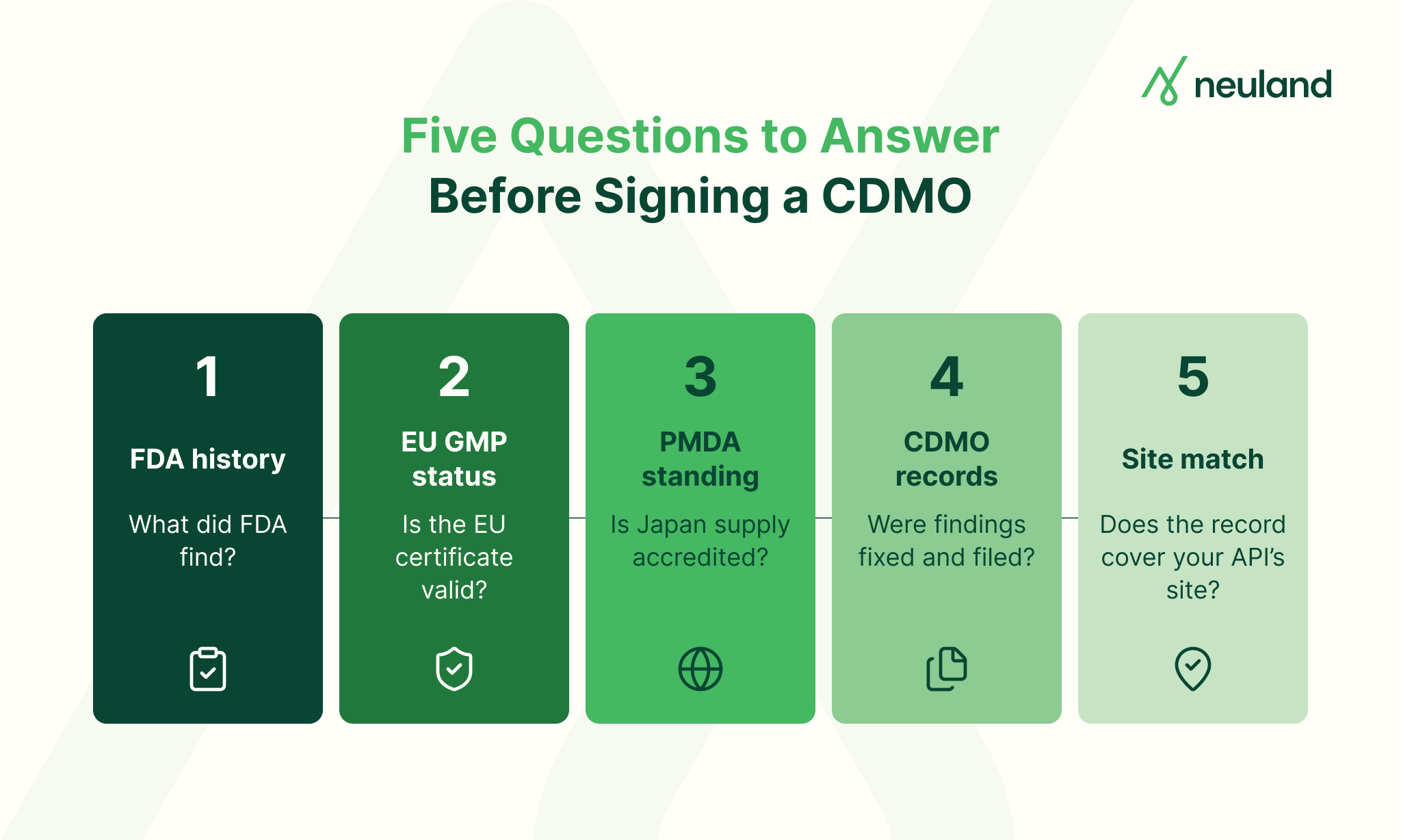
You verify a CDMO's regulatory track record in two stages: Public regulator records first, then the CDMO’s own files. Public records tell you what each regulator found at the site and how it acted. The CDMO’s files then explain how the site fixed those findings. Together, the five steps below confirm whether the record applies to your specific product.
FDA records are the best starting point because they are public and searchable by site. Search the FDA Data Dashboard using the site name or its FDA Establishment Identifier (FEI). The dashboard lists each inspection by date with its final classification. Each classification shows how FDA judged the site against ICH Q7, its current good manufacturing practice guidance for APIs.
Each inspection closes with one of three outcomes:
Of the 1,309 inspections FDA classified in FY2025, 60% were closed as VAI and 18% as OAI. A VAI history is therefore common for an active manufacturing site. An OAI is less frequent and more serious. So, when you find an OAI, these FDA sources show what followed and what triggered it:
EudraGMDP is EMA’s public database of GMP inspection outcomes for sites supplying the EU. National authorities across the European Economic Area upload each result, so the record comes directly from the inspectors. This lets you verify CDMO GMP certification yourself, without relying on copies the CDMO provides.
A search by site name returns one of two document types:
Some API sites also supply the EU through a Certificate of Suitability (CEP) issued by EDQM. A GMP non-compliance finding can lead EDQM to suspend that CEP, so confirm its status as well.
Finding no certificate at all needs context before it raises concern. EU authorities inspect API manufacturers based on risk, so some sites have not had an EU inspection yet. In that case, ask which regulator last inspected the site and request that outcome instead. For supply to emerging markets, also ask whether the site holds WHO-GMP certification from its national regulator.
If Japan is a target market, check the site’s PMDA standing before you sign. Any foreign facility supplying Japan needs an Accreditation of Foreign Manufacturer from Japan’s health ministry. PMDA supports that decision by examining the facility’s buildings and equipment. Once a product enters review, PMDA also inspects the site against Japanese GMP, either on-site or by desk review.
Public access to these outcomes is limited, so the CDMO’s records become your main proof. Under PMDA’s process for foreign manufacturers, the CDMO receives a copy of each result report. That gives you two documents to request:
After the public checks, ask the CDMO for the files that show how each finding was resolved. So, request the records from the last three to five years:
Filing history then completes the site’s API manufacturing regulatory history by showing what regulators have accepted. FDA’s public Drug Master File list is the place to start, since it shows file status. Active Type II DMFs on that list suggest the CDMO has supported drug substance filings before. For Europe or Japan, CDMO regulatory support for global filings should also cover their master files. Then ask for examples of CDMO support for DMF filing, including Letters of Authorization that let your filing reference it.
A clean record protects your filing only when it belongs to the facility making your API. Regulators inspect each site separately, so one CDMO can hold different records across sites. Before relying on a record, match its FEI number and EU certificate address to the proposed facility. If they match, confirm that recent inspections also covered the production block assigned to your product.
Two situations can still leave that block unverified. After an acquisition, registrations may lag the ownership change, so ask when they were updated. A new block may lack inspection history, so ask which application will trigger its first inspection.
A CDMO needs phase-appropriate GMP manufacturing and filing support that grows with your program at one site. Regulators expect more at each stage, so the CDMO regulatory track record you verified must hold throughout.
Those capabilities build phase by phase:
Multi-market supply adds regulatory work at this stage, since each region uses its own master file format. The US relies on DMFs, while the EU accepts Active Substance Master Files or CEPs. Japan runs a separate Master File system, so the CDMO needs working experience with all three. Its approach to phase-appropriate development shows whether those filings stay consistent across markets.
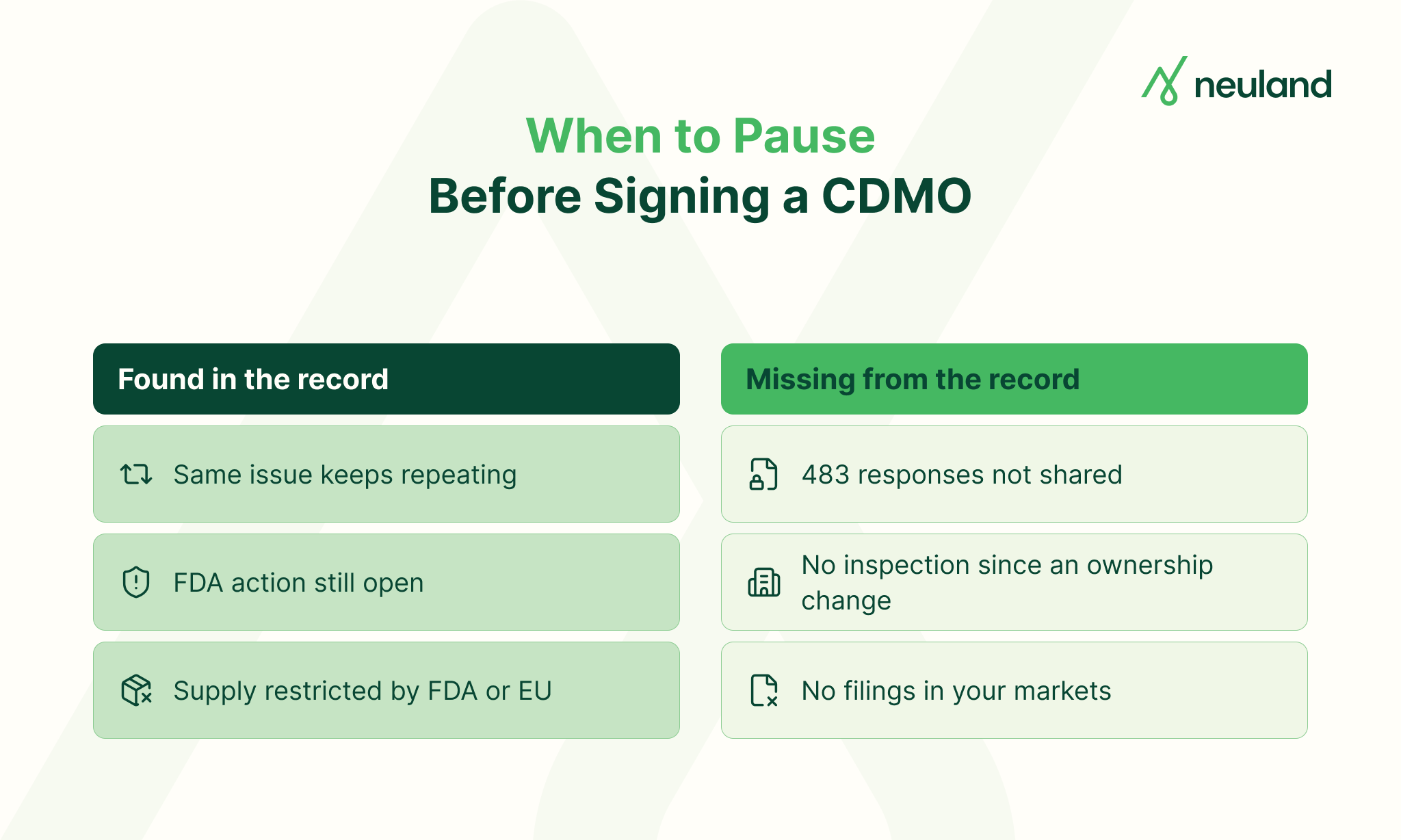
Pause a CDMO contract if verification reveals any of these six warning signs:
A CDMO due diligence checklist should pair each regulatory check with its source and the evidence to file. Use this table to confirm a CDMO regulatory track record before signing:
| Step | What to Check | Where to Check | What to Keep on File |
|---|---|---|---|
| 1. FDA history | Inspection results and any warning letters | FDA Data Dashboard and warning letter database | Dated search results |
| 2. EU GMP status | A valid GMP certificate and no non-compliance statement | EudraGMDP | Certificate copy |
| 3. PMDA status | Current accreditation and latest inspection result | Documents from the CDMO | Accreditation and report copies |
| 4. CDMO records | Closed observations and active DMFs | CDMO files and FDA DMF list | Inspection reports and DMF numbers |
| 5. Site match | The inspected site is the one in your proposal | FDA and EU records | Matching site ID and address |
A CDMO welcomes scrutiny when its record stays consistent across regulators and inspection cycles. Neuland Laboratories meets that standard with more than 40 regulatory inspections passed worldwide. Those inspections have come from the US FDA and European authorities, as well as Japanese and Korean regulators. WHO has also inspected Neuland’s operations, which matters for buyers supplying emerging markets.
Neuland sustains that record through a fixed internal audit schedule. Corporate quality assurance audits the whole organization once a year. In between, each site’s QA head leads twice-yearly self-inspections with cross-functional experts. As a result, buyers can test Neuland’s CDMO regulatory track record against every verification step above.
Want inspection records that hold up under audit?
Neuland’s manufacturing data sits in 21 CFR Part 11-compliant systems with electronic batch records. That keeps every batch record traceable when auditors review the site. Ask Neuland’s team to walk you through its batch record controls and see how they support your audit.
Successful biotech companies evaluate API development partners by running regulatory checks at set points in the deal. They search public inspection records while shortlisting, before sharing anything confidential. Once a confidentiality agreement is signed, they request inspection reports and CAPA records. A quality audit then confirms those findings before the purchase order goes out.
A CDMO’s regulatory status should be rechecked at each supplier requalification and whenever the site changes. Three events call for an immediate recheck:
Recording each recheck gives you the audit trail that quality risk management in the pharmaceutical industry expects.
Pharma companies reduce risk in small molecule API manufacturing by qualifying a second API site. If one facility receives an adverse inspection outcome, supply can shift to the other. A quality agreement then adds early warning. It can require the CDMO to report inspection outcomes promptly and give advance notice of process changes. That notice gives you time to update your filings.
A peptide CDMO is commercially ready when its commercial-scale facility has passed a GMP inspection. Development labs may have separate inspection records, so confirm the inspection covered the commercial line itself. During that inspection, regulators check how the site controls peptide-specific impurities, such as truncated or deleted sequences. With those controls in place, active master files in your target markets confirm the site can support your filing.