Meet Neuland at CPHI India 2026 | Hall 2, Booth 2D38 | Yashobhoomi Convention Centre, New Delhi | 24-26 November 2026 Schedule a Meeting
Meet Neuland at CPHI India 2026 | Hall 2, Booth 2D38 | Yashobhoomi Convention Centre, New Delhi | 24-26 November 2026 Schedule a Meeting

Each vendor handoff in active pharmaceutical ingredient (API) development adds weeks of rework and raises the chance of failed batches. The new vendor must re-verify methods and run trial batches, none of which appears on a quote. An integrated CDMO, or contract development and manufacturing organization, keeps the process with one team throughout. Its scope runs from route scouting to commercial API manufacturing, excluding drug product work.
An integrated CDMO is a single organization that develops and manufactures an API from first route to commercial supply.
In a multi-vendor model, a company assigns each stage to a different specialist. A typical chain starts with a research lab that scouts the route. A development CDMO then refines that route into a repeatable process. Finally, a contract API manufacturing site scales it to commercial volumes. This structure lets a company price and fund each stage separately.
An integrated CDMO replaces those moves with internal transfers under one quality system. The table below shows where this difference appears in practice.
| Factor | Integrated CDMO | Multi-vendor model |
|---|---|---|
| Process ownership | One team holds the process from route scouting to commercial supply | Ownership changes at each vendor boundary |
| Technology transfers | Internal moves between units, under one quality system | External moves between companies, each needing its own transfer package |
| Analytical methods | Developed and validated within one quality system | Often re-verified at each new lab before release testing |
| Chemistry, manufacturing and controls (CMC) data | Drawn from one set of records | Compiled from records held by several vendors |
Vendor handoffs happen at the points where an API moves to its next stage under a different company. A typical small molecule project has five of these points, mapped in the table below.
| Handoff Point | What the New Company Has To Rebuild | Effect on Time | Main Risk | What Changes Under One Organization |
|---|---|---|---|---|
| Route scouting lab → process development CDMO | Why the chosen route won, and which routes already failed | Feasibility runs repeated to confirm the route | A rejected route or known safety hazard returns | Route chemists answer process questions directly |
| Process development CDMO → external analytical lab | How each method was built and what early samples showed | Methods rechecked before they can test release batches | The two labs report different purity results | Methods are refined alongside the process |
| Development methods → good manufacturing practice (GMP) methods | Data showing how each method holds up under small changes | Side-by-side testing to prove results match | Batches fail because methods differ, though the API meets specification | The same lab validates the methods it developed |
| Kilo lab and clinical supply → commercial manufacturer | Undocumented process know-how, such as why a temperature was set | Engineering batches before the first commercial GMP batch | New impurities appear in larger, different equipment | Development scientists stay on the project during scale-up |
| All vendors → regulatory CMC authors | The context behind data generated at several sites | Query rounds with vendors who have moved on | Process descriptions conflict across filing sections | Filings draw on one set of records |
A CDMO technology transfer between vendors costs you in two ways: repeated work and added oversight. Repeated work comes first, since the new vendor must prove the process before running it. That proof appears on the new vendor’s invoice as:
An integrated CDMO typically covers the full scope with one quality agreement and one data system.
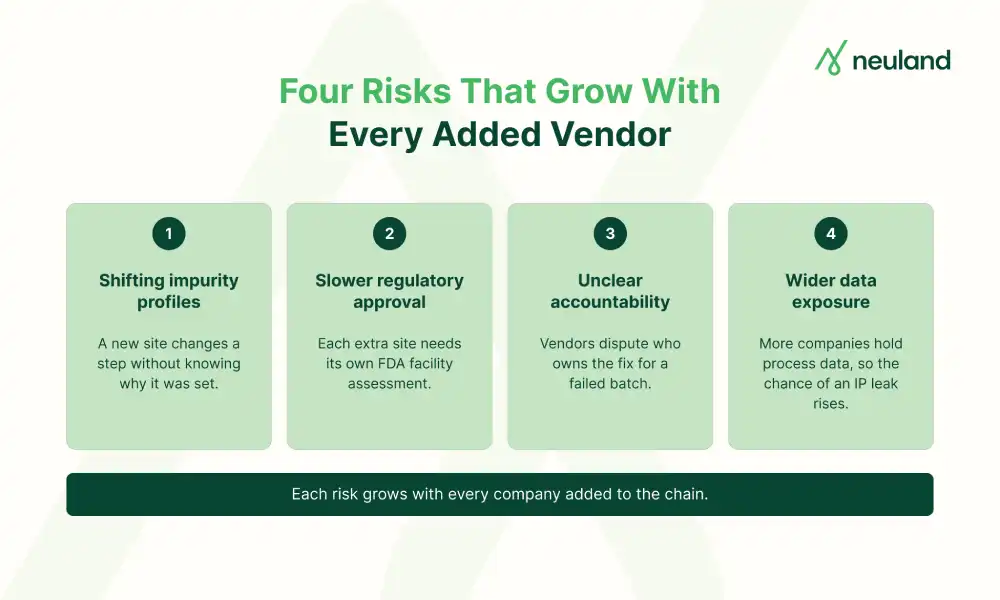
Using multiple vendors for API development raises five risks. Most of them stay hidden until a batch fails or a filing stalls. Here is where each risk comes from:
Pharma companies reduce risk in small molecule API manufacturing by limiting how many organizations touch the process. Two common approaches achieve this:
Handoffs are only one source of delay, so supply and capacity planning also matter when reducing small molecule API delays.
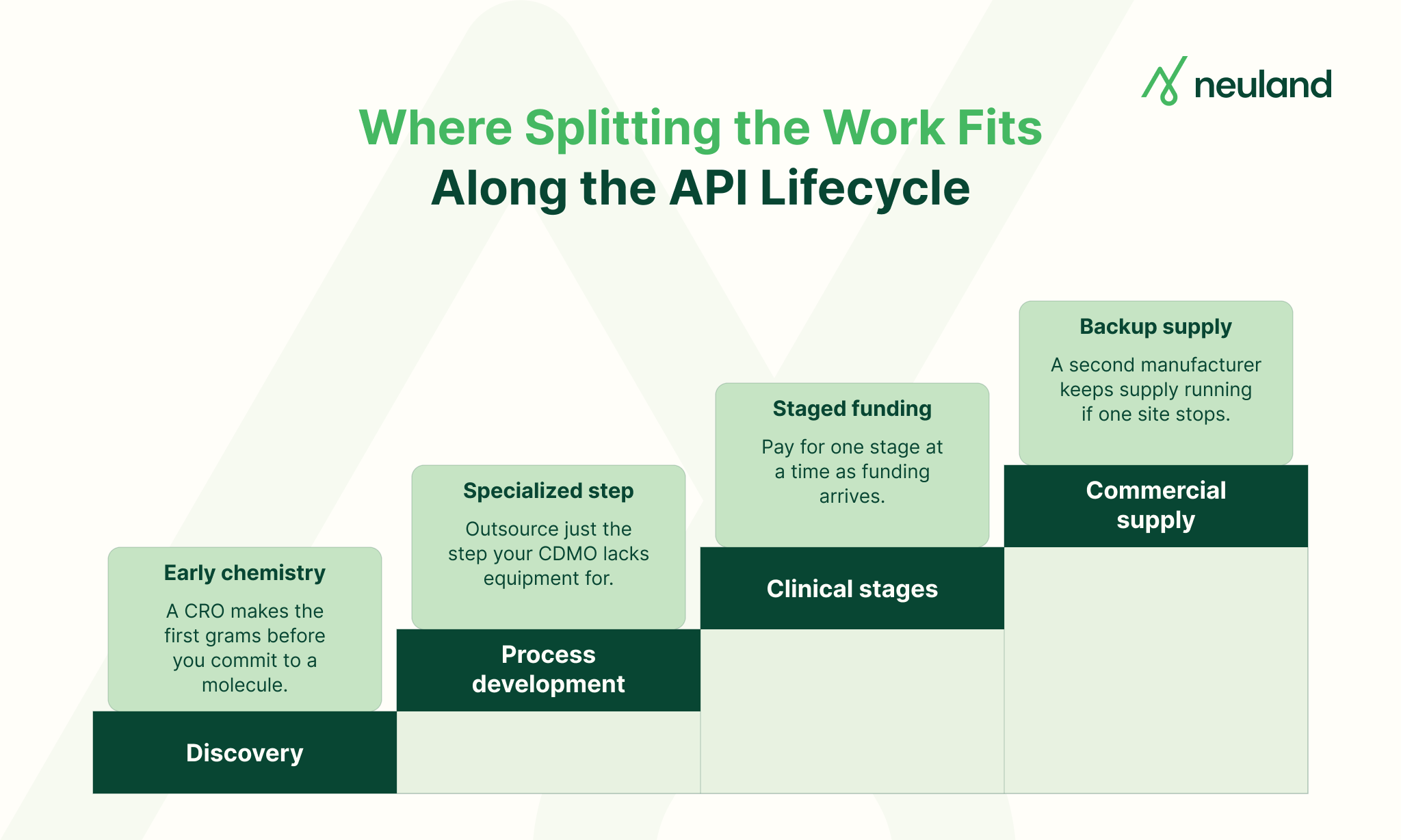
A multi-vendor approach makes sense for API development when a second vendor meets a need the main CDMO cannot. Each situation below names that need and why splitting the work is justified:
An integrated CDMO offers all three when each stage runs in-house and has a delivery record with other clients. However, price comparisons of API development services can mislead. So, before shortlisting an end-to-end CDMO, check what each stage looks like in practice:
Neuland Laboratories works as an integrated CDMO from route scouting to commercial API manufacturing. Because every stage sits in one organization, the handoffs in the Handoff Cost Map can stay internal. Regulatory CMC work also stays in-house, sized to each clinical stage through phase-appropriate development.
That clinical-stage work draws on more than 150 innovator new chemical entity (NCE) programs Neuland has supported. Once a molecule reaches commercial scale, production moves to Neuland’s three cGMP-certified facilities in India. Across those operations, Neuland has completed 18 FDA inspections with zero critical observations. That record matters, since one site with compliance issues can stall an entire filing.
Planning how many vendors your next API needs? Neuland has supported more than 500 customers across 80+ countries from early development to commercial supply. Discuss your API project with our team.
A vendor handoff typically adds several weeks to several months to API development. Simple, well-documented processes fall at the shorter end of that range. Complex routes with tight impurity limits take longer, since the new site must repeat method checks and trial batches.
A technology transfer package gives the receiving site everything it needs to run your process as intended. Here is what a complete package usually contains:
Using one CDMO is usually the better choice for small molecule API development that runs stage by stage. Your process stays with the same team, so knowledge and accountability do not change hands. Several vendors still make sense when one step needs specialist chemistry, or when commercial supply needs a backup source.
Before you structure your vendor chain, asking these five questions early can prevent costly rework later: