Meet us at Tides Europe 2026, Stand No. 805, Nov 3-5, RAI Amsterdam, Netherlands Schedule a Meeting

The right small molecule API partner for clinical trials moves fast and works in small batches. Clinical programs rarely follow a fixed plan. The dosing cohorts change between phases, and protocols get amended as new data come in. A manufacturing partner suited to this stage keeps pace with those changes rather than forcing the trial to wait.
That responsiveness is what API research and development actually demands at the clinical stage, where speed to the first human trial matters more than unit cost. Commercial-scale manufacturers answer a later question: how to deliver steady, high-volume output once a molecule is approved. A clinical-stage API manufacturer answers an earlier one, built around small, fast, adaptable runs instead. Choosing the right partner comes down to matching that capability to the trial's actual pace.
Clinical trials and commercial manufacturing need different things from an API supplier. A Phase 1 trial usually needs only a small amount of small molecule API. Sometimes that amount is just a few kilograms. That batch also needs to move fast. The batch size can change as well, as the trial protocol shifts.
Commercial manufacturing works toward a different goal. It produces the same API in large, steady volumes for years. This kind of API process development and manufacture isn't built for quick turnarounds. A single small clinical batch doesn't fit that model well.
This difference shows up on the plant floor, too. Large reactors built for hundreds of kilograms aren't efficient for a 500-gram batch. Teams used to long, repeat production runs aren't set up to replan quickly. A small molecule CDMO built only for commercial work often treats a small clinical order as a disruption.
This gap matters more as more molecules enter trials each year. The FDA received 1,960 commercial and research IND applications in 2025. Each filing is a new molecule that will need API research and development support before it reaches a trial. That many molecules compete for the same clinical-stage capacity. A slow or inflexible supplier can hold up a trial at this stage. Choosing a partner built for clinical-stage work avoids that problem early.
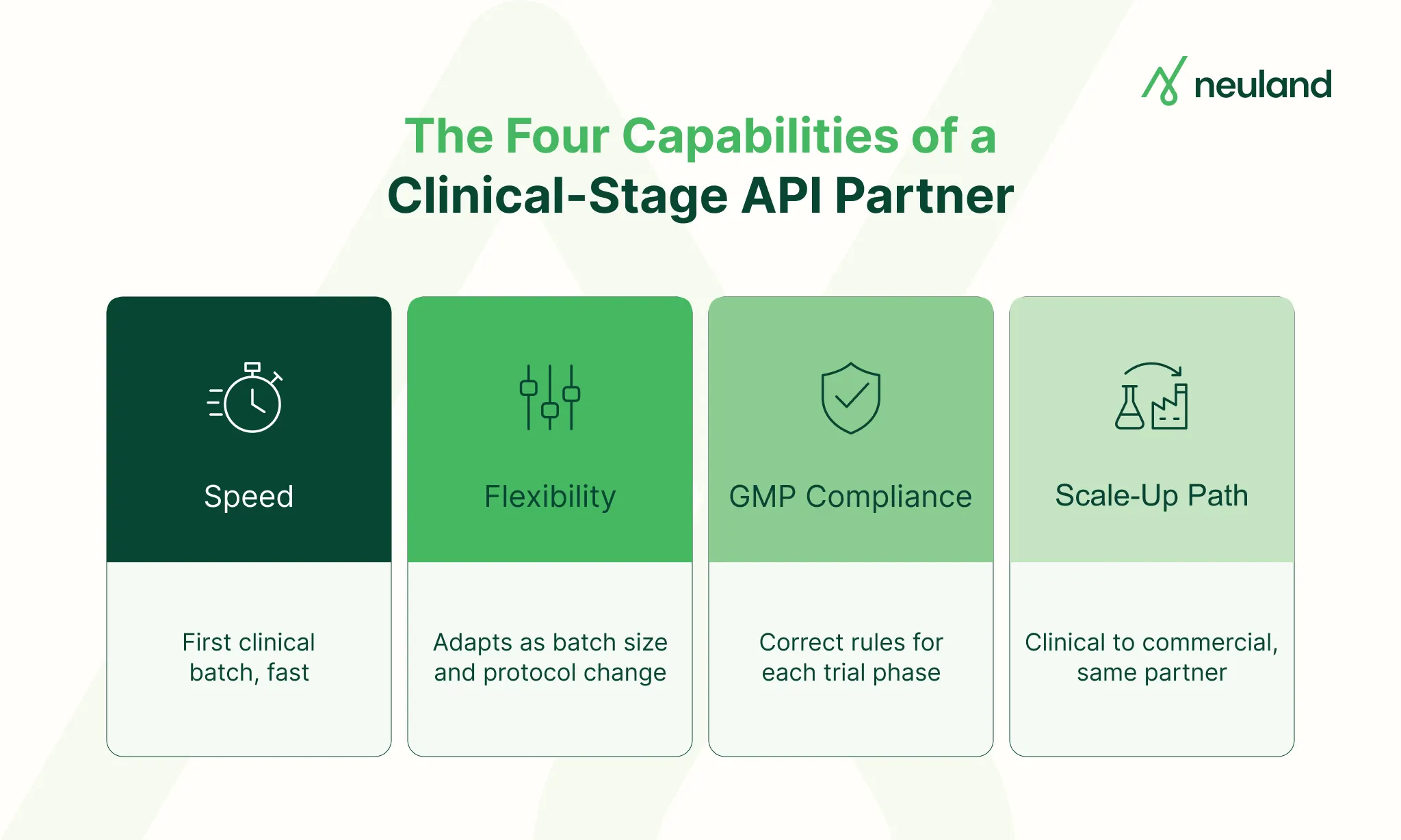
The best small molecule API partner for clinical trials brings four capabilities together:
Each capability solves a different risk in a clinical program. Missing any one of them can stall a molecule before it reaches a trial site.
Speed to the first clinical batch decides when a molecule can enter human testing. Toxicology studies and the IND filing itself depend on having GMP-ready material in hand. A slow route-to-batch timeline delays both and pushes back the entire trial start date.
This is why weeks matter more than incremental savings at this stage. A small molecule CDMO running dedicated small-scale reactors, instead of squeezing clinical work between large campaigns, keeps that timeline tight. Teams sourcing IND-enabling API supply should ask for a documented timeline from route confirmation through batch release, not a general estimate.
Flexibility means a manufacturer can resize a batch as the trial itself changes. Phase 1 and Phase 2 protocols often drop cohorts once early data comes in. A facility built around large, fixed production runs struggles to fill a sudden request for a few hundred grams.
That struggle shows up as a delay, instead of just as an inconvenience. Modular equipment and cross-trained staff let a clinical-stage API manufacturer absorb a protocol change without stopping to replan the whole schedule. Clinical trial API manufacturing works best when small, fast campaigns can run alongside larger ones at the same site.
Clinical material follows different quality rules depending on the trial phase. Under 21 CFR 210.2(c), most Phase 1 investigational drugs skip the detailed manufacturing rules in 21 CFR Part 211. The FDA instead checks that basic quality controls are in place, since Phase 1 involves a small number of patients. Phase 2 and Phase 3 material must meet stricter rules closer to commercial standards, because far more patients take the drug at that point.
A clinical-stage API manufacturer has to apply the correct rule set for each phase, instead of the same checklist every time. Using Phase 1 shortcuts on Phase 3 material can trigger findings during an FDA inspection. Using full commercial-level controls on a Phase 1 batch adds unnecessary cost and time. Before committing, ask a prospective small molecule CDMO which rules they apply at each trial phase, and how they adjust as a molecule advances.
Yes, a small-molecule CDMO with both commercial and clinical capacity can carry a molecule through its full lifecycle. Switching partners between those two stages triggers a second technology transfer. That transfer forces the new site to re-validate the process from scratch. It also means refiling documentation with regulators and retraining analytical methods locally.
Each of those steps adds months to an already tight program. A continuous partner removes that repeated cycle entirely. The clinical-stage process, once proven, carries forward instead of being rebuilt. This is why API process development and manufacturing capability across both scales matters more than either scale alone.
Evaluating this capability means asking specific questions. Confirm the facility has scaled prior molecules from kilo-lab batches to commercial reactors. Ask what reactor capacity exists at each scale, and whether the same analytical team supports both. A CDMO with continuous capacity turns scale-up into a planned step rather than a second sourcing decision.
Clinical-stage API pricing runs on a batch-based model, while commercial pricing runs on a volume-based model. Every clinical batch carries fixed costs for setup and analytical testing, regardless of size. Spread across a few hundred grams, those fixed costs push the per-kilogram price higher.
Commercial batches spread the same fixed costs across tons of output, so the per-kilogram price drops. The gap traces directly to production volume. Clinical batches simply haven't reached that volume yet.
A clinical-stage API manufacturer with transparent batch pricing helps teams budget accurately for each trial phase. Expect quotes tied to batch size and process complexity rather than a flat per-kilogram rate. Planning for multiple batches across Phase 1 and Phase 2 keeps that budget realistic.
The right questions while evaluating an API partner reveal whether they are built for clinical-stage work or retrofitted for it. Each question below targets one criterion that separates a genuine clinical-stage API manufacturer from a commercial-first supplier stretched to fit.
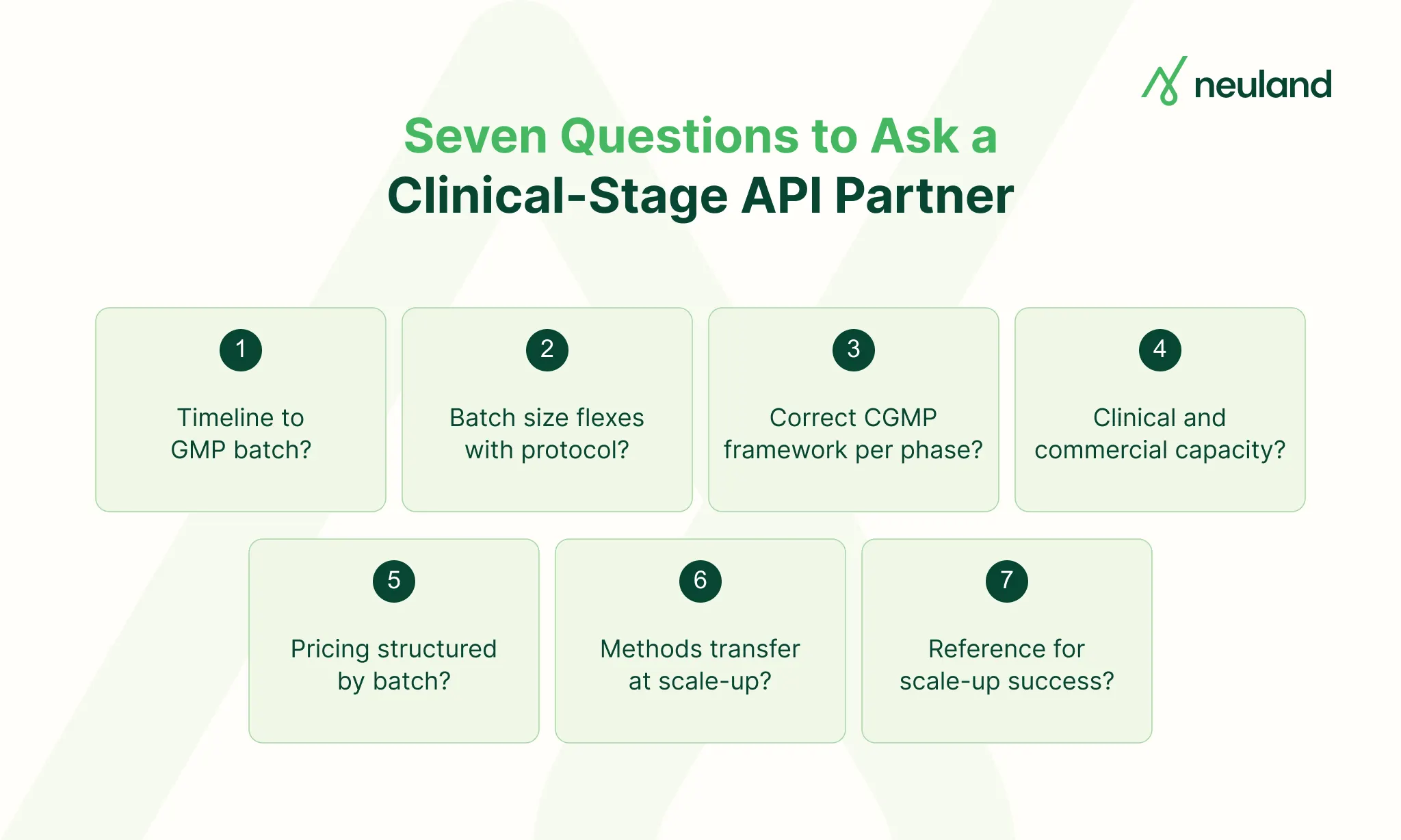
Run through all seven before signing an agreement. Together, they test speed, flexibility, regulatory fit, and long-term scalability, the four criteria on which this entire evaluation rests.
Some CDMOs answer all seven questions well. Neuland Laboratories is one example worth noting. It runs three cGMP-certified facilities. These support development and manufacturing from pre-clinical through large-scale Phase III material. A team of 400+ R&D specialists supports small molecule development from early-stage work onward. That same team carries a molecule through to commercial-scale supply. Tech transfer between those stages stays minimal by design. This kind of continuity is exactly what questions four and seven are testing for.
API research and development covers route scouting, process development, and analytical method-building before a molecule enters human testing. This stage confirms the synthesis route is reproducible and defines the quality tests that will track the molecule through every later phase.
Phase 1 trials typically need only one to three small batches, depending on dosing groups and trial duration. Batch count depends on a few factors:
A partner who can quote batch needs against the protocol helps a program plan more accurately.
Timelines for a clinical batch of small molecule API vary by molecule complexity and route readiness. Route confirmation through a GMP-ready batch typically spans a few months for straightforward molecules. Complex chemistries can extend that timeline further.
An IND filing needs Chemistry, Manufacturing, and Controls (CMC) documentation. It should cover the synthesis route and specifications, along with stability data for the API. For GMP small molecules, this typically includes:
Incomplete CMC documentation is a common cause of IND filing delays.