
Key Takeaways
- Continuous flow manufacturing for APIs runs connected reaction and purification steps nonstop, sometimes for months.
- Batch plants scale up with larger reactors, while continuous lines scale through longer runs or identical lines.
- The biggest benefits of continuous manufacturing are shorter production time and more consistent quality.
- Since November 2022, ICH Q13 has given the FDA and the EMA one framework for continuous manufacturing.
- With shared regulatory expectations in place, the next step for API producers is to prove a process at scale. Neuland supports this step through a 360-scientist R&D Centre backed by a pilot plant and a kilo lab. Its three manufacturing units provide 15 production blocks for commercial supply.
Continuous flow manufacturing for APIs makes a drug substance on one connected line, with no pauses between steps. Because material keeps moving, this approach can shorten production time and make hazardous reactions safer to run.
Yet most API producers have stayed with batch processing, partly because regulators lacked shared rules for continuous processes. In November 2022, ICH Q13 gave regulators such as the FDA and the EMA a common framework. With regulatory clarity in place, the choice now rests on each molecule's chemistry and the cost of new equipment.
What Is Continuous Flow Manufacturing in API Production?
Continuous flow manufacturing is a method of producing an API in which materials move through connected equipment without stopping. Pumps feed starting materials into the system at a fixed rate. As the material flows, it passes through each reaction and purification step in sequence. The finished API is collected at the end of the line, while new material keeps entering at the start. This allows a single line to run for long periods, sometimes several months.
In API synthesis, reactions usually run in flow reactors consisting of narrow tubes or coils. Because each tube holds little material, heat dissipates quickly, and the temperature remains stable. Reaction time is precisely set by the flow rate. When a single reaction runs this way, chemists call it flow chemistry.
Continuous flow manufacturing for APIs links several such reactions and their purification steps into one line. Many API processes combine continuous steps with conventional batch steps. ICH Q13's own example runs two reactions continuously, then mills the finished API in batch mode.
Continuous vs. Batch API Manufacturing: What's the Difference?
Batch and continuous processing differ in how material moves between production steps. In batch mode, a fixed quantity finishes one step completely before moving to the next. In continuous mode, all connected steps run at the same time as material flows through the line. This difference shapes how quality is controlled and how output grows in manufacturing for APIs.
The table below compares continuous manufacturing vs batch manufacturing across the factors that matter most:
| Factor | Batch Manufacturing | Continuous Manufacturing |
|---|---|---|
| How material moves | A fixed quantity completes each step before the next step begins. | Material flows through all connected steps simultaneously. |
| Quality control | Production pauses after key steps so analysts can test intermediates offline. | In-line sensors, such as on-line HPLC, measure quality while the material moves through the line. |
| Off-spec material | The affected batch may need rework or rejection. | The system diverts only the affected portion once a reading drifts outside set limits. |
| Scale-up | Output grows through larger reactors, which often means repeating process studies at each new scale. | Output increases with longer run times or by adding identical lines. The equipment size stays the same throughout. |
| Development data | Small-scale results may not fully predict behavior in larger vessels. | Development runs can use commercial-scale equipment, so data transfers more directly. |
| Reaction safety | Large reaction volumes increase the risk of heat-releasing reactions. | Small reacting volumes make it easier to control the heat. |
| Upfront investment | Lower where batch reactors are already installed. | Higher, due to new equipment and control systems. |
| Best suited to | Low volumes and multiproduct plants. | High, steady volumes and fast or heat-releasing reactions. |
What Are the Benefits of Continuous Manufacturing for APIs?
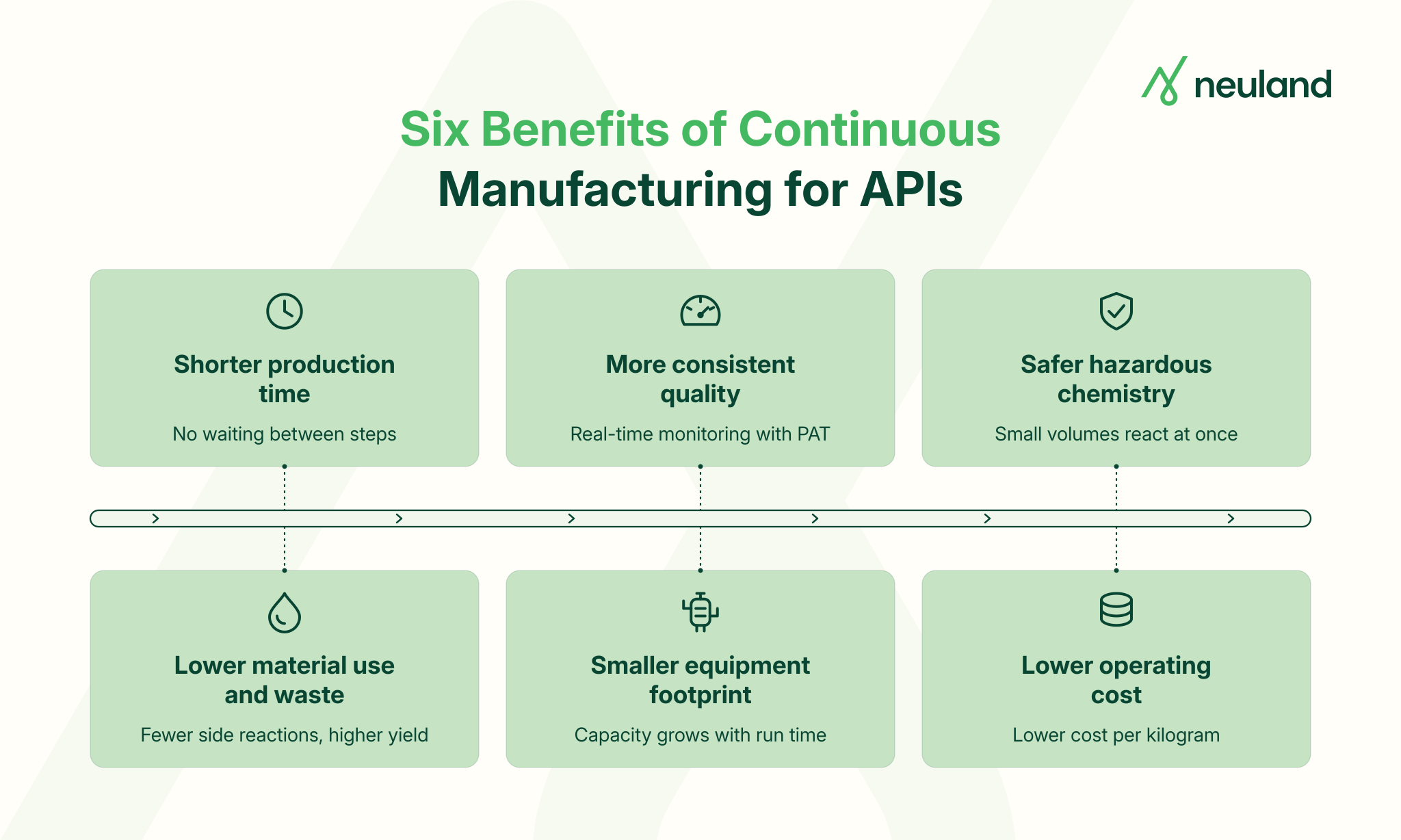
The main benefits of continuous manufacturing for APIs are shorter production time and more consistent quality. Continuous lines also handle hazardous reactions more safely. These gains come from reacting small volumes of material under constant conditions, an approach called process intensification.
Here are the key benefits continuous processing offers API producers:
- Shorter production time: In batch plants, material often waits between steps for isolation and testing. A continuous line eliminates these waits because each step feeds directly into the next.
- More consistent quality: Process analytical technology (PAT), such as on-line HPLC, measures reaction progress while the line runs. Operators can adjust conditions as soon as a deviation appears, which limits off-specification material.
- Safer hazardous chemistry: A small reactor volume limits how much material can react at once during an upset. This makes reactions with strong heat release or toxic reagents more manageable at a commercial scale.
- Lower material use and waste: Tight temperature control reduces side reactions, improving yield and reducing excess reagent use. ICH Q13 notes that well-designed reactors can also reduce impurities and purification steps.
- Smaller equipment footprint: Output increases through longer run times, so reactor size can stay the same. This lets producers add capacity within existing floor space.
- Lower operating cost: Shorter cycle times and higher yields together lower the cost of each kilogram produced. The size of these savings depends on the molecule and the expected production volume.
What Is ICH Q13?
ICH Q13 is a global guideline that explains what regulators expect from the continuous manufacturing of drug substances and drug products. The International Council for Harmonization adopted it in November 2022, after a four-year drafting process. Each ICH regulatory member then brought Q13 into its own regional rules. The FDA published it as final guidance for industry in March 2023. The EMA's adopted version of ICH Q13 took effect in July 2023.
The ICH Q13 continuous manufacturing guideline covers two product types: chemical entities and therapeutic proteins. It applies to new products, such as new drugs and generics. It also applies when a company converts an existing batch process to continuous operation. To make these principles practical, the guideline pairs its main text with five annexes. Each annex applies the principles to a specific product type or operating scenario.
How Has ICH Q13 Changed Continuous Manufacturing for APIs?
ICH Q13 has given continuous manufacturing for APIs a defined regulatory path across major markets. Before its adoption, companies often agreed on technical expectations with each agency separately. ICH regulators, including the FDA and EMA, now assess continuous processes against the same guidelines. One process design and control approach can therefore support filings in several regions.
The guideline also answers practical questions that are unique to continuous operation. The first is how to define a batch when material flows without a natural endpoint. Q13 lets companies set batch size by material quantity or by run time at a defined flow rate. Companies can also register a batch size range and adjust output within it without a new filing.
The second question is how to handle material that falls out of specification during a run. Q13 addresses this through residence time distribution, which measures how long material stays in each unit. This timing data lets producers trace affected material and divert only that portion from the batch. Annex V uses worked examples to show which disturbances require diversion.
What Challenges Still Limit Continuous Manufacturing for APIs?
Most challenges limiting continuous manufacturing for APIs are now practical, because ICH Q13 has clarified the main regulatory expectations. The first hurdle is the existing plant base. Most commercial API plants run multipurpose batch reactors that produce many different molecules. Companies have already invested heavily in this equipment, so replacing it needs a strong business case.
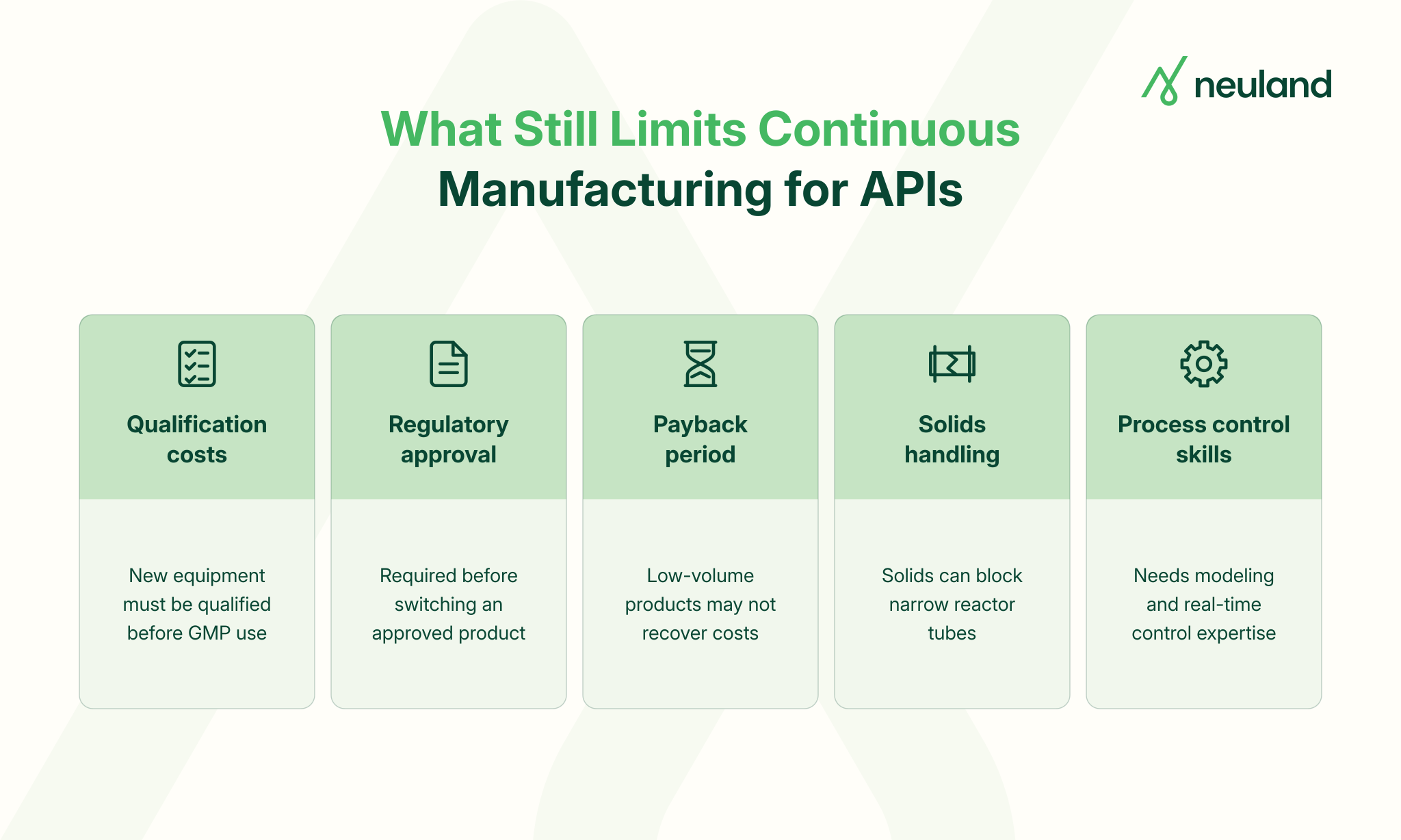
That business case must account for these costs and technical limits:
- Qualification costs: Flow reactors and in-line analytical tools need installation and full qualification before GMP production.
- Regulatory approval: For an approved product, ICH Q13 expects regulatory approval before switching from batch to continuous.
- Payback period: These steps add cost and time, so low-volume or short-lifecycle products may never recover the investment.
- Solids handling: Some reactions form solids that settle in narrow reactor tubes and block flow. Crystallization and filtration are also harder to run continuously than liquid-phase reactions.
- Process control skills: Continuous lines require process modeling and real-time control expertise. Teams trained mainly in batch work need time to build these skills.
Because of these limits, the process format is best decided early in pharmaceutical process development. Routes with solid-forming steps often work better as hybrid batch-continuous processes. Fast reactions with sharp heat release or intense mixing needs usually suit flow reactors. Slower reactions with gentle heat profiles run well in batch vessels.
Neuland Laboratories measures both factors through its Process Safety and Engineering Assessment services. Its process safety team uses reaction calorimetry to measure heat release before lab-to-plant transfer. The company's engineers also simulate mixing and heat transfer for plant-scale scenarios. Hazard and operability studies then document risks ahead of scale-up and technology transfer. This evidence helps shape an API manufacturing process that stays safe and consistent at commercial scale.
Summary
- Many API processes use hybrid routes that combine continuous and batch steps.
- Beyond speed and quality, continuous manufacturing for APIs improves yield and reduces excess reagent use.
- ICH Q13 answers practical questions, such as how to define a batch on a line with no natural endpoint. It also sets out how to trace and divert off-spec material during a run.
- Installed batch plants and solid-forming reactions remain key barriers, especially for low-volume products.
- These barriers make early process understanding essential before committing to either format. Neuland, which works with more than 500 pharma and biotech organizations, builds this understanding in its Process Engineering Lab. The lab uses QbD and DoE to define the design space for each process before transfer.
Assessing hazardous chemistry before choosing a format?
Neuland's process safety team identifies explosive properties and classifies dangerous goods during development. It also evaluates operational hazards such as flammability and static electricity. Talk to Neuland's process safety team about your API's hazard profile today.
FAQs
The APIs best suited to continuous flow manufacturing combine steady, high demand with fast liquid-phase chemistry. These molecules keep a line running long enough to recoup the cost of the equipment.
Common signs of a good fit include:
- Long commercial lifecycles that justify dedicated equipment over many years
- Reactions with short-lived intermediates that must be used right after they form
- Hazardous reagents, such as organolithiums or azides that are safer in small volumes
- Reactions that stay fully in solution from start to finish
Yes, continuous manufacturing is FDA-approved for pharma, with approval granted to each product and its process. The agency reviews the continuous process as part of each drug application. The FDA approved its first drug made on a continuous line in July 2015. By May 2026, an FDA official reported 17 approved drugs that use continuous manufacturing.
Moving an API from batch to continuous manufacturing requires data showing that the new process delivers comparable quality. ICH Q13 asks companies to establish this through a science- and risk-based approach. A typical data package includes:
- Side-by-side quality results for batch-made and continuously made API
- Validated in-line analytical methods, including any PAT models used for process decisions
- Documented start-up and shutdown procedures for the continuous line
- Stability data from batches representative of the commercial continuous process
Continuous manufacturing does not require real-time release testing under ICH Q13. Real-time release testing uses in-process data to confirm quality without separate end-product tests. Companies can still use conventional release testing for a continuous line. If a company proposes real-time release, Q13 expects a backup plan for any lapse in data collection.