Meet Neuland at CPHI India 2026 | Hall 2, Booth 2D38 | Yashobhoomi Convention Centre, New Delhi | 24-26 November 2026 Schedule a Meeting
Meet Neuland at CPHI India 2026 | Hall 2, Booth 2D38 | Yashobhoomi Convention Centre, New Delhi | 24-26 November 2026 Schedule a Meeting
Small molecule API manufacturing delays mostly show up as missed batch dates or stalled tech transfers. Both look like scheduling failures on the surface. The real cause sits earlier, in how scale-up cost and risk are managed before those failures happen. A CDMO that skips locking its process before tech transfer absorbs cost overruns, and those overruns resurface later as delayed batches. A pharma company that skips dual-sourcing or inspection checks carries risk forward, and that risk surfaces later as a stalled production run.
Cost control and risk management are the two decisions behind both outcomes. Together, they will determine whether small molecule API manufacturing stays on schedule in the year ahead. Address both early, and timelines hold. Miss either one, and a routine scale-up turns into a months-long delay.
Small-molecule API manufacturing delays occur when unmanaged pressure builds along a molecule's path from lab to plant scale. That pressure rarely shows up as one clear event. It accumulates at four specific points in the process.
Here are the pressures driving small molecule API manufacturing delays in 2027:
A manufacturing delay that remains unresolved does not remain a scheduling problem. It eventually reaches patients as a supply gap. The average U.S. drug shortage lasted 1,585 days in 2024, more than double the 706-day average recorded in 2019, per a 2025 American Medical Association report. That widening gap reflects the same unmanaged coordination and inspection pressure behind small molecule API manufacturing delays upstream.
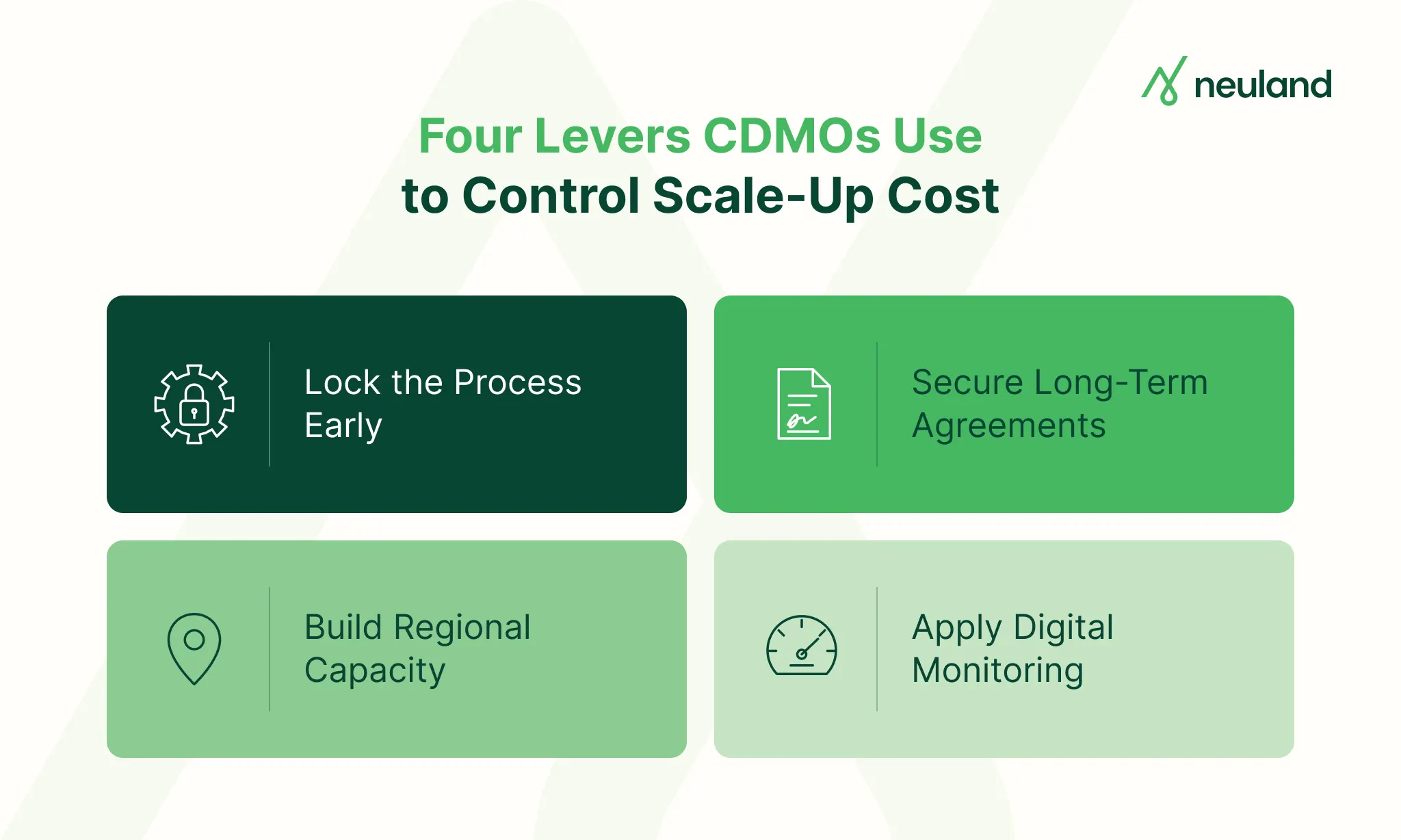
CDMOs reduce manufacturing costs during scale-up through four connected levers. These are locking the process at pilot scale, securing long-term supply agreements, building regional capacity, and applying digital process monitoring. Each lever targets a different cost driver in small-molecule API manufacturing, and together they determine whether a scale-up stays on budget.
These four levers reinforce each other rather than working in isolation. Confirming which of these levers a CDMO has in place is the next step before committing to a timeline.
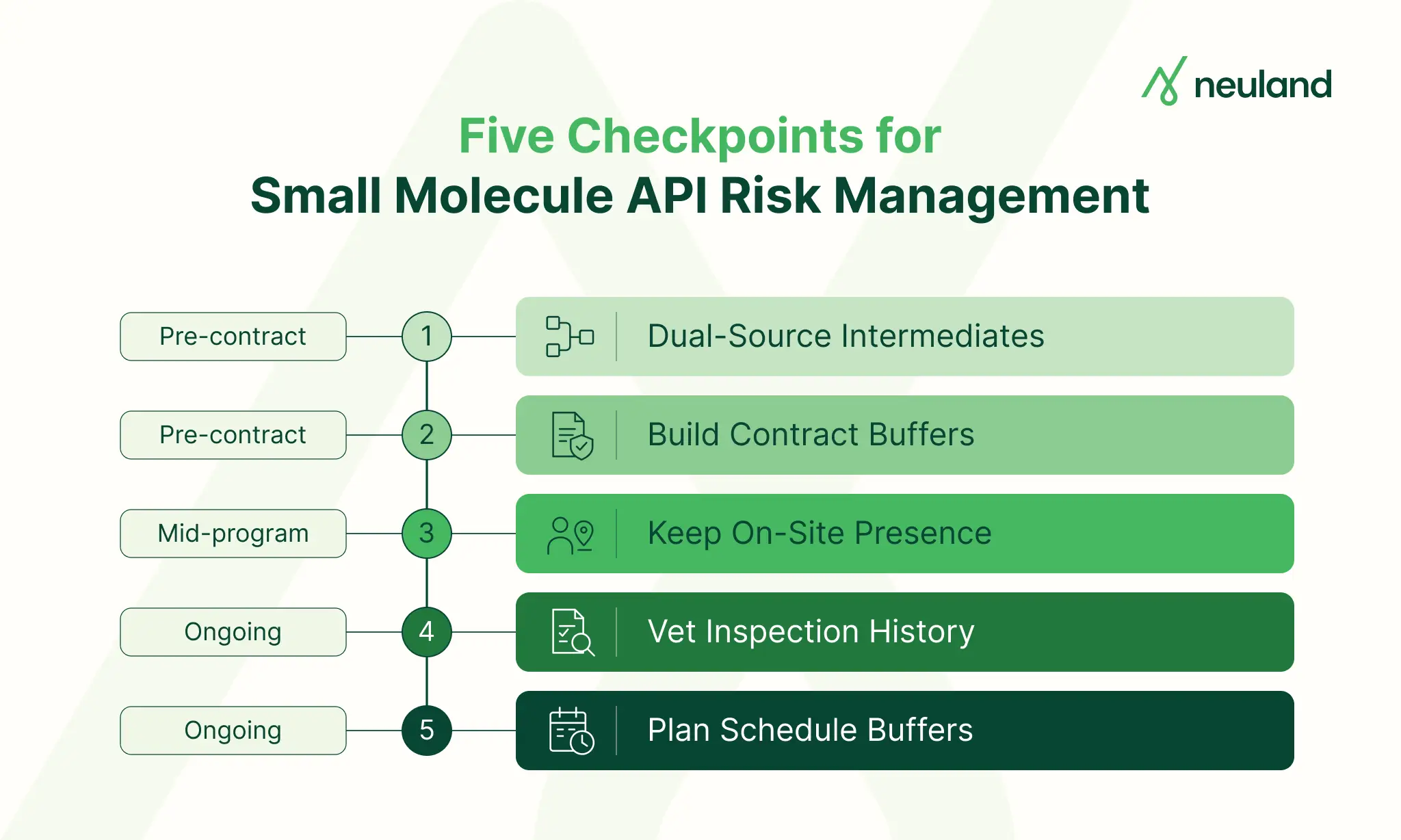
Pharma companies reduce risk in small molecule API manufacturing by controlling supply, contract terms, and oversight before a delay can start. Each step targets a specific point where a scale-up plan tends to break down.
Pharma companies that apply all five together treat API risk management as a planning discipline rather than a reaction to problems after they surface.
Neuland Laboratories supports small molecule API manufacturing through process development built to reduce scale-up risk before it reaches the plant floor. Route scouting and process optimization run on Design of Experiments and Quality by Design methods. They are applied before a process moves to the kilo lab or commercial scale. This sequencing directly reduces the risk pharma companies face in 2027. A process confirmed at pilot scale needs far less rework once full-scale production begins.
Three cGMP-certified facilities, backed by regulatory approvals from the FDA, EMA, and PMDA, carry this work through to commercial supply. Over 400+ R&D scientists support projects from early process development through scale-up. It gives pharma companies a single point of continuity across tech transfer.
Neuland serves pharma and biotech companies in close to 80 countries. Programs move from process development through commercial supply without changing manufacturing sites. Connect with Neuland's team to review capacity for your 2027 scale-up.
A small molecule API CDMO is a contract manufacturer that develops and produces active pharmaceutical ingredients for small molecule drugs. It handles process development and tech transfer on behalf of pharma and biotech companies, through to commercial scale-up.
Small molecule API manufacturing relies on multi-step chemical synthesis, typically producing molecules under 900 daltons. Large molecule APIs, such as biologics, are grown using living cells, which requires different equipment, facilities, and regulatory pathways.
Small molecule API tech transfer typically takes six to twelve months, depending on process complexity. Timelines extend further when scale-up parameters are not confirmed at the pilot scale. It’s also a common source of API tech transfer delays.
A pharma company should check a CDMO's FDA and EMA inspection outcomes from the past three to five years. Reviewing API manufacturing capacity alongside inspection history gives the clearest risk picture.