
Key Takeaways
- Commercial readiness means running validated GMP peptide manufacturing at multi-kilogram to ton scale, proven through completed batch records.
- GLP-1 demand has pushed peptide manufacturing volumes well past what clinical-batch scale was built to handle.
- Five markers decide readiness: regulatory track record, demonstrated scale-up, technology depth, supply chain integration, and quality systems.
- A completed commercial batch record separates a ready peptide CDMO from one still finishing its build-out.
- Neuland pairs its GMP peptide manufacturing certification with 21 CFR Part 11-compliant data systems and DCS-based automation.
A peptide CDMO is commercially ready when it runs validated GMP peptide manufacturing at multi-kilogram to ton scale. Reaching that stage takes a regulatory filing history across major agencies, alongside in-house control over key intermediates.
It also takes demonstrated tech transfer from lab-scale synthesis to validated commercial batches. Capacity plans and equipment orders describe intent, but they stop short of proving performance. A completed commercial batch record is what confirms it. That confirmation rests on five specific markers, each one separating a peptide CDMO that has reached this stage from one still building toward it.
Why Does Commercial-Scale Peptide Manufacturing Matter Right Now?
Commercial-scale peptide manufacturing matters now because patient demand for GLP-1 therapies has moved past a niche market. An estimated 6.9 million US adults with diagnosed diabetes used a GLP-1 medication in 2024, per CDC data. That figure covers diabetes patients alone, before counting obesity-only prescriptions.
Supplying this many patients' needs production volumes far above a typical clinical-stage batch. A peptide CDMO handling milligram-to-gram quantities needs proven reactor capacity and purification infrastructure for commercial-scale GMP manufacturing.
That scale of patient demand puts direct pressure on how quickly a molecule can move from approval to steady supply. A peptide CDMO still building toward commercial capacity adds real timeline risk at exactly this stage. Readiness means capacity already proven in production, sized to the volume a commercial peptide therapy needs. It decides whether millions of patients receive their medication without disruption.
What Are the Five Markers of Commercial Readiness in a Peptide CDMO?
Five markers separate a peptide CDMO that has reached commercial readiness from one still building toward it. Each marker reflects a track record. Together, they cover the regulatory and operational ground a molecule has to clear before it can move to ongoing commercial supply.
Regulatory Track Record Across Major Agencies
Regulatory readiness comes from a facility's inspection history across multiple agencies. A GMP peptide manufacturing certificate confirms that a facility met standards on one audit day. Repeat inspections by USFDA, EMA, and PMDA show whether that standard holds over time.
Peptide-specific DMF filings add a second layer of proof. A peptide DMF documents the process history for that exact molecule class, separate from any small-molecule filings. Clients can reference an existing Type II DMF through a letter of authorization, cutting months off their own filing timeline. This is where regulatory and CMC support built on real filing history speeds up readiness for new clients, too.
Demonstrated Scale-Up in Reactor Capacity
Demonstrated scale-up means a CDMO has already run commercial batches on its reactors. Reactor capacity in the hundreds to thousands of liters is now standard for SPPS and LPPS. However, that capacity figure says little about the performance.
What confirms readiness is batch validation across multiple production runs at that volume. A single successful batch can be a good result under ideal conditions. Repeated batches that hold the same purity and yield prove the process. Large-scale cGMP manufacturing infrastructure has to carry that consistency forward, as order volumes grow.
Synthesis and Purification Technology Depth
Technology depth means a peptide CDMO can match the synthesis method to the molecule. Solid-phase synthesis suits shorter peptide chains and offers the most automation. Liquid-phase synthesis handles longer chains at higher volumes with efficient cycle times. Hybrid approaches combine fragments from both methods for the most complex sequences.
This flexibility carries through to purification. A CDMO built around one synthesis route often builds its purification train around that route. Preparative RP-HPLC systems then need enough capacity to hold commercial-grade purity once volumes scale past a single method's limits.
Supply Chain Integration for Peptide Building Blocks
Supply chain integration is where a peptide CDMO produces its own protected amino acids, resins, or fragments in-house. Full dependence on outside suppliers hands over a risk that the CDMO cannot directly manage. A single delayed shipment of a specialty building block can stall an entire production schedule.
Many peptide building blocks come from a small pool of specialized suppliers, which raises this risk further. In-house production of the most critical inputs removes that single point of failure from the delivery schedule for peptide manufacturing work.
Quality Systems and Workforce Depth at Scale
Quality systems and workforce depth decide whether a CDMO holds consistency as volume grows, long after the equipment is installed. Change control and deviation management surface problems that clinical-batch volumes never reveal. A process that looked stable at the kilogram scale can expose new variability once it runs at the ton scale.
Trained process chemists and downstream operations staff are the tighter constraint across the industry right now, often more than capital. A capacity built without the staff to run it consistently does not translate into commercial readiness. A CDMO that combines reactor investment with experienced quality and operations teams is better positioned for real-world production demands.
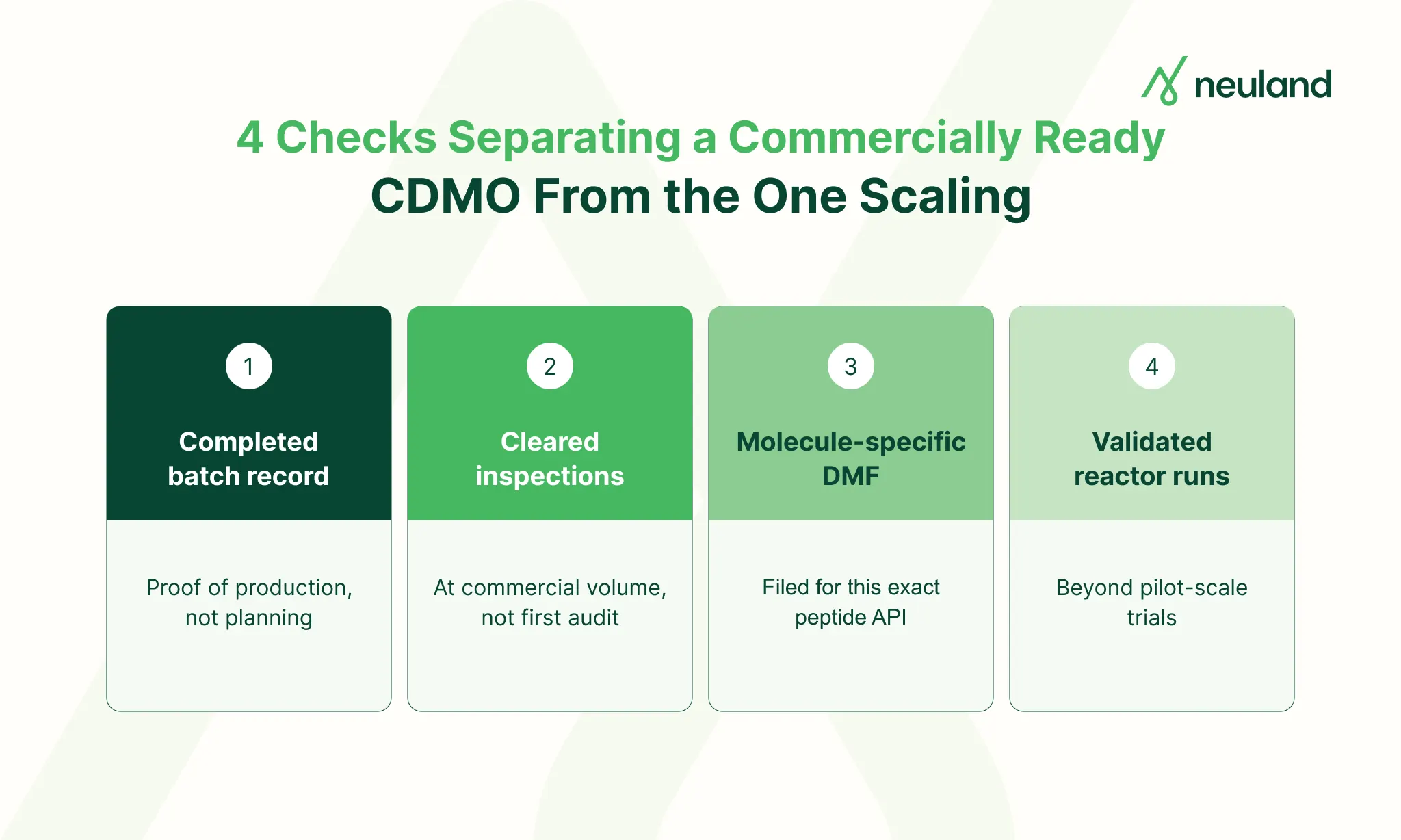
- Regulatory Track Record — Repeat inspections, peptide-specific DMF filings
- Demonstrated Scale-Up — Validated batches at commercial reactor volume
- Technology Depth — SPPS, LPPS, and hybrid synthesis under one roof
- Supply Chain Integration — In-house peptide building blocks
- Quality & Workforce Depth — Change control that holds at scale
What Separates a Commercially Qualified Peptide CDMO From One Still Building?
A commercially qualified CDMO for peptides can show completed records from real production runs. A CDMO still scaling up can usually only share projected capacity and construction timelines. This gap between proof and projection is the clearest signal of commercial readiness.
Four checks reveal where a CDMO stands:
- Request a completed commercial batch record. This confirms the CDMO has already produced at that scale, beyond the planning stage.
- Confirm which regulatory inspections have been cleared. An inspection history at commercial volume carries more weight than a certificate awaiting its first audit.
- Check if DMF filings cover the specific peptide API in question. A general filing history does not guarantee experience with that exact molecule class.
- Verify reactor capacity against actual validated runs. Installed capacity becomes proof only once it has produced consistent commercial batches, beyond pilot trials.
Each answer narrows the gap between a CDMO's stated capabilities and its working track record.
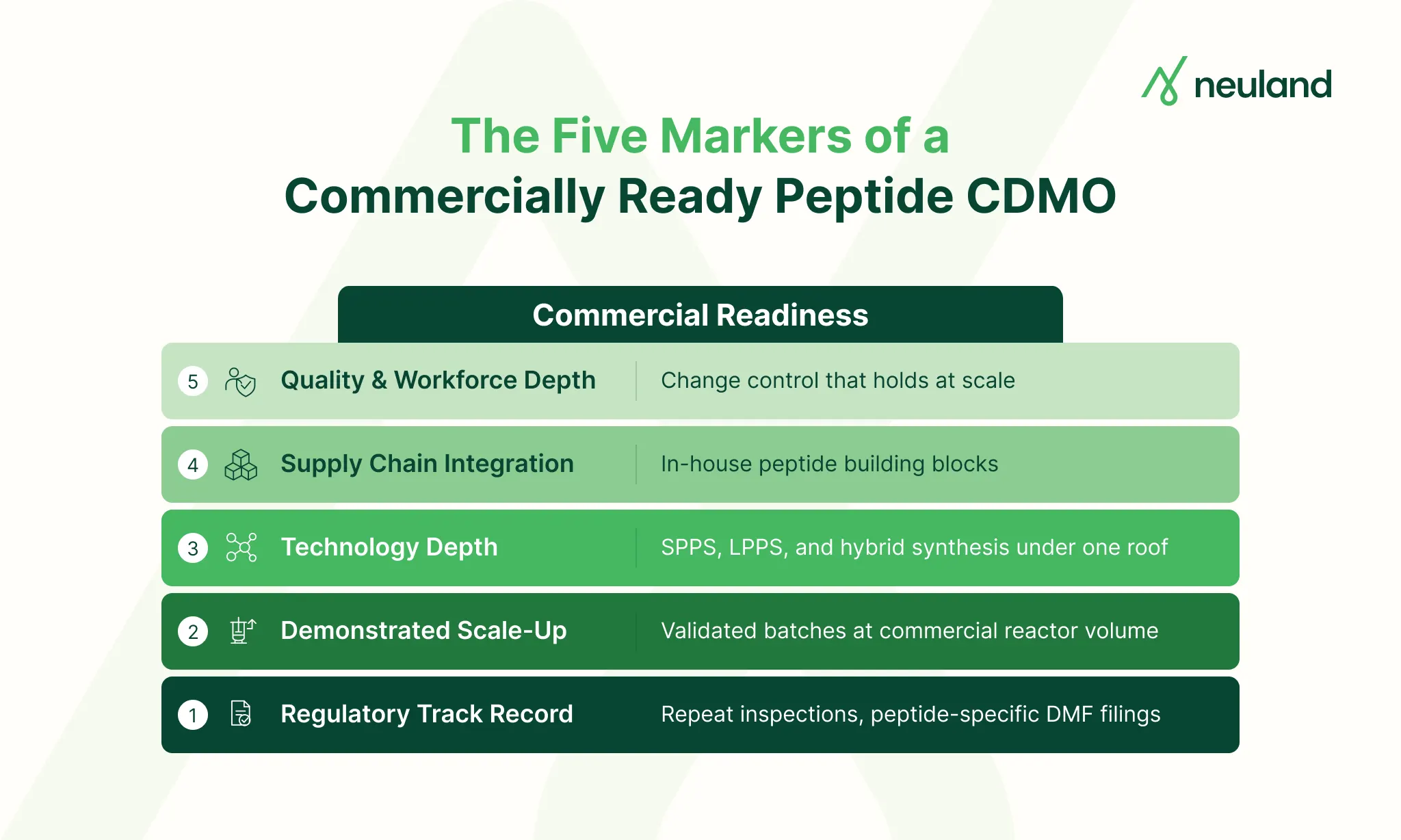
- Completed batch record — Proof of production, not planning
- Cleared inspections — At commercial volume, not first audit
- Molecule-specific DMF — Filed for this exact peptide API
- Validated reactor runs — Beyond pilot-scale trials
What Does Commercial Readiness Look Like in Practice at Neuland?
Neuland's peptide operations reflect the same five markers covered above. Its facilities run under GMP peptide manufacturing standards, inspected by the USFDA, EMA, and PMDA.
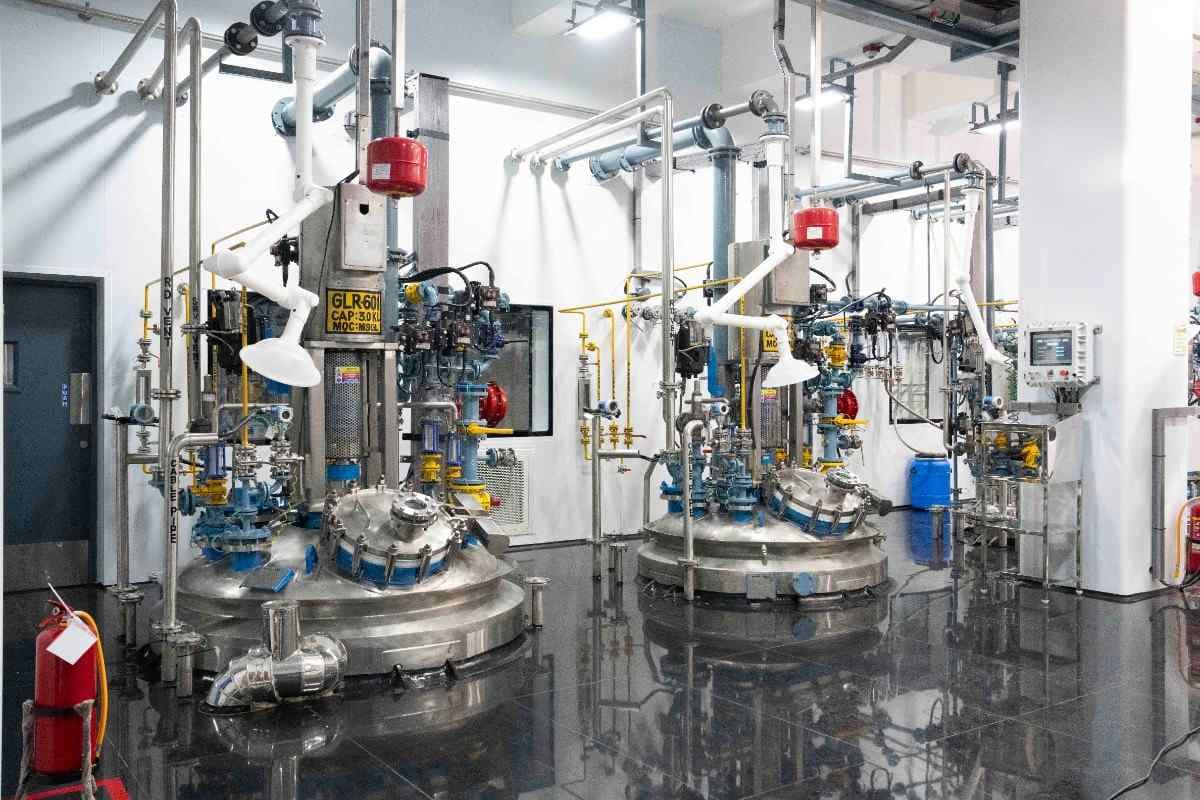
Reactor capacity backs this up directly. The Bonthapally facility adds 7,000 liters of combined SPPS and LPPS capacity in its first module. This sits alongside over 1,226,000 liters of existing API manufacturing capacity across three USFDA-approved facilities. Three synthesis methods run in-house, letting sequence length decide the route rather than equipment limits.
Neuland has run API development work for over four decades, and this peptide expansion extends that experience into a newer, purpose-built facility for commercial-scale supply.
Summary
- Commercial readiness is proven through completed batch records, not capacity plans or equipment still on order.
- GLP-1 demand has moved peptide manufacturing volumes well beyond clinical-batch scale.
- The five markers span regulatory track record, demonstrated scale-up, technology depth, supply chain integration, and quality systems.
- DMF filings specific to a peptide API carry more weight in batch validation than a general regulatory history.
- Neuland has filed its first US DMF for a peptide API, Difelikefalin, with a GLP-1 analog DMF in its pipeline.
Evaluating a peptide CDMO for your next commercial-scale program?
At Neuland, the scientists who develop a peptide's process stay engaged through scale-up and into commercial manufacturing. This keeps institutional knowledge of the molecule intact instead of resetting it at each handoff. Connect with Neuland's team to discuss your molecule's path to commercial-scale supply.
FAQs
A commercial GLP-1 peptide program needs reactor capacity that scales into the thousands of liters. Patient volume drives this number more than the molecule itself. A few factors decide the exact figure:
- The size of the patient population being supplied
- Whether the therapy requires weekly or daily dosing
- The peptide's synthesis route and achievable yield per batch
A CDMO sizing reactors for GLP-1 supply has to plan around these variables together, not any one alone.
Clinical-scale manufacturing of peptides produces gram to kilogram quantities for early-phase trials. Commercial-scale production runs at multi-kilogram to ton volumes for ongoing patient supply. This jump in volume changes more than just batch size. Equipment and staffing needs grow sharply once production moves to commercial scale. Quality systems have to hold steady across many more batches than any clinical run required.
A peptide CDMO needs several years to reach commercial readiness. Building qualified reactor capacity can take one to three years, and that timeline only covers the physical infrastructure. Regulatory filing history and inspection track records take further time to establish, on top of that, build. That’s because both depend on a working process history rather than installed equipment.
A peptide CDMO does not strictly need to manufacture every intermediate in-house to be commercially ready. What matters more is how much of that supply sits outside its own control. In-house production of key building blocks reduces dependence on outside suppliers. That control lowers the risk of delivery delays once a molecule moves into commercial supply.