Meet us at Tides Europe 2026, Stand No. 805, Nov 3-5, RAI Amsterdam, Netherlands Schedule a Meeting
Meet us at Tides Europe 2026, Stand No. 805, Nov 3-5, RAI Amsterdam, Netherlands Schedule a Meeting

Scaling an approved molecule to commercial volume is a major capital decision. Most pharma teams face it only once or twice a decade. Once the basics of what a CDMO does are settled, a harder question follows. Should the company build a dedicated facility, or keep outsourcing API manufacturing to a partner? The decision usually surfaces right after a molecule clears clinical trials, when commercial demand becomes real.
Choosing wrong at this stage is expensive to reverse once a route is locked into a regulatory filing. What shapes that decision is a set of factors pulling in different directions. Cost favors outsourcing at most volumes. However, risk tolerance and the need for direct control can pull toward building in-house. Production volume and timeline add further weight to either side. Neither path is inherently better, and the right one often depends on where the product sits in its lifecycle.
Outsourcing API manufacturing to a CDMO is cheaper for most pharma companies. The core reason is structural. A CDMO spreads its facility investment across many clients, so no single company pays for the full plant. That converts a high fixed cost into a variable one tied to production volume.
In-house API manufacturing only turns cheaper once volume is high enough to keep a facility running near capacity for years. That means no idle periods between production campaigns. At that scale, a company's own cost per batch can eventually undercut what a CDMO charges. Below that volume, shared CDMO infrastructure keeps the per-batch cost lower.
| Factor | CDMO | In-House |
|---|---|---|
| Capital Expenditure (Capex) | None upfront, cost scales with capacity booked | High covers land, construction, and equipment qualification |
| Operating Expenditure (Opex) | Bundled into per-batch or contract pricing | Ongoing staffing, maintenance, and utilities are incurred regardless of output |
| Cost behavior | Variable, tied directly to batches produced | Mostly fixed, regardless of whether the facility runs or sits idle |
| Break-even volume | No threshold, cost tracks actual output | Favorable only at sustained, near-blockbuster production levels |
| Time to capacity | Weeks to months, if slots are available | Years, covering construction and regulatory qualification |
| Utilization risk | Borne by the CDMO | Borne by the company, idle capacity becomes a sunk cost |
| Headcount | Minimal | Full manufacturing, quality, and regulatory staff |
Facility construction timelines directly affect the total cost of the in-house option. Capital tied up in construction earns no return until the plant is validated and producing salable batches. A 2025 federal review found that new pharmaceutical and API manufacturing capacity can take five to ten years to build. That multi-year stretch between spending and revenue is itself a cost, even before the first batch ships. Outsourcing avoids that opportunity cost, since spending scales directly with production booked. Cost is only one half of this decision.
Outsourcing to a CDMO reduces two specific types of risk. It inherits an already-proven inspection record instead of building one from scratch. It also avoids concentrating operations and capital inside a single company-owned facility. It does not remove dependency on a partner's schedule and quality performance. In-house manufacturing removes that dependency. Every risk then stays inside one facility instead.
| Factor | CDMO | In-House |
|---|---|---|
| Regulatory track record | Inherits the partner's existing inspection history with the FDA, EMA, or other agencies | Builds its own inspection record over time, with none to draw on at first |
| Response to a quality event | A multi-site CDMO can often shift a batch to a second facility | Production stops company-wide until the issue is resolved |
| Control over corrective action | Limited, the CDMO manages its own remediation process and timeline | Full, the company sets and controls the remediation timeline directly |
| Capital concentration | Spread across the CDMO's broader client base | Concentrated in one facility and one balance sheet |
| Scheduling dependency | Production competes with the CDMO's other client work for capacity | No competition for internal manufacturing capacity |
Neither risk profile is inherently safer for every manufacturing decision. The better fit depends on how critical the molecule is and how much oversight the company can realistically provide.
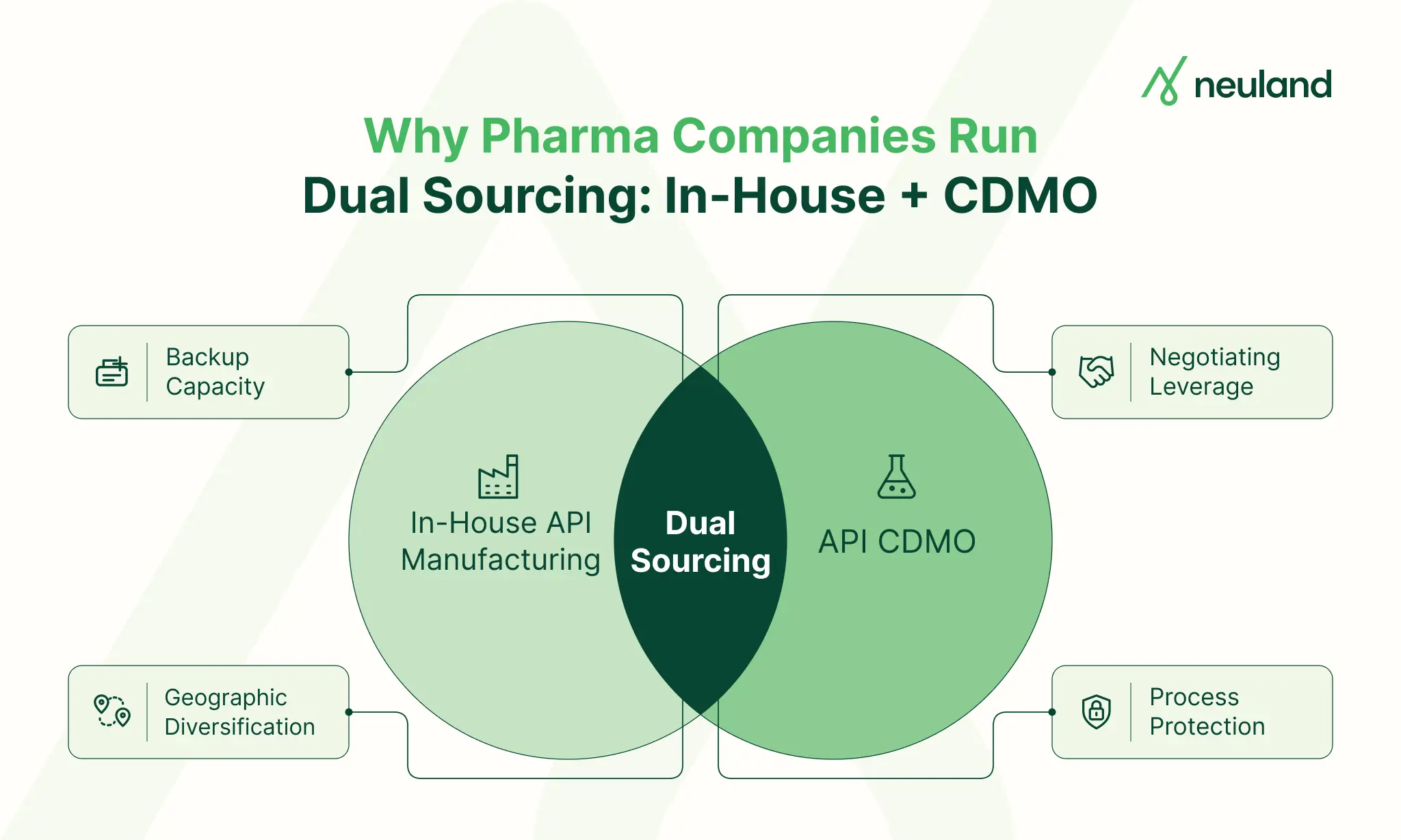
Combining the two models protects supply when a single source cannot be trusted alone. This is called dual sourcing, and it means running in-house and outsourced manufacturing for the same product at the same time. Large pharma companies increasingly choose this over relying on one model exclusively. It works because each side compensates for what the other lacks.
Companies layer these two models together for a few specific reasons:
As outsourcing has grown, more large portfolios treat this combination as standard practice. Dual sourcing rarely happens on day one, though. Qualifying a second source, whether internal or outsourced, requires its own validation batches and regulatory filings. Most companies wait until commercial demand is proven before taking on that added cost. Once both sources are qualified, the payoff shows up. Production continues even if one source faces an inspection delay or a demand spike.
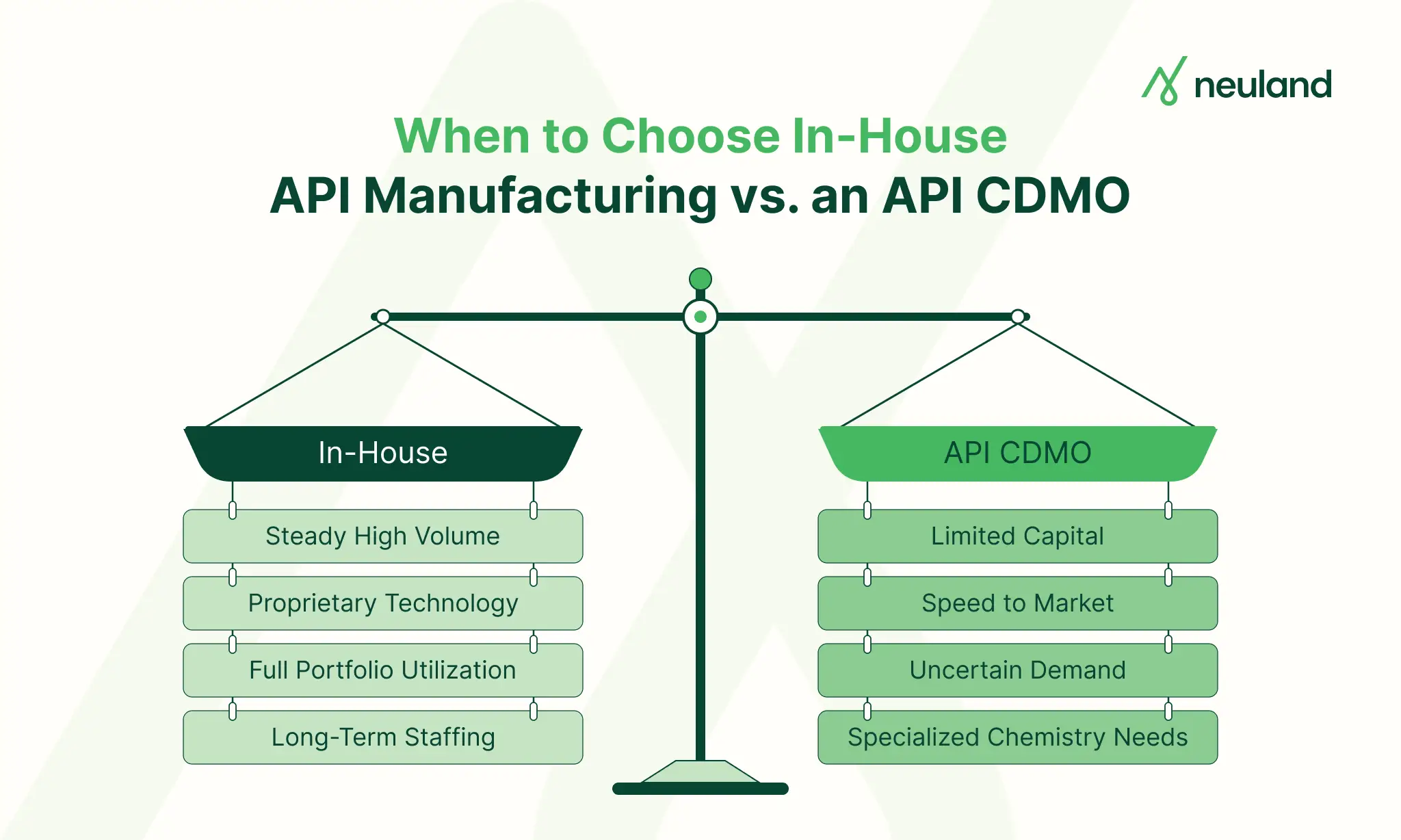
The choice between in-house manufacturing and an API CDMO depends on volume certainty and capital availability. It also depends on how much manufacturing risk a company wants to own directly. In-house control fits steady, high-volume production. An API CDMO fits companies that need speed or lower upfront capital exposure.
Building a dedicated facility usually pays off under these conditions:
Few companies meet every condition above at once. That scarcity is why in-house API manufacturing stays concentrated among large pharma companies with high-volume portfolios.
An API CDMO becomes the stronger choice once volume is uncertain or speed matters more than ownership. Here are the situations where outsourcing API manufacturing usually wins:
Companies facing either constraint can turn to a CDMO that already has this capacity built and validated. Neuland Laboratories, for instance, operates three cGMP-certified facilities with a combined reactor capacity of over 1,22,6000 liters. Each facility is already validated and inspected by the FDA, EMA, and PMDA. That capacity is available without the multi-year construction timeline a new facility would require. Neuland also operates as a dedicated API manufacturer. For a company facing uncertain demand or specialized chemistry needs, the existing infrastructure offers a shorter path. Building the same capacity from scratch would take years.
Weighing an API CDMO for your next scale-up?
Neuland supports a molecule from kilo lab production through full commercial-scale API manufacturing. So a scale-up decision doesn't require switching partners mid-project. Connect with Neuland's team to discuss capacity for your molecule's next stage.
Switching an API manufacturing site after approval usually requires a regulatory filing update in each market. Agencies need to confirm the new site meets the same quality standards as the original. This process can take several months, so switching mid-commercial life needs advance planning.
A clear majority of pharma and biotech companies now use outsourced API manufacturing rather than building their own capacity. That share has risen steadily as molecule complexity and capital costs both increase. Exact figures vary by source, so treat any single percentage with caution.
A CDMO covering IND to commercial supply needs strong API process development capabilities alongside validated analytical methods. Scale-up capacity under one roof matters too, since it avoids handing the molecule to a different vendor partway through development. A regulatory track record across major markets also affects how quickly each stage moves.
API manufacturing follows current Good Manufacturing Practice, known as cGMP, enforced by agencies like the FDA. Many manufacturers also follow ICH Q7, the international guideline written specifically for active ingredient production. These standards cover facility design and testing procedures. They also require full documentation and batch record control.