

Key Takeaways
- Most biotech companies no longer build manufacturing in-house. Capital discipline and molecule complexity have made a biotech CDMO the default path instead.
- The global CDMO market keeps growing through 2034, and biotech companies are capturing a bigger share of that revenue every year.
- Peptide and high-potency molecules are hard to justify building for in most biotech companies. The economics rarely work out in-house.
- Deciding what to outsource gets easier once you weigh strategic differentiation against manufacturing complexity. It gives biotech leaders a clear starting point.
- Staying with one integrated CDMO saves time. Fewer technology transfer delays, and one regulatory filing that stays current throughout.
Biotech manufacturing has moved away from an ownership model. A decade ago, most biotech companies planned to build a plant once a molecule reached Phase III. That capital investment rarely happens now. A molecule now moves from route scouting through commercial-scale manufacturing at a CDMO (contract development and manufacturing organization), without the company owning a reactor.
Two forces are driving this change. Complex modalities, including peptides and high-potency APIs, need infrastructure most biotech companies cannot justify for one program. Investor expectations have shifted alongside. They expect biotech companies to stay lean and prioritize pipeline spending over infrastructure investment.
That shift leaves biotech leaders with a decision to make. Which parts of manufacturing are safe to hand off, and which still need in-house oversight? Getting that call right shapes a program's timeline and burn rate for years.
What Is a Biotech CDMO?
A biotech CDMO is a contract partner that develops and manufactures a molecule, starting in the lab and ending at commercial-scale supply. It handles the development work a small biotech company might often lack. That includes route scouting and process development, before manufacturing begins.
This two-part scope separates a CDMO from a CMO (Contract Manufacturing Organization), a partner that only executes manufacturing. It designs the synthetic route and builds the analytical test methods. It then manufactures the API using that same validated process.
This distinction matters because few biotech companies employ in-house process chemists. Without that expertise, lab-scale routes often fail to reproduce at commercial scale. A pharmaceutical CDMO closes that gap early, before a route locks into a regulatory filing.
What's Driving Biotechs Toward a CDMO Partnership?
Five distinct mechanisms are driving the current wave of biotech outsourcing, and here’s how each works differently.
Molecule complexity has outpaced in-house capability
Peptide and antibody-drug conjugate programs need dedicated reactors and containment systems most small-molecule facilities lack. A single API plant can cost millions or more to build. Validating it for commercial production adds another one to three years. Few biotech companies can justify that spend for one molecule. A CDMO already has this infrastructure and spreads that cost across many programs.
Capital efficiency and investor expectations
Every dollar spent on owned manufacturing capacity is a dollar unavailable for clinical trials. Venture investors evaluate burn rate closely and expect capital to flow toward trial milestones. A CDMO relationship converts a fixed capital cost into a variable, program-linked expense. Boards notice when capital sits in fixed assets rather than active programs. Choosing a drug development partner over owned infrastructure keeps that capital where investors want it.
Speed-to-clinic pressure
Developing a new peptide sequence can take 12 to 18 months before clinical-grade material is ready. That's a long runway before a single dose reaches a patient. A CDMO with qualified equipment and existing SOPs can start that work right away, skipping the internal build-out delay. Saving that time can be the difference between reaching first-in-human trials before a competitor.
Supply chain diversification and geopolitics
The BIOSECURE Act, signed into US law in December 2025, restricts government contracts tied to certain Chinese biotechnology manufacturers. For biotech companies relying on a single geography, that kind of regulatory action can become a problem. Working with an integrated CDMO that has sites across multiple regions removes that single point of failure.
What Does the Data Say About the Growth of Biotech CDMOs?
The global market size gives a sense of scale. The more useful number for a biotech company is who is driving that growth. According to Fortune Business Insights, the global CDMO market reached $199.27 billion in 2025. It is projected to reach $214.95 billion in 2026, growing at an 8.7% CAGR through 2034.
Biotech companies are responsible for a growing share of that expansion. Global Market Insights reports that biotechnology companies accounted for 35.9% of global pharmaceutical CDMO revenues in 2025. That share is rising each year as biotech pipelines expand. That growth has a direct effect on manufacturing capacity.
More biotech programs are competing for the same production slots. So, CDMOs with strong scientific and regulatory infrastructure fill their calendars earliest. Securing a CDMO partner early has, therefore, become part of planning a program's timeline and budget together.
Is Outsourcing Right for Every Molecule Type?
Outsourcing makes sense for every molecule type, but the case strengthens as manufacturing complexity rises. Peptides and high-potency APIs need a dedicated biotech CDMO involved from development stages. It is also usually a better predictor of the outsourcing decision than company size.
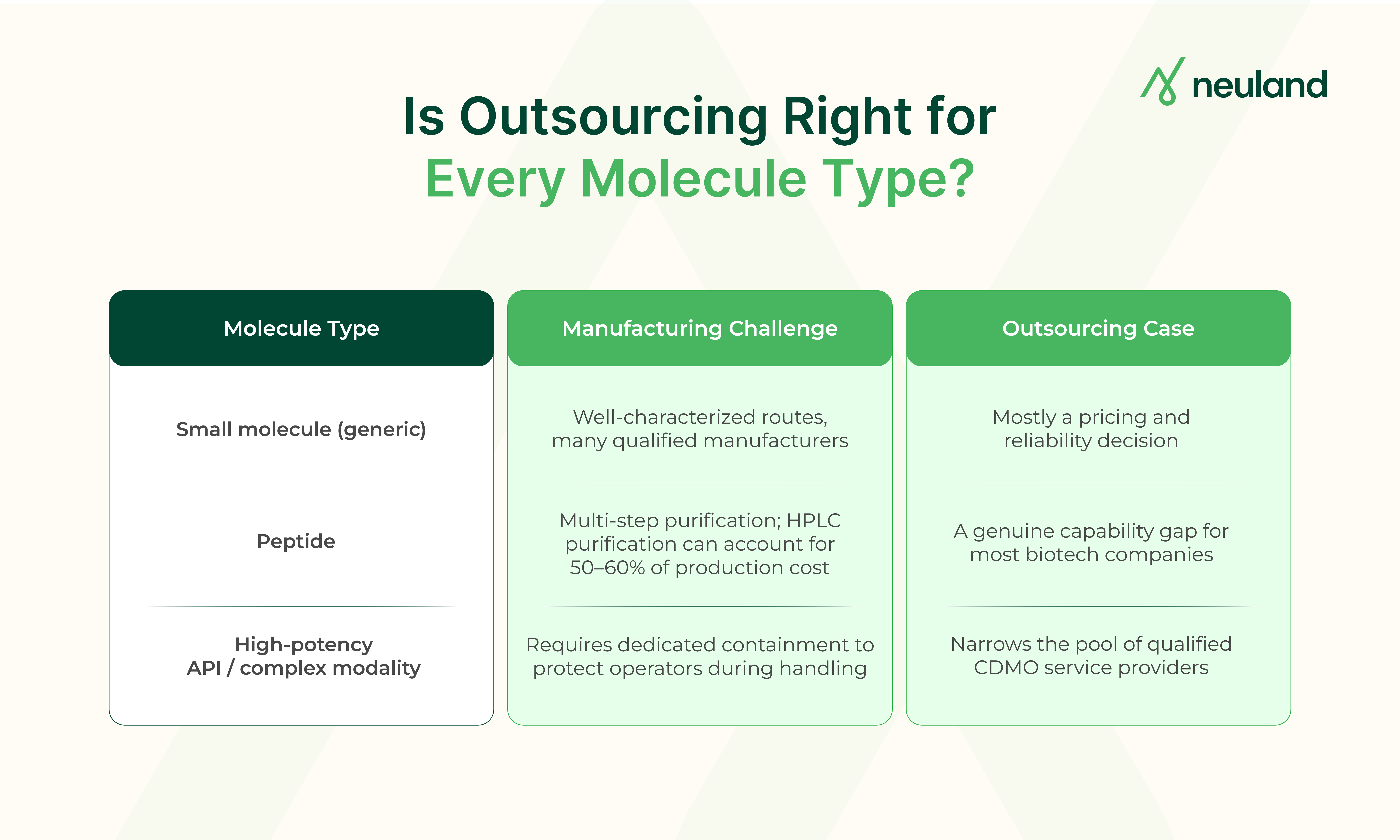
Few biotech companies can justify building peptide or high-potency infrastructure for one molecule. A complex peptide program needs a strategic CDMO partner involved early. That capability can be built internally, and some large pharmaceutical companies have done so. But this path needs long-term capital and steady volume.
That gap is why most biotech companies default to a transactional vendor or an integrated CDMO. A transactional vendor covers a defined scope of work. An integrated CDMO stays involved through commercial supply.
How Should a Biotech Leader Decide What to Outsource?
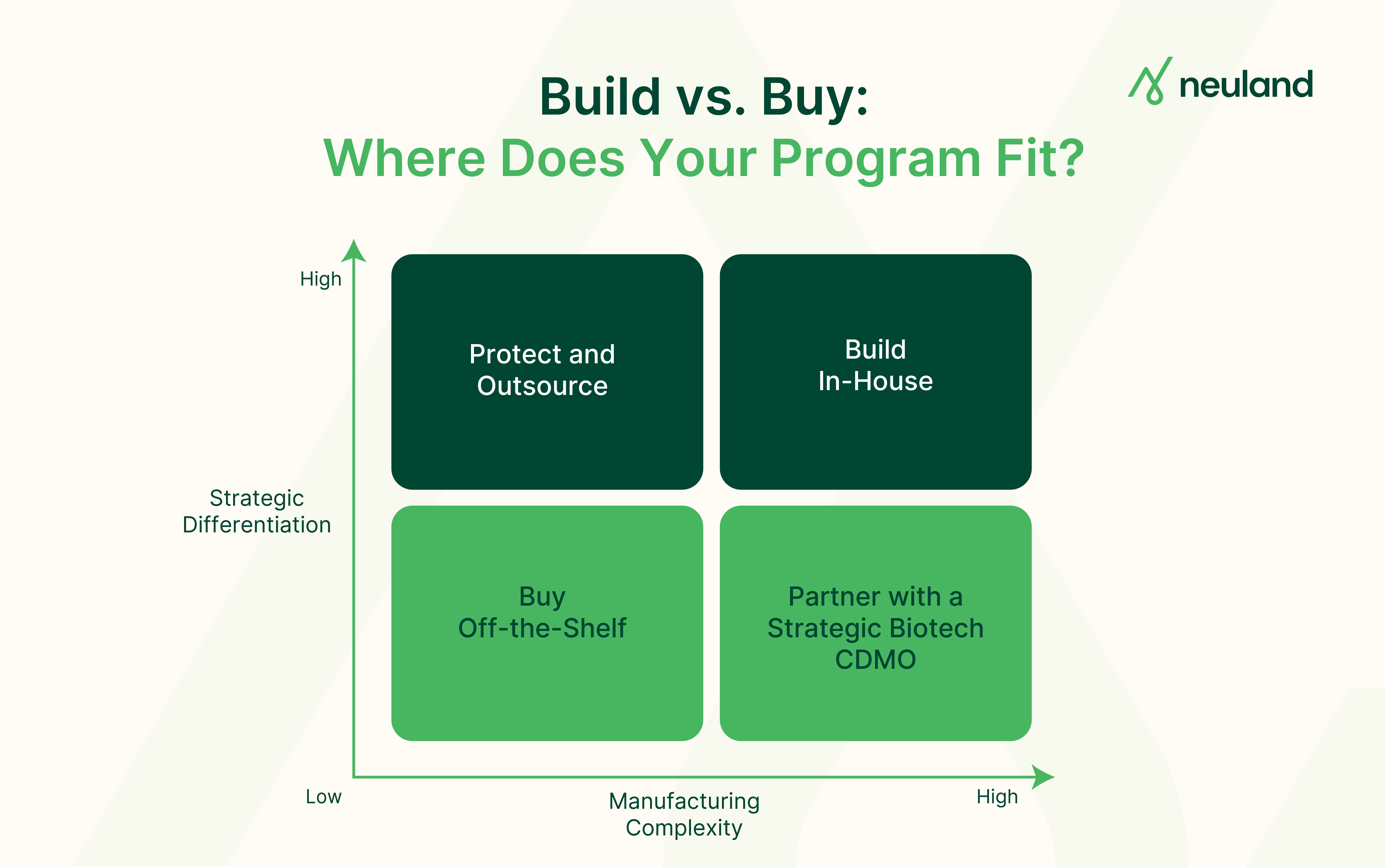
Deciding what to build internally and what to outsource requires asking two questions. Does the molecule need specialized equipment or hazardous chemistry most facilities can't handle? Does the process give the company a real competitive edge, or does it just need to work reliably? The answers place a program into one of four quadrants:
- Buy Off-the-Shelf: Low complexity, low differentiation. A generic small-molecule API with an established route fits here. Any qualified vendor can handle it.
- Partner with a Strategic CDMO: High complexity, low differentiation. A peptide API or HPAPI often fits here. The chemistry is demanding, but it isn't proprietary.
- Protect and Outsource: Low complexity, high differentiation. A novel route that is core to the company's edge, but doesn't need exotic equipment, fits here. Outsource under strict IP terms, or run a small in-house pilot.
- Build In-House: High complexity, high differentiation. A proprietary conjugation or delivery technology that is both core IP and technically demanding fits here. This is the only quadrant that justifies owned infrastructure.
What Makes an Integrated CDMO the Right Long-Term Partner?
An integrated CDMO is the right long-term partner as it keeps one technical team on a molecule from development through commercial supply. A transactional vendor executes a single batch, then the engagement ends. Each new phase often means a new provider, and technology transfer starts over.
An integrated CDMO avoids that reset. Process knowledge and validated methods carry forward instead of being rebuilt at each stage. That continuity cuts weeks of requalification work and lowers the risk of batch failures tied to process drift.
A CDMO spanning development and manufacturing also keeps a single Drug Master File current. Switching vendors means filing separate DMF updates or amendments each time, which adds regulatory lead time.
At Neuland, we operate this model across three cGMP-certified facilities, with regulatory approvals from the FDA, EMA, and PMDA. Our R&D and kilo lab teams stay on the same API as it moves to commercial-scale manufacturing, which matters for peptide and high-potency molecules.
Summary Points
- The shift from in-house manufacturing to outsourced development reflects real structural change in the biotech industry.
- Four distinct forces, from molecule complexity to capital efficiency, are pushing biotech companies toward a biotech CDMO partnership.
- Market data confirms the trend: the global CDMO market is projected to reach $214.95 billion in 2026.
- Molecule type shapes the outsourcing decision. Peptides and high-potency APIs carry a stronger case for outsourcing than established small molecules.
- Choosing an integrated biotech CDMO early, rather than a transactional vendor, reduces handoffs and protects program timelines.
Evaluating a biotech CDMO for an upcoming program?
Neuland Laboratories brings more than four decades of API manufacturing experience to biotech and pharma partnerships, from early development through commercial-scale supply. Talk to our team about your program.
FAQs
Outsourcing pharmaceutical manufacturing carries real risks alongside its benefits. A biotech company loses some day-to-day visibility into the manufacturing floor. Quality issues at the partner site become its own risk. A failed inspection can halt supply. Relying on a single geography or supplier adds capacity and compliance exposure. Choosing a CDMO with a strong regulatory record and multi-site capacity reduces most of this exposure.
A virtual biotech company runs its pipeline without owning labs or manufacturing plants. It relies on external partners, including a CDMO, for its technical work. A small internal team manages strategy and regulatory direction. External partners handle manufacturing and formulation along with clinical testing. This model lets a small biotech company move a molecule forward without heavy capital spending.
No, this trend does not contradict the broader outsourcing trend for most biotech companies. That’s because some large pharmaceutical companies have reinvested in internal biologics and fill-finish capacity in recent years. Large pharma companies that insource biologics usually have the capital and production volume to justify it. They also often have existing plants already built for that purpose.
Technology transfer is the process of moving a validated manufacturing method from one facility to another. It matters because errors during transfer can affect product quality. Switching CDMOs partway through a program means repeating this process. Analytical methods usually need revalidation as well. Staying with one CDMO across development stages avoids this repeated cost.
Onboarding timelines for a biotech CDMO vary by molecule complexity. A simple small molecule with an established route can start within a few weeks. A novel peptide or high-potency molecule usually takes longer, since route scouting comes first. Most programs move from initial discussion to active development within one to three months.