
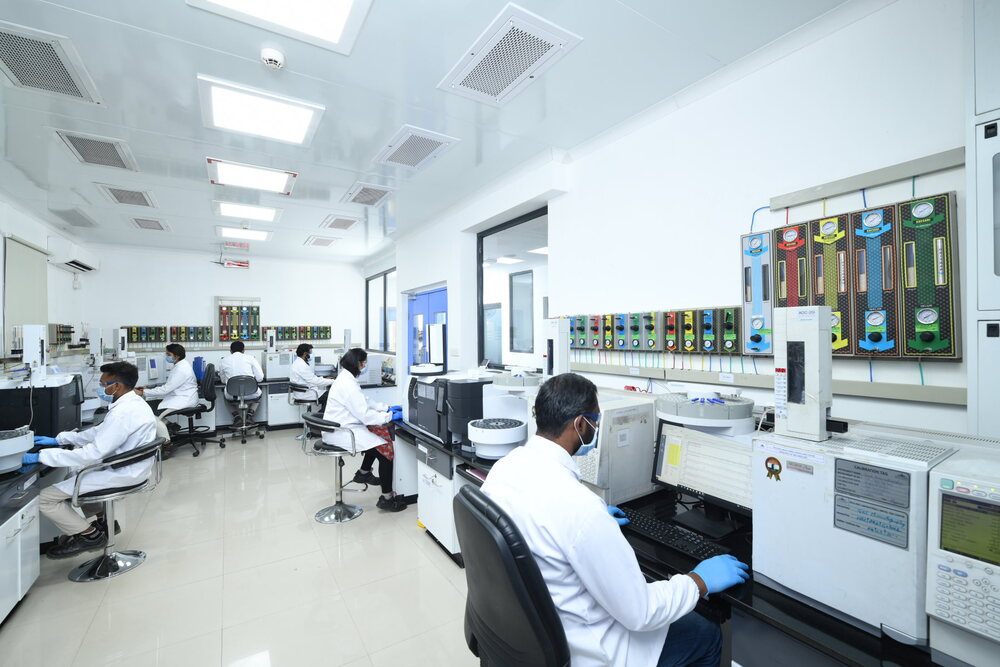
Key Takeaways
- Analytical capabilities and drug quality are inseparable. You cannot assure the quality of an API without the analytical science to measure and prove it at every stage.
- Analytical work is not a single testing step at the end. It runs across the full API lifecycle, from route scouting through commercial release.
- The depth of a partner's techniques matters. Complex molecules such as chiral compounds, high molecular weight structures, and peptides demand specialized methods.
- Impurity profiling, residual metals quantification, and genotoxic impurity detection are three areas where analytical rigor directly protects patient safety.
- Instruments alone do not assure quality. The reproducible, documented process behind each method is what makes analytical data reliable.
Analytical capabilities and drug quality are directly linked because quality is only real once it can be measured, proven, and reproduced. Every claim about a molecule's purity, identity, and safety rests on analytical data. This is why an evaluation of analytical capabilities is one of the most important steps when a company selects a CDMO partner. A manufacturer that cannot characterize a molecule to the required sensitivity cannot reliably assure its quality.
The connection runs deeper than final testing. Strong analytics reduce risk at every stage of API development, catching problems while they are still cheap to fix rather than after a batch is committed.
How Do Analytical Capabilities Support the Entire API Lifecycle?
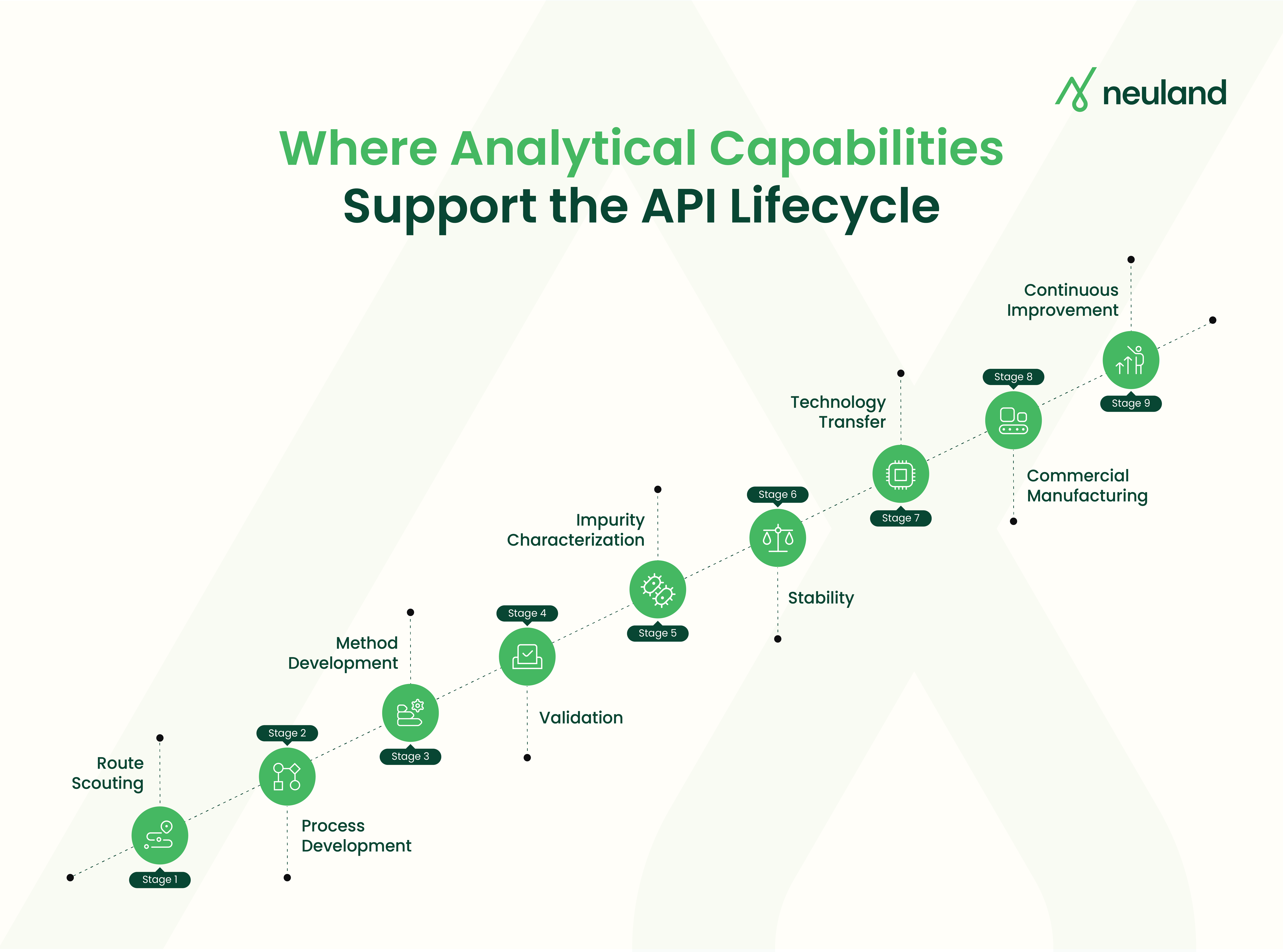
Analytical capabilities support the API lifecycle by generating the data that guides decisions at every stage, not just at release. Analytical science is active from the first route evaluation through to commercial supply.
Here is how analytical support maps across the lifecycle:
- Route scouting: Analytical data compares candidate routes, revealing which generates a cleaner impurity profile before a route is chosen.
- Process development: Methods track how process changes affect quality attributes, guiding optimization.
- Method development and validation: Each quality attribute gets a reliable, documented method proven fit for purpose.
- Impurity characterization: Impurities are identified and quantified so their origin and control are understood.
- Stability studies: Data establish how the molecule behaves over time and define its shelf life.
- Technology transfer: Validated methods move to the manufacturing or QC site without loss of performance.
- Commercial manufacturing: Release and in-process testing confirm every batch meets specification.
- Continuous process improvement: Ongoing analytical trending detects drift and informs refinement.
The pattern is consistent. At each stage, pharmaceutical testing is the instrument that converts a quality intention into a quality fact.
What Analytical Methods Matter Most for Complex Molecules?
The methods that matter most are those capable of resolving complexity, because chiral compounds, high molecular weight molecules, and peptides defeat routine approaches. Rugged, robust analytical method development is the baseline requirement.
Companies consistently look for proven analytical method validation expertise across the techniques used to estimate impurities and confirm identity. In practice, this frequently involves:
- HPLC for routine separation and quantification
- GC for volatile compounds and residual solvents
- Chiral HPLC for resolving enantiomers in chiral molecules
- HPLC-ELSD for compounds lacking a strong chromophore
- HPLC-RI for refractive index detection, where needed
For complex chiral molecules, high molecular weight structures, and peptides, method ruggedness is not a luxury. A method that drifts or fails to resolve a critical pair of peaks cannot support a reliable quality decision.
How Is Residual Metals Quantification Handled?
Residual metals quantification measures trace metal contaminants introduced during manufacture, typically down to parts-per-million levels. It matters because repeated patient exposure to metal contaminants, especially in drugs used long-term, carries a toxicity risk.
The standard technique is Inductively-Coupled Plasma Mass Spectrometry (ICP-MS), which determines metal contaminants to ppm levels with high sensitivity. This is a core part of pharmaceutical quality control for many APIs.
Some samples need extra preparation. Compounds that are not in aqueous solution may require additional steps, such as high-recovery micro digestion before analysis, so that the measurement remains accurate.
Why Does Genotoxic Impurity Detection Require Special Methods?
Genotoxic impurity detection requires special methods because these impurities pose a risk at extremely low concentrations, far below the thresholds that matter for ordinary impurities. Detecting them demands exceptional analytical sensitivity.
Rising awareness of genotoxic risk has driven rigorous testing standards. Sensitive impurity analysis must detect and quantify these impurities down to the Threshold of Toxicological Concern (TTC), around 1.5 micrograms per gram, or 1.5 ppm.
Achieving this sensitivity relies on hyphenated techniques, particularly iterations of LC-MS and GC-MS. This is a specialized field of impurity profiling where analytical capability directly determines whether a low-level risk can be seen at all.
What Range of Analytical Technologies Supports Full Characterization?
.webp)
Full characterization requires a broad suite of complementary technologies because identifying and characterizing both impurities and drug substances often demands several orthogonal approaches. No single technique answers every question.
A comprehensive set of analytical laboratory capabilities typically includes:
- Mass spectroscopy (LC-MS and GC-MS) for structural identification
- Infrared spectroscopy (IR) for functional group confirmation
- Nuclear magnetic resonance (NMR) for detailed structural elucidation
- Differential scanning calorimetry (DSC) for thermal behavior
- X-Ray Diffraction (XRD) for solid form and crystallinity
- Thermal gravimetric analysis (TGA) for thermal stability and volatiles
- Particle size distribution (PSD) analysis for physical characterization
Used together, these technologies build a complete evidence base for a molecule. This breadth is what distinguishes strong contract analytical services from a lab that can run only routine assays.
Why Does Process Matter as Much as Technology?
Process matters as much as technology because a method is only as valuable as the reproducible, documented system that runs it. Cutting-edge instruments do not assure quality on their own.
Analytical technology changes rapidly, and staying current is essential. Yet a method that cannot be reproduced consistently, documented properly, and implemented reliably across runs and sites offers little real assurance.
This is the discipline that separates capability from equipment. Rugged methods, disciplined documentation, and controlled transfer are what make pharmaceutical analytical services dependable, and it is a central reason companies weigh analytical maturity so heavily when outsourcing.
Neuland's quality control and assurance function is built around exactly this principle, pairing analytical depth with the process control that makes the data trustworthy across small molecules, peptides, and complex APIs.
How Should Companies Evaluate a CDMO's Analytical Maturity?
Companies should evaluate analytical maturity by looking past the equipment list to the depth, sensitivity, and process discipline behind it. The instruments are necessary but not sufficient.
Use these questions when assessing a CDMO with analytical capabilities:
- Can they handle your molecule's complexity? Chiral, high-molecular-weight, and peptide molecules need proven, specialized methods.
- How sensitive is their impurity work? Genotoxic detection of TTC levels signals genuine depth.
- Is their technology suite broad enough? Orthogonal techniques are needed for full characterization.
- Are their methods reproducible and documented? Process discipline is what makes data reliable.
- Can methods transfer cleanly? Validated methods must move to another site without losing performance.
Assessed this way, pharmaceutical analytical testing capability becomes a clear differentiator between partners rather than a checkbox.
Summary Points
- Analytical capabilities and drug quality are two sides of the same coin. Quality that cannot be measured and proven is not assured quality.
- Analytical science operates across the whole API lifecycle, from route scouting and process development through stability, technology transfer, and commercial release.
- Complex molecules demand specialized methods, and impurities, residual metals, and genotoxic work are where analytical rigor most directly protects patients.
- A broad suite of orthogonal technologies is needed for full characterization, since no single technique answers every question.
- The reproducible, documented process behind each method matters as much as the instrument, and it is central to evaluating a CDMO partner.
Ready to evaluate a CDMO with the analytical depth your molecule needs?
Neuland Labs supports pharmaceutical and biotech companies with analytical capability across the full API lifecycle, from route scouting through commercial supply, for small molecules, peptides, and complex APIs. Talk to our team about your program.
Frequently Asked Questions
What are analytical capabilities in pharmaceutical manufacturing?
Analytical capabilities are the combined methods, instruments, and expertise used to measure and prove an API's identity, purity, and safety. They span technique breadth, method sensitivity, and the documented processes that make the resulting data reliable and reproducible.
How do analytical capabilities affect drug quality?
Analytical capabilities determine whether drug quality can actually be verified. Strong analytics catch impurities, contaminants, and stability issues early and prove that a molecule meets specification, so quality is demonstrated with data rather than assumed.
Why do companies evaluate analytical capabilities before outsourcing?
Companies evaluate analytical capabilities before pharmaceutical outsourcing because a partner that cannot characterize a molecule to the required sensitivity cannot reliably assure its quality. Analytical depth is one of the strongest predictors of whether a program will meet quality and regulatory expectations.
What is the difference between analytical testing and analytical development?
Analytical testing applies existing validated methods to measure a sample, such as a release test on a batch. Analytical development creates and validates those methods in the first place. Development builds the measurement tool; testing uses it.
How are genotoxic impurities detected in APIs?
Genotoxic impurities are detected using highly sensitive hyphenated techniques such as LC-MS and GC-MS, capable of quantifying to the Threshold of Toxicological Concern near 1.5 ppm. This sensitivity is essential because these impurities pose risk at concentrations far below ordinary impurity limits.
Does analytical capability matter for peptides and complex molecules?
Yes, significantly. Peptides, chiral compounds, and high molecular weight molecules require specialised, rugged methods that routine approaches cannot provide. Neuland's peptide CDMO services are supported by analytical method development built for exactly this kind of complexity.