

Key Takeaways
- A pure-play API CDMO develops and manufactures only active pharmaceutical ingredients, with no finished-dose generics business of its own.
- A CDMO that also sells generics can turn into a future competitor, putting your IP and manufacturing priority at risk.
- An API CDMO's advantages, from reused technology to closer data sharing, stem from having no competing products.
- Biotech companies protecting one molecule often choose the pure-play API CDMO model over a full-service alternative.
- Neuland has developed more than 100 APIs and holds 75 active US drug master files, a record built entirely on API work.
A pure-play API CDMO develops and manufactures only active pharmaceutical ingredients. It carries no finished-dose generics business that competes with its clients. That structural choice shapes two things for companies sourcing an API partner. It shapes how a manufacturer handles your process data during technology transfer.
It also shapes how much priority your project receives on that manufacturer's schedule. Full-service CDMOs that also sell generics compete directly with their own clients in the market. That overlap puts IP protection and project priority both at risk. An API CDMO removes that overlap, keeping your data secure and your project first in line.
What Is a Pure-Play API CDMO?
A pure-play API CDMO is a manufacturer that produces only active pharmaceutical ingredients (APIs). It develops and manufactures APIs for pharmaceutical and biotech clients. It does not manufacture or market finished drug products under its own name. Many CDMOs run a generics business, filing their own generic drug applications and selling finished tablets or capsules to patients.
A pure-play manufacturer holds no such filings and sells no competing product. Its entire revenue comes from API development and manufacturing services performed for clients. That structure keeps the API CDMO's priorities tied entirely to your molecule.
Why Does It Matter If A CDMO Also Sells Generics?
It matters because a CDMO's generics business can turn your manufacturing partner into a future market competitor. This overlap creates a conflict of interest that every API CDMO buyer should weigh before signing a contract. During drug development, your CDMO gains full visibility into your process, from route chemistry to impurity control methods.
If that same CDMO also manufactures generics, this knowledge sits inside a competing division. That division competes with your product once patent protection ends. This access gives the CDMO a manufacturing head start that no other generics maker holds.
Capacity allocation creates a second risk beyond data exposure. Reactor time and analytical resources are split between your project and the CDMO's own generics pipeline. When demand rises across both, your batch competes internally for the same equipment and scientists. This factor falls under intellectual property protection, a criterion that buyers weigh when evaluating a small-molecule API partner.
A pure-play API CDMO removes this risk by design. It carries no generics revenue to protect and no competing product to prioritize. That keeps its incentives and your intellectual property aligned with your project alone.
What Are the Advantages of a Pure-Play API Contract Manufacturer?
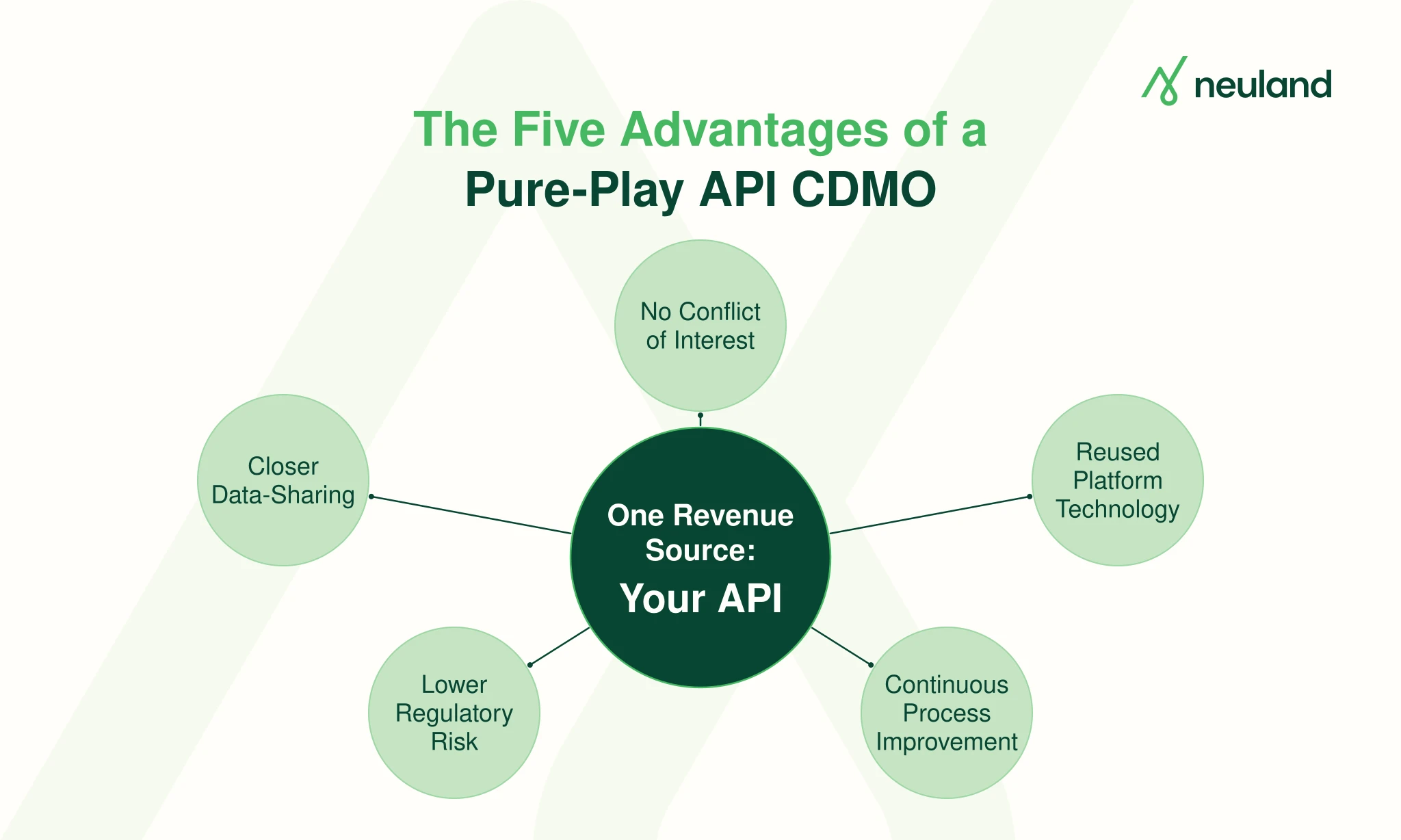
A pure-play API CDMO delivers five advantages, and each traces back to one fact: this manufacturer earns revenue from your API alone. That single revenue source shapes how capacity, R&D, and compliance work get allocated across every project it runs.
No Competitive Conflict of Interest
Manufacturers running their own generics line split reactor time and R&D hours between that product and client work. A pure-play API CDMO carries no internal product competing for that same capacity. Your batch never sits behind an in-house generic on the production queue.
Platform Technology Reused Across Molecules
With capacity undivided, technology built for one client carries forward to the next. Purification and route-scouting methods developed for one molecule often transfer directly to another. A crystallization step perfected on one API can shorten development time on an unrelated one. This shared library grows with every project, and each client benefits from work done for others before them.
Continuous Process Improvement Focus
That same technology base keeps advancing because the margin depends entirely on process efficiency. Higher yield and a cleaner impurity profile raise the manufacturer's return on your molecule directly. No internal product exists to pull that improvement effort elsewhere. Process teams stay engaged with your route well past technology transfer, not just at handover.
Lower Regulatory and Financial Risk Profile
This same focus simplifies compliance, too. A pure-play API CDMO operates one type of facility under one quality system, built around client APIs alone. An integrated manufacturer's generics line can draw a warning letter that pulls inspection resources away from your project. A pure-play facility's entire compliance record applies directly to your work.
Closer Communication and Data-Sharing
An API CDMO shares data without an internal filter deciding what a competitor should see. Integrated manufacturers often route sensitive results through legal or business review before sharing. A competing product line changes what counts as safe to disclose. A pure-play manufacturer has no such conflict. Analytical results and deviation reports reach your team as soon as they're ready. That speed directly shortens technology transfer and scale-up troubleshooting.
Pure-Play vs. Full-Service (Integrated) CDMO: What's the Difference?
A pure-play API CDMO supplies only active pharmaceutical ingredients. A full-service CDMO manufactures APIs and also sells its own finished generic drug products. That second business line creates the overlap discussed earlier. A full-service CDMO can end up competing with the same client whose API it manufactures. The table below breaks down how that difference plays out across the factors buyers evaluate.
| Factor | Pure-Play API CDMO | Full-Service (Integrated) CDMO |
|---|---|---|
| Core business | Develops and manufactures APIs only, with no branded or generic finished-dose products | Manufactures APIs and also markets its own finished generic drugs |
| Conflict of interest | None, the manufacturer has no product that could compete with the client's drug | Present whenever the CDMO's own generic overlaps with a client's therapeutic area |
| IP and data handling | Process data stays tied only to the client's project | Process data sits inside an organization that also runs its own drug development |
| Regulatory exposure | One facility type and one quality system to track | Two operations under one roof, so a compliance issue in one can affect the other |
| Best suited for | Biotech companies protecting a molecule ahead of broad patent coverage | Companies with a diversified portfolio, where losing exclusivity on one product carries less impact |
Choosing between the two models comes down to how much exposure a company can accept. A molecule still years from patent expiry carries more to lose from a conflict of interest. That risk pushes many early-stage biotech companies toward the pure-play API CDMO model. A company with a broad, established portfolio can accept that trade-off for wider manufacturing capacity.
What Should You Ask a CDMO About IP Protection and Conflict of Interest?
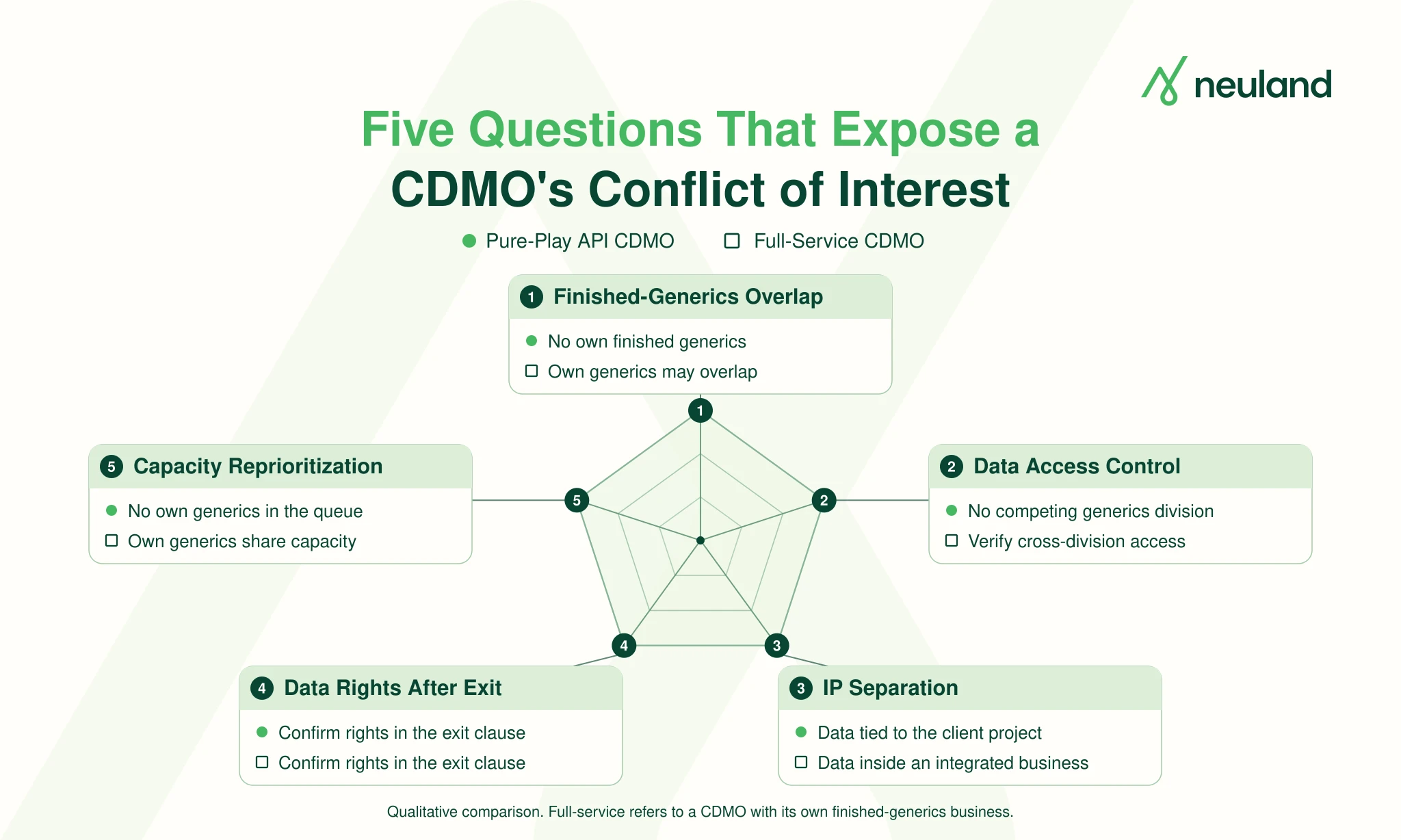
The right questions expose whether a CDMO has a structural conflict of interest before you sign anything. Each question below targets one specific risk point in the manufacturing relationship. Ask these five questions during evaluation, not after the contract is signed:
- Does this manufacturer sell finished generic products in my therapeutic area? A yes signals a possible competing product line.
- Who has access to my process and analytical data, and how is that access controlled? This confirms whether your data stays isolated from other projects.
- How is my intellectual property separated from other client projects on-site? Look for dedicated suites, segregated systems, or named safeguards, rather than a general assurance.
- What happens to my data and process knowledge if I end this contract? A clear exit clause protects your IP after the relationship ends.
- Does my project's capacity get reprioritized during periods of high demand? This reveals whether another client, or the CDMO's own product, can bump your production schedule.
A pure-play API CDMO answers each question directly, with no competing generics line to protect or prioritize. A full-service CDMO's answers often reveal exactly where that conflict sits.
Why Do Biotech Companies Choose Neuland's Pure-Play Model?
Biotech companies choose Neuland because its business model rules out competition with its own clients. Neuland Laboratories operates as a pure-play API CDMO, supplying only active pharmaceutical ingredients. It runs no finished-dose generics business. This singular focus has shaped the company's approach to API manufacturing for more than four decades.
That commitment is backed by robust infrastructure. Neuland operates three cGMP-certified facilities, with regulatory approvals from the FDA, EMA, and PMDA. More than 400 R&D scientists support process development and scale-up work for molecules developed for clients. Biotech and pharma teams sourcing a small-molecule CDMO gain a project team that stays with their molecule, start to finish.
Summary
- A pure-play API CDMO earns revenue from API development alone, keeping every incentive tied to your molecule.
- Full-service CDMOs that also sell generics can access your process data from inside a competing division.
- A pure-play API CDMO's edge, from no internal capacity conflict to ongoing process improvement, comes from having no competing product.
- Full-service CDMOs suit companies with diversified portfolios that can absorb the risk of shared manufacturing capacity.
- More than 60% of Neuland's customer partnerships last beyond five years, a sign of the trust its pure-play model builds.
Ready to evaluate a pure-play API CDMO for your molecule?
Neuland supplies API clients across close to 80 countries, all served under the same pure-play structure. No finished-dose generics line divides that focus. Connect with Neuland's team to discuss your API project.
FAQs
A CDMO protects your IP by separating your process data from other client projects and avoiding any competing product lines. A pure-play manufacturer has no generics business that could benefit from your process knowledge. That separation supports freedom to operate throughout development and commercial supply.
Working with a pure-play manufacturer does not always cost more. Pricing depends on molecular complexity and facility utilization, factors that drive costs at any API CDMO. The IP protection this model provides often offsets any premium over time.
A pure-play manufacturer can support a molecule across its full lifecycle. That includes small-scale clinical batches and commercial-volume manufacturing once a product is approved. The manufacturer stays focused on API supply at every stage.
Many API CDMOs support both small molecules and peptide APIs. Peptide APIs need specialized synthesis capabilities, including solid-phase peptide synthesis and hybrid routes. The same no-compete structure applies to both molecule types, since the CDMO has no competing generics business. Confirm capacity for both areas before signing a contract.