Meet Neuland at CPHI India 2026 | Hall 2, Booth 2D38 | Yashobhoomi Convention Centre, New Delhi | 24-26 November 2026 Schedule a Meeting
Meet Neuland at CPHI India 2026 | Hall 2, Booth 2D38 | Yashobhoomi Convention Centre, New Delhi | 24-26 November 2026 Schedule a Meeting
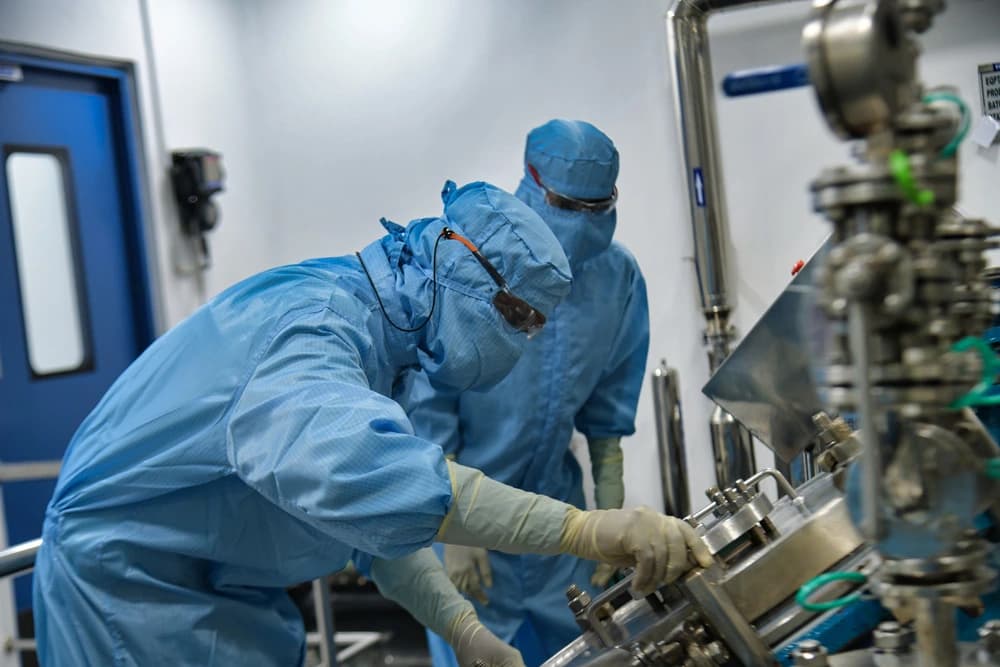
Moving an API from lab glassware to a plant reactor takes more than bigger equipment. During API scale-up, larger vessels mix more slowly and release heat less efficiently. A process that runs cleanly in the lab can then produce new impurities. Here are the seven most common challenges and how to overcome each.
API scale-up is the process of taking an API synthesis from gram-scale lab batches to commercial production. The step is harder than it sounds, because flask chemistry often behaves differently in a plant reactor. Two physical changes usually explain the difference.
The first change is cooling. Reactors lose heat through their walls, and wall area grows more slowly than volume. So the bigger the vessel, the more slowly each liter cools. Mixing is the second change, since reagents take longer to spread evenly in a large batch. Together, these shifts leave warm, concentrated pockets where side reactions can start. Most API scale-up problems, from new impurities to unstable crystal forms, grow out of those pockets.
The biggest challenges in scaling peptide manufacturing follow the same pattern, with large-scale purification added on top. That chromatography capacity is worth checking early when sourcing pharmaceutical peptide APIs.
The seven most common API scale-up challenges fall into two broad groups. Some come from the reaction chemistry and its safety risks. Others surface later, in how the solid API behaves or in the move to the plant. Each section below covers why the problem happens and how teams get past it.
Why it happens: A clean lab reaction can form new impurities after API scale-up, usually because a large reactor mixes and cools more slowly:
These impurities cause two problems. First, each new impurity needs extra purification, and every added step lowers yield. Second, some impurities also creep up during storage, after the batch has passed release testing.
If that level crosses the allowed limit after the drug reaches pharmacies, the batch has to be recalled. FDA data shows how often this happens. In its FY2024 quality report, impurities above the allowed limit were behind 46% of recalls for failed quality specifications.
How to overcome it: The lab is usually the cheapest place to catch these impurities during API process development. Most teams follow three steps:
The outcome is a safe operating window, or design space, for plant batches. It also gives regulators a clear reason for each control.
Why it happens: Reactions that release heat become harder to control after API scale-up, because a plant reactor cannot remove heat as quickly as a lab flask. Reactors are cooled through their outer walls, but heat comes from the whole batch inside. As reactors grow, volume increases much faster than wall area, leaving less cooling surface for each liter. Heat can then build faster, which creates two risks:
Pressurized gas reactions, such as a hydrogenation scale-up, can face both risks at once.
How to overcome it: The safer route is to measure these hazards in the lab before plant equipment is designed. Teams usually run three tests:
Engineers then use these numbers to set how slowly reagents are added and how large the vents must be.
Why it happens: Most APIs are isolated as crystals, so crystallization decides both their purity and their physical form. That form has two parts. The crystal’s outer shape is its crystal habit, and its inner molecular packing is its polymorph. Both can shift with plant cooling and mixing, a lab-to-plant problem that a 2026 review of crystallization process development still lists as unsolved. That is why crystallization in drug substance development needs attention before the first plant batch.
Here is how each change affects the batch:
| Crystal Habit | Polymorphism | |
|---|---|---|
| What changes | The outer shape of each crystal | How molecules pack inside the crystal |
| What it affects | Filtering, washing and powder flow | How fast the drug dissolves and how stable it stays |
| How it is detected | Microscopy | X-ray powder diffraction (XRPD) |
How to overcome it: The fix is to learn which conditions produce the right crystals before the process leaves the lab. Most teams start by screening for polymorphs early, so development begins with the most stable form. During development, in-line probes track crystal size and shape in real time, a method known as process analytical technology (PAT). That data then sets the plant’s cooling rates and seeding. Getting the form right early can avoid a far costlier change after clinical batches are made.
Why it happens: Residual solvent stays in large batches mainly because it gets trapped inside the crystals before drying starts. Two things make it hard to remove:
Longer drying is the usual response, but the extra heat can break down sensitive APIs or change their crystal form. If solvent levels still stay above the limit, the batch must be reprocessed or rejected.
How to overcome it: The more reliable fix is to keep solvent out of the crystals in the first place. Teams do this by growing crystals slowly and steadily, which traps less solvent. You can also choose a solvent that evaporates at a lower temperature, so it dries off without overheating the APIs.
Near-infrared (NIR) probes then track solvent levels as the batch dries, so heating stops once the limit is met. So, planning both steps together helps keep drying shorter and batch results more predictable during API scale-up.
Why it happens: Particle size often drifts after API scale-up because plant equipment forms and handles crystals differently. What matters most is the particle size distribution (PSD), or the range of sizes in a batch. Two batches can share an average size and still differ widely in that range. In a plant, the range tends to shift for two reasons:
That shift causes problems downstream, because PSD affects how fast the drug dissolves and how well the powder flows.
How to overcome it: The work starts with clear API particle size targets, agreed early with the drug product team. Teams then try to hit those targets in two steps:
Each extra step adds cost, so targets should match what the drug product needs.
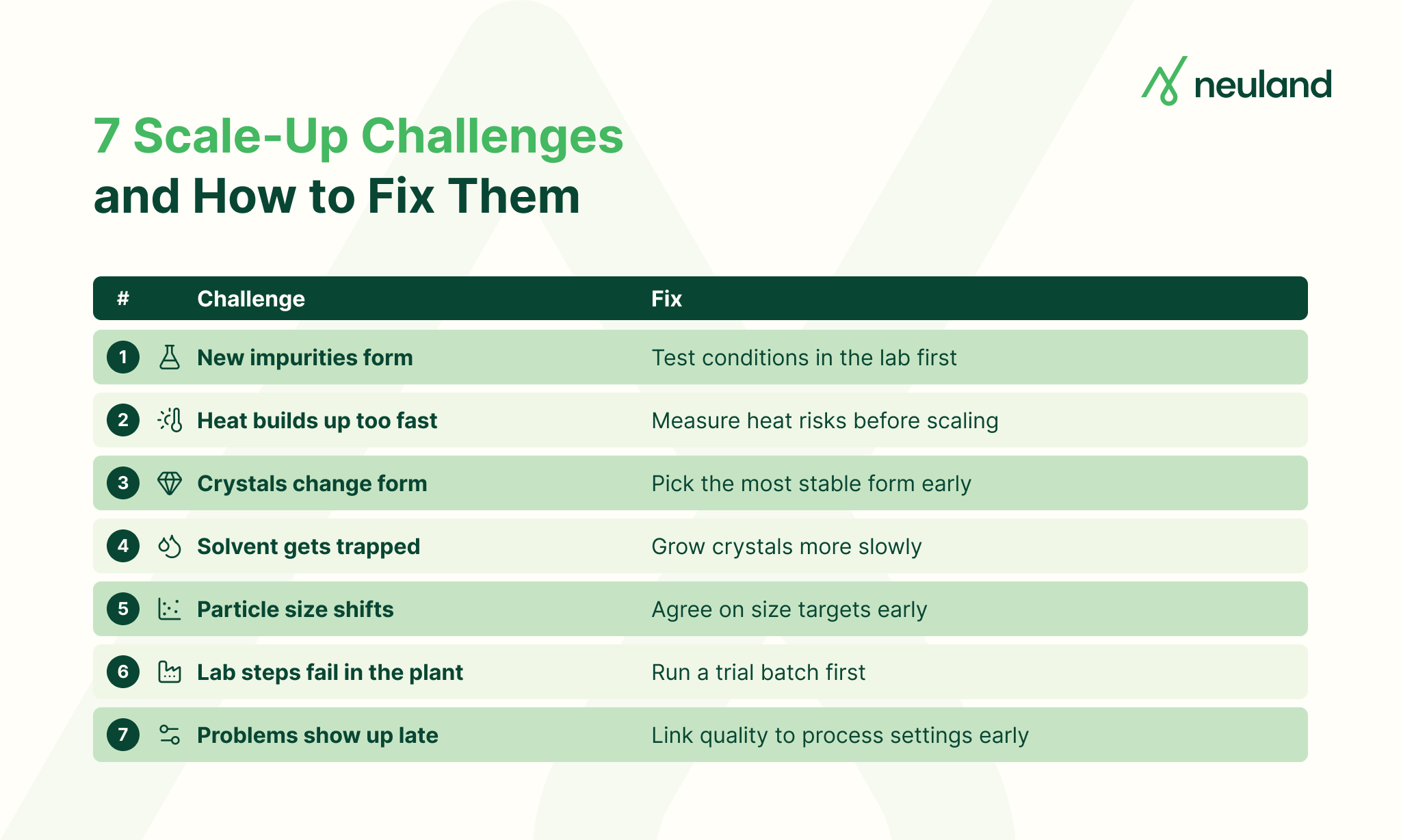
Why it happens: Technology transfer often breaks down during API scale-up because plant equipment behaves differently from lab glassware. Three differences cause most of the trouble:
Together, these small shifts can turn a working lab process into a failed batch. Separate development and plant teams can also lose details in the handover.
How to overcome it: A well-run technology transfer to CDMOs catches these differences early, in four steps:
Why it happens: Most scale-up delays come from problems found too late. When an earlier weakness first shows up in a plant batch, the cost adds up quickly:
How to overcome it: Late failures are best prevented by understanding the process early, an approach called Quality by Design (QbD). QbD for API scale-up links each quality target, such as purity, to the process settings that control it. With that link mapped, teams know:
Fewer surprises mean fewer failed batches, and the same data gives regulators a clearer submission to review.
CDMOs reduce manufacturing costs during scale-up mainly by fixing problems in the lab, where changes cost less than a failed plant batch. In practice, they do it in five main ways:
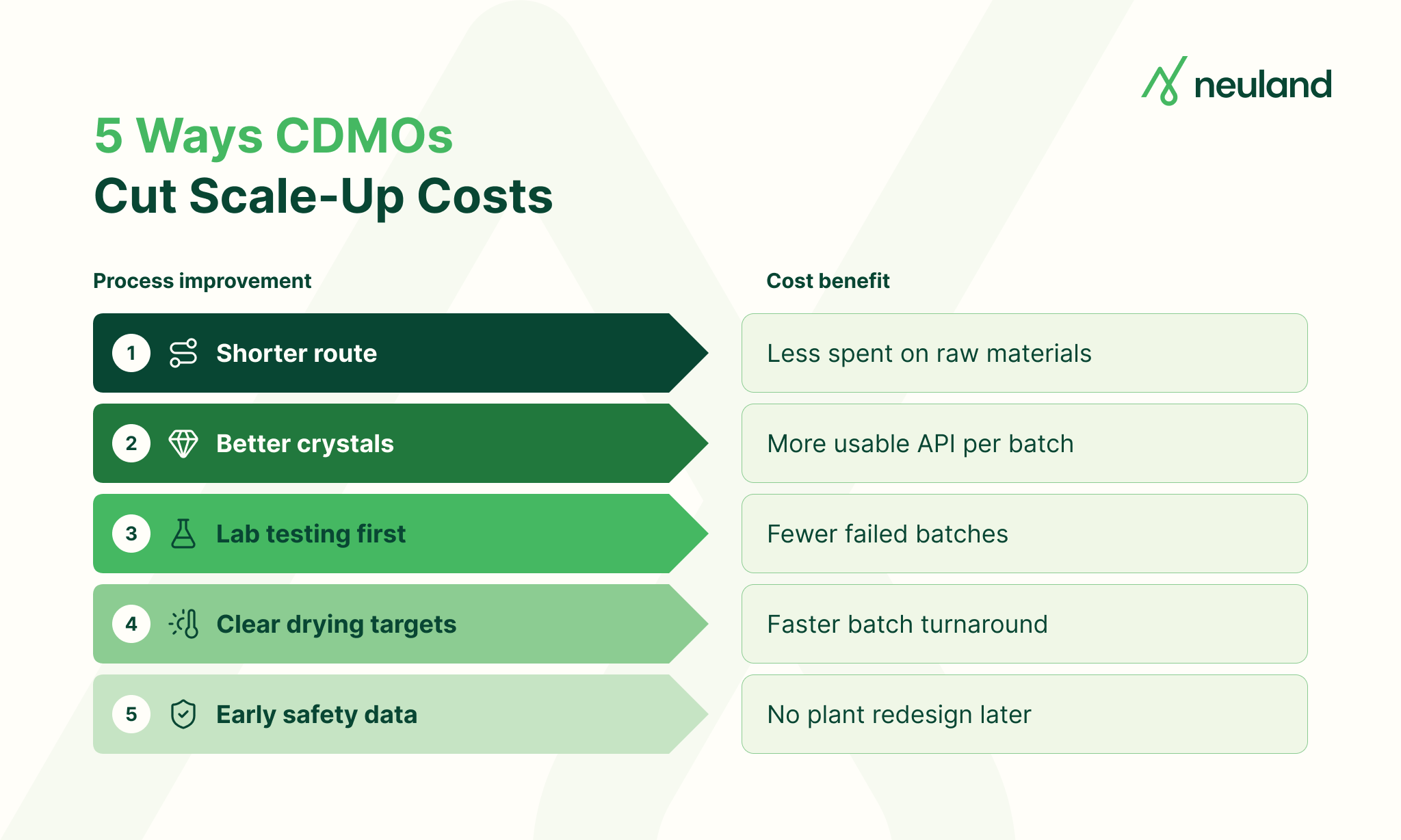
In practice, an integrated API scale-up setup keeps lab work and plant work inside one organization. The goal is to protect process knowledge. When a process moves between companies, the reasons behind its settings can get lost.
A new plant team may see that a reagent is added slowly without knowing the slow rate keeps heat under control. To avoid that, CDMOs supporting early-stage through commercial manufacturing often pair their R&D site with kilo and pilot plants. The chemists who designed a process can then test it at larger volumes themselves.
Neuland Laboratories’ Genome Valley R&D Center follows this layout:
Across more than 40 years of API work, Neuland has supported 150+ NCE programs and 18+ commercial programs. For teams comparing CDMO services, the commercial count is often the most telling figure, since it shows how many programs reached the market.
Want validation built into development from the start?
At Neuland, 408+ scientists work alongside the quality and validation teams who track each process into production. Data gathered during development then supports validation directly. Plan your path to a validated process today.
Pharma companies reduce risk in small molecule API manufacturing by solving problems in the lab before the first plant batch. That means testing reactions for safety hazards and finding the conditions that keep impurities in check. Many also pick a shorter route through synthetic route scouting, which leaves fewer steps that can go wrong.
The CDMOs that offer GMP manufacturing alongside development and scale-up usually run all three within one company. Between the lab and the plant, kilo and pilot runs test each process at a larger scale first. Because the molecule never changes hands, lab knowledge carries straight through to production.
The key considerations for technology transfer in API manufacturing start with a complete written record of the process. That record should cover two things:
With that record in hand, both sites can agree in advance on what a successful batch looks like and who resolves deviations.
A design space in API scale-up is the tested range of conditions where batches reliably meet quality standards. Those conditions usually include temperature and mixing speed, mapped through planned lab experiments. Once regulators approve the design space, the manufacturing team can adjust settings within it without filing a regulatory change.