

Key Takeaways
- Six properties, from synthesis type to isolation strategy, decide whether an API synthesis route holds yield and purity together.
- Linear routes compound yield loss at every step, while parallel routes cap that loss by building fragments simultaneously.
- Propinquity sets how many steps fall under GMP oversight, shaping both cost and delivery timeline.
- A reliable synthesis partner is judged on how it handles route tradeoffs.
- Neuland's reactors scale a validated route from 100-gram batches up to 150 kg, so yield and purity data carry forward as the process moves toward commercial delivery.
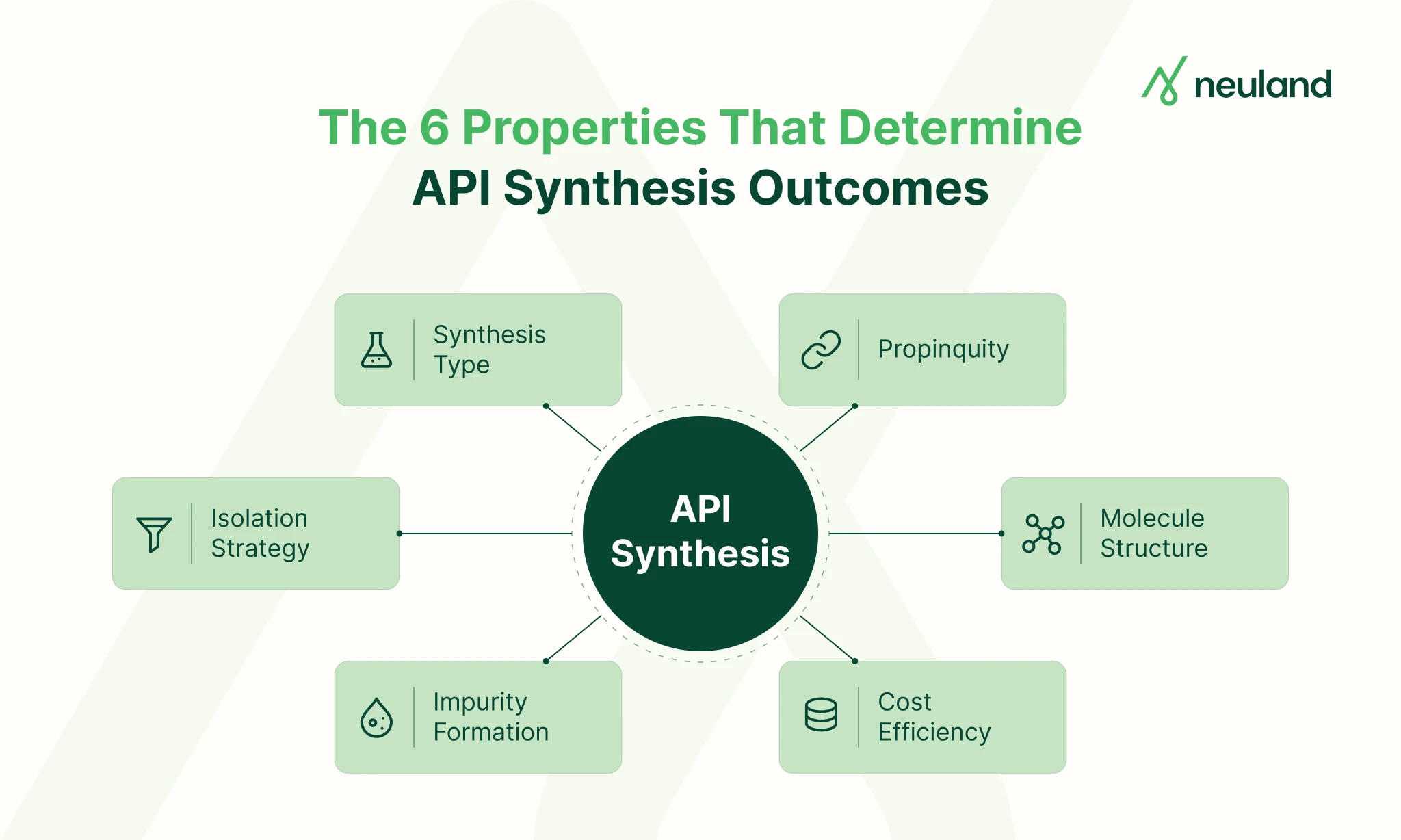
Six properties decide how well an API synthesis route performs. They are synthesis type, propinquity, molecule structure, cost efficiency, impurity formation, and isolation strategy. Synthesis type and molecule structure set the limit on yield, since losses build up as a route grows longer or more complex.
Propinquity and isolation strategies determine how many steps fall under GMP control, which directly shapes cost and delivery time. Impurity formation ties back to all four, since a shorter, cleaner route needs less correction later. These six properties work together to determine whether an API manufacturing process maintains yield and purity while staying on schedule.
What Are the Key Properties of API Synthesis That Affect Yield, Purity, and Delivery Timelines?
The key properties range from synthesis type and step count to molecule structure and isolation strategy. Each property interacts with the others, so a route rarely fails or succeeds on a single factor alone. The sections below break down what each property controls and why it matters for a working API manufacturing process.
Linear and Parallel Synthesis Produce Different Yield Outcomes
Linear synthesis builds an API through one continuous sequence of steps. Parallel synthesis builds separate fragments simultaneously, then joins them in a final coupling step. This difference changes how yield compounds across the route.
In linear synthesis, a loss at any step carries forward through every step after it. Table 1 shows the effect. A six-step linear route at 85% yield per step delivers only 38% overall. A parallel route splitting that work across three simultaneous steps and one coupling step yields at 52%.
Table 1: Linear vs. Parallel Synthesis Yield Comparison
| Synthesis Type | Steps | Yield per Step | Overall Yield |
|---|---|---|---|
| Linear synthesis | 6 sequential steps | 85% | 38% |
| Parallel synthesis | 3 parallel steps + 1 coupling step | 85% | 52% |
Parallel synthesis also shortens delivery timelines, since both fragments are built together instead of one after another. This makes synthetic route design a direct lever on yield and speed alike.
Propinquity Determines How Much of the Synthesis Route Falls Under GMP Control
Propinquity is the number of chemical steps between the starting material and the finished API. It decides how much of an API synthesis route falls under GMP oversight, since regulators treat the starting material as the point where GMP controls begin.
A shorter propinquity brings fewer steps under the GMP scope, lowering cost and timeline. A longer propinquity brings more steps under oversight, adding time and documentation but often tightening control at each stage. This tradeoff makes propinquity a key factor in planning the synthesis, even though it gets little attention outside process chemistry.
Molecule Structure Complexity Sets a Ceiling on Achievable Yield
Molecule structure sets a ceiling on achievable synthesis yield before process work begins. Chiral centers lower that ceiling, since each one creates multiple isomers of the same molecule, and usually only one isomer is active or safe to use.
Isomer separation isolates that one correct form from its counterparts. A molecule with two chiral centers can generate up to four isomers, only one of them being the target. Recovering it through chromatography or crystallization costs yield, since material is lost to the other three. Structural complexity, more than any process change, therefore, sets the limit on what a route can yield.
Cost-Efficient API Synthesis Depends on Step Count and Cycle Time
Cost-efficient synthesis depends on step count and cycle time. Each step adds solvent use, equipment time, and a fresh chance to lose material. Fewer steps bring all three costs down together.
Raw material choice shapes cost as well. Routes built on widely available starting materials avoid the price and supply risk of scarce reagents. Yield ties these factors together, since a route that loses less material at each step needs less raw input for the same output. A truly cost-efficient route protects yield and quality throughout the drug development and manufacturing process.
Reducing Impurities Starts With Route Design
A route with fewer steps and cleaner chemistry generates fewer byproducts in the first place, leaving less work for purification later. This differs from correcting impurities after they form, which is slower and less reliable.
Solvent choice and reaction order, along with the step count, all influence which impurities appear and in what quantity. Nitrosamines and genotoxic-related risks deserve their own detailed treatment. Within route design itself, the goal is a sequence that limits impurity formation early. This way, the finished API meets the specification with fewer corrections downstream.
Isolation Steps Shape Both Yield and Timeline in API Synthesis
Isolation steps recover and purify an intermediate before it moves to the next reaction. Each isolation adds time, equipment use, and a point where material can be lost. Minimizing isolation steps without sacrificing control is one of the clearest ways to shorten a synthesis timeline.
The isolation strategy depends on the intermediate itself. Charge-based methods, such as acid-base extraction, work well for ionizable compounds. They avoid the need for a separate purification step. Column-based separation offers finer control for complex mixtures but adds processing time and solvent use. Choosing the right isolation method for each intermediate keeps both yield and timeline in check.
Why Does API Synthesis Design Matter When Choosing a CDMO Partner?
The synthesis design matters because it decides a molecule's cost, quality, and timeline for its entire commercial life. A partner who understands propinquity, isomer separation, and isolation strategy can catch problems before they reach a regulatory filing. Fixing a route after that point means new comparability data and fresh submissions, which adds cost and time.
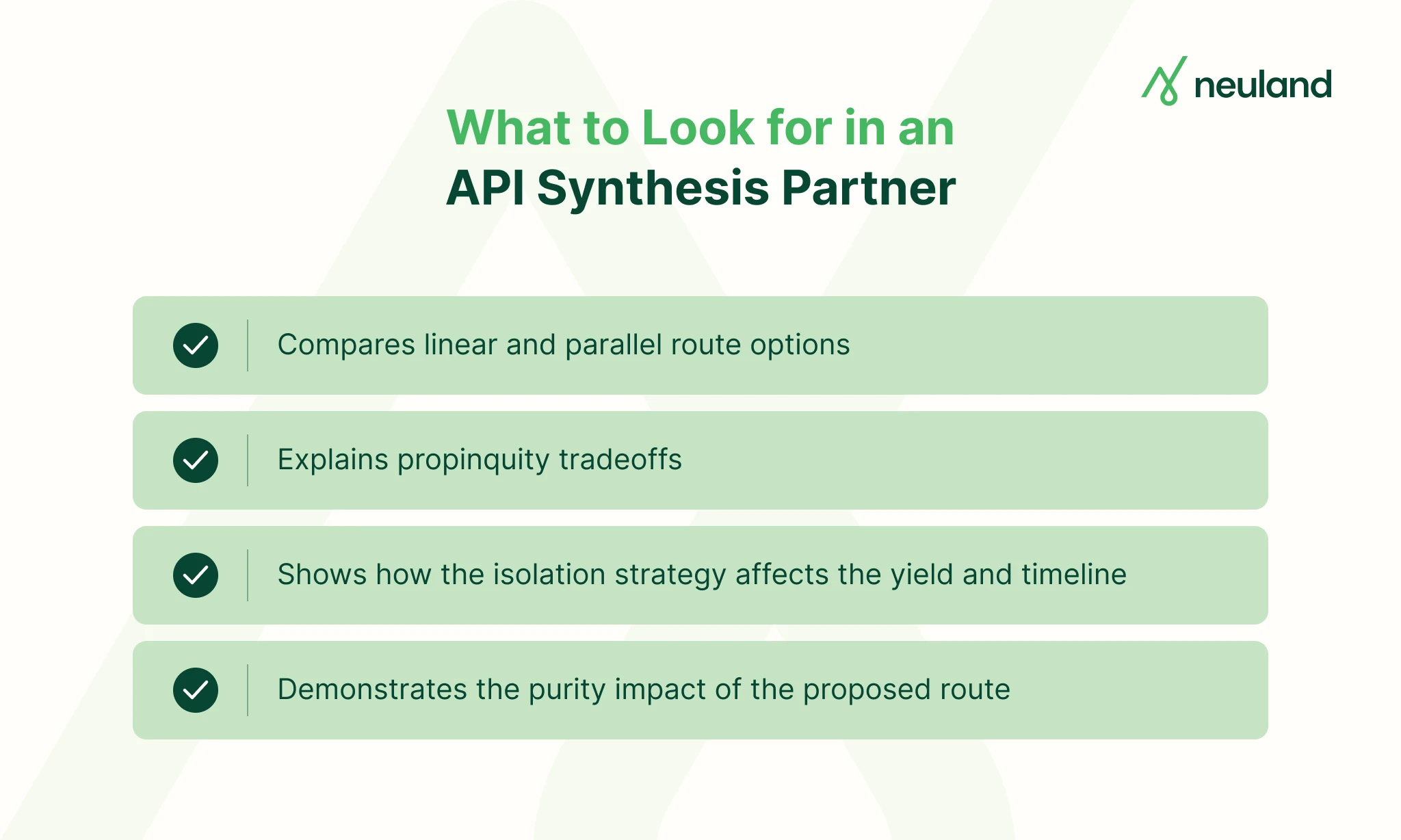
This makes route evaluation a key factor in choosing a partner for API synthesis work. A strong partner should be able to:
- Compare linear and parallel options and explain which fits the molecule better
- Justify the tradeoffs in propinquity between cost, speed, and GMP oversight
- Show how the isolation strategy affects both yield and timeline
- Demonstrate, with specifics, how the proposed route affects purity before the drug manufacturing begins
This kind of insight matters more than API manufacturing process capacity alone.
Neuland Laboratories works through these same tradeoffs during process development, before a route is locked in. Its teams study each step of a molecule's chemistry first, and then test where the propinquity boundary should sit. This early groundwork is what lets a route hold up once it reaches a regulatory filing, rather than needing correction after commercial-scale production has already begun.
Summary
- All six API synthesis properties interact, so no single factor determines a route's outcome.
- Cost efficiency and shorter timelines trace back to step count, while impurity formation depends on route design.
- Isolation strategy and propinquity decide how much of a route sits under GMP control.
- Reviewing route trade-offs before a CDMO partnership begins helps avoid costly corrections later.
- Neuland's 400+ R&D specialists work across process development, analytical development, and CMC regulatory support. Each synthesis project has a team that carries route decisions through to filing and scale-up.
Looking for a partner who understands route tradeoffs?
Neuland works as a dedicated API provider to more than 500 customers globally, applying route-scouting experience across a wide range of molecule types. Talk to Neuland's team about your next API synthesis project.
FAQs
Route selection and process development typically take several months before commercial synthesis begins. It depends on molecule complexity. Structural challenges, such as multiple isomers, can extend this timeline further.
Yes, an existing synthesis route can be re-scouted after commercialization. A second-generation route can improve yield, remove a constrained raw material, or reduce cost, extending the commercial life of the product.
API synthesis refers to the chemical steps that build the active molecule itself. API manufacturing is the broader process, covering synthesis, purification, quality testing, and release under GMP conditions. Synthesis is one part of the larger manufacturing process, rather than a substitute for it.
A CDMO proposing an API synthesis route should share more than a final yield number. Useful data points include:
- Step-by-step rationale for why a linear or parallel approach was chosen
- Where the propinquity boundary sits, and why
- The planned isomer separation method, if the molecule has chiral centers
- Projected yield and purity at each major stage, instead of just the final output