
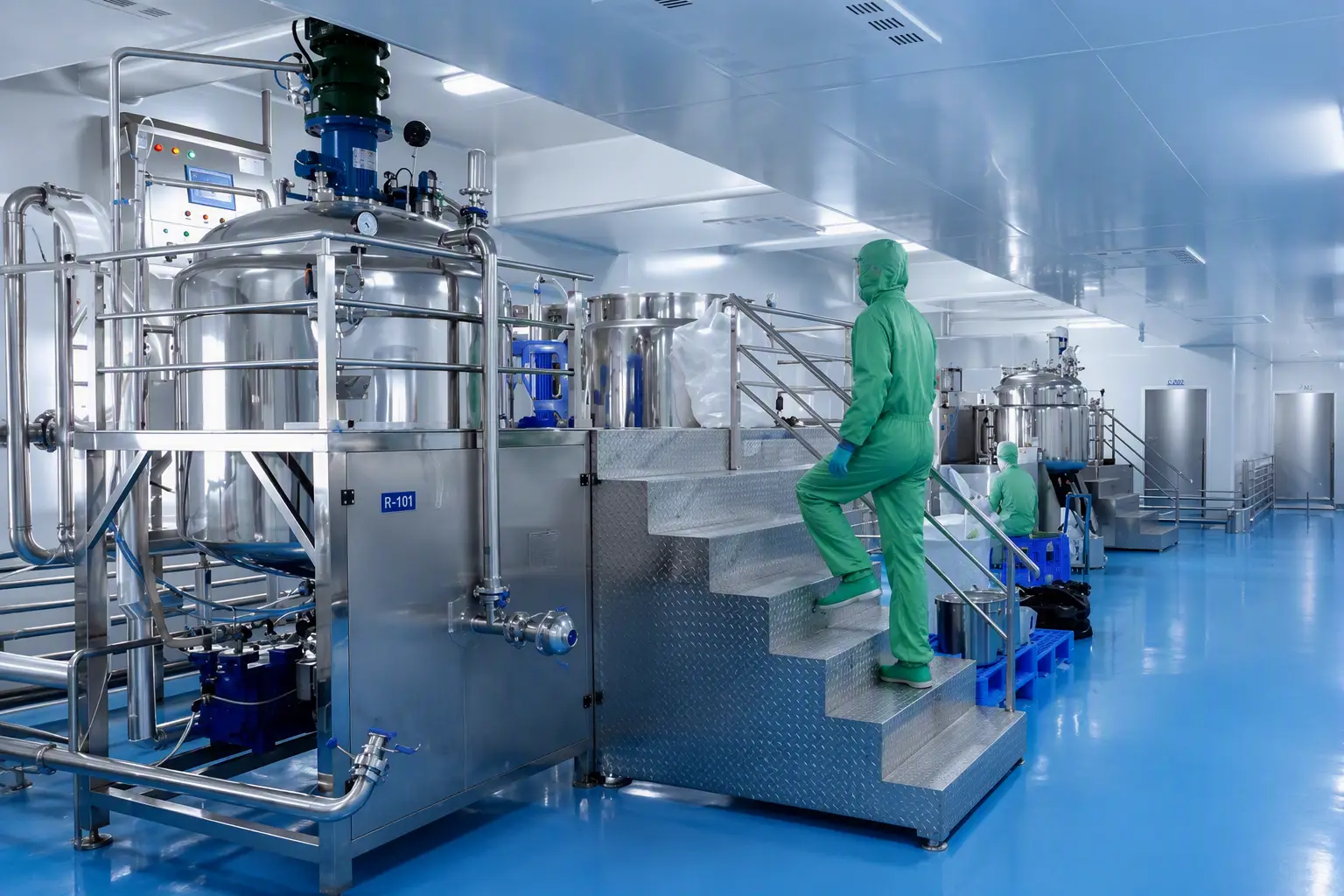
In pharmaceutical manufacturing, capacity is often estimated using straightforward metrics such as reactor volume, batch size, and cycle time. For many traditional processes, this approach provides a reliable view of how much output a facility can deliver.
Peptide manufacturing, however, does not follow this model.
Peptide manufacturing does not scale through equipment volume alone. Because each molecule brings its own sequence length, impurity profile, purification challenge, and isolation behavior, capacity must be assessed as an end-to-end process constraint rather than a simple measure of batch size or reactor availability.
For biotech and pharmaceutical companies developing peptide therapeutics, understanding these dynamics early is critical for accurate forecasting, risk mitigation, and selecting the right development and manufacturing partner.
Why Conventional Capacity Models Fall Short
In many API manufacturing processes, capacity scales linearly:
- Larger reactors enable bigger batch sizes
- Faster cycle times increase annual throughput
This model works when synthesis is relatively short, yields are stable, and purification is not a limiting factor.
Peptides break this linear relationship.
Peptide APIs are assembled step-by-step through sequential amino acid addition, often across 20 to 50 or more cycles. Each step introduces variability, yield loss, and potential impurities. At the same time, downstream purification demands are significantly higher due to the structural similarity of these impurities.
As a result, peptide capacity is not determined by equipment size alone. It is shaped by molecule complexity, process efficiency, raw material performance, purification throughput, and isolation capacity.
Key Factors That Define Peptide Manufacturing Capacity
1. Molecule-Specific Characteristics
Unlike more standardized processes, peptide capacity varies significantly from one molecule to another based on each molecule’s intrinsic properties.
Key variables include:
- Sequence length, which affects impurity generation and yield
- Chemical modifications, such as cyclization, PEGylation, or lipidation, which alter the physical characteristics of the peptide
- Stability, including susceptibility to oxidation or degradation
These factors directly influence the scalability of peptides. Therefore, each peptide program must be evaluated independently, and capacity cannot be generalized across projects.
2. Quality and Availability of Starting Material
Peptide manufacturing relies on specialized raw materials such as resins, Fmoc-amino acids, coupling reagents, additives, and solvents. During scale-up, variations in the quality, specifications, or source of these materials can significantly impact process performance, leading to:
- Increased impurity generation
- Reduced coupling efficiency
- Unexpected yield losses
- Batch-to-batch variability
- Delays due to material shortages or long lead times
3. Synthesis Strategy and Route Design
The choice of synthesis method directly influences capacity outcomes:
- Solid-phase synthesis (SPPS) supports automation and speed but increases downstream purification load
- Solution-phase synthesis (LPPS) can improve scalability for shorter peptides
- Hybrid approaches balance yield, impurity control, and purification efficiency
Selecting the optimal route early is critical to achieving consistent, scalable production.
4. Cumulative Yield Across Multi-Step Synthesis
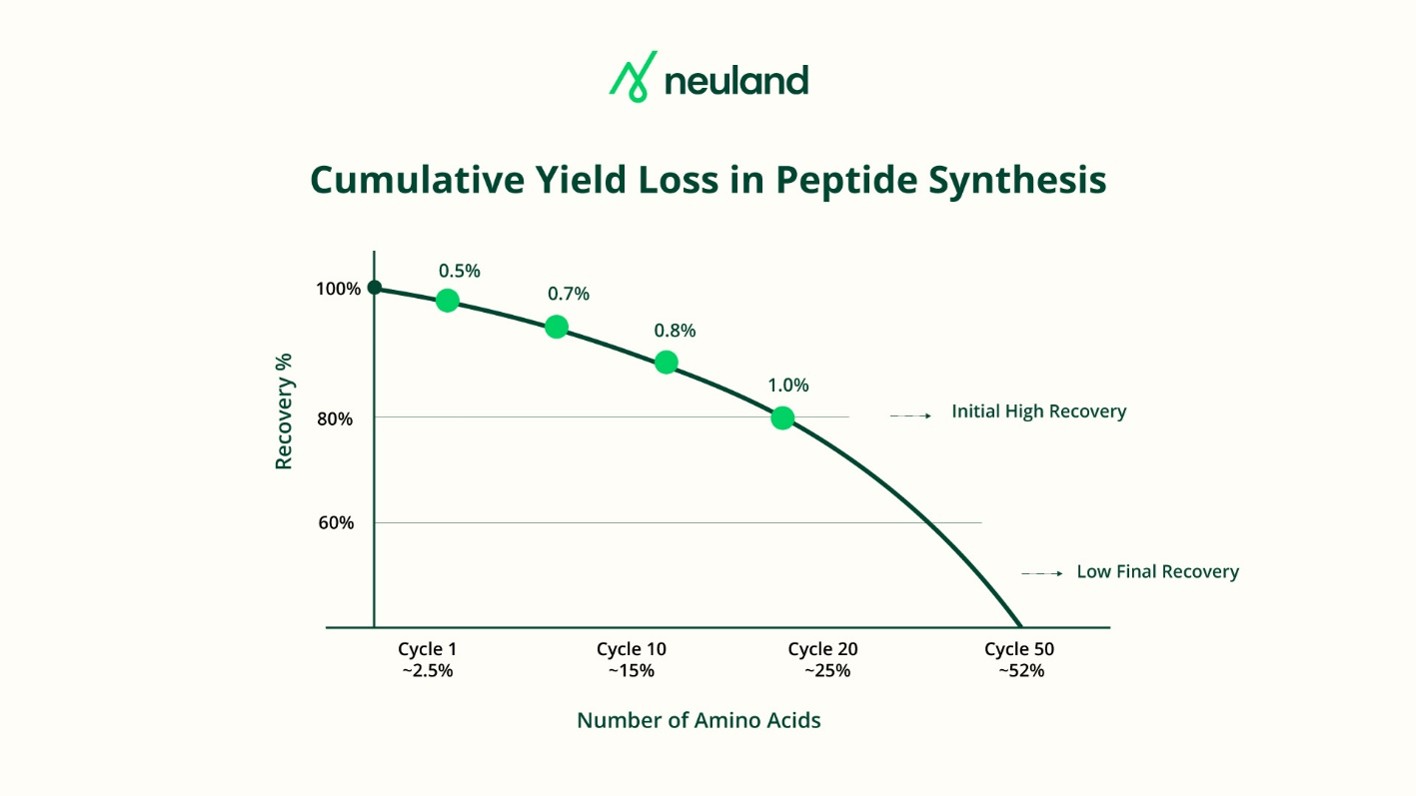
Peptide synthesis involves a series of repetitive coupling and deprotection cycles. While each individual step may exhibit high efficiency, even small levels of incomplete reactions or impurity formation can accumulate over the course of multiple cycles.
As peptide chain length increases:
- Minor losses at each step become magnified.
- Longer sequences experience greater cumulative yield reduction.
- Truncated and deletion impurities increase.
- Crude purity declines, increasing purification burden.
Therefore, overall product recovery per batch can fall sharply as sequence length increases. Even when individual coupling steps appear efficient, the cumulative effect of many small losses can reduce crude purity, increase purification load, and limit the quantity of acceptable peptide recovered from each batch.
5. Impurity Profile Complexity
Peptide synthesis generates a range of closely related impurities, including:
- Addition/ deletion sequences
- Epimers
- Oxidation variants
These impurities:
- Exhibit similar molecular weight and physicochemical properties
- May co-elute during chromatography
- Require advanced analytical and purification strategies
This increases processing time and reduces overall output efficiency.
6. Purification Throughput as a Capacity Constraint
Purification is one of the most defining elements of peptide capacity.
Peptide impurities are structurally very similar to the target molecule, often differing by only a single amino acid, stereochemical variation, or minor modification.
Because of this:
- Often Single step purification by preparative reverse-phase HPLC is not enough to separate.
- Multiple purification step may be needed based on the complexity
- Column loading capacity is limited
- Requirement of large solvent volumes and managing them
Purification can account for 50–60% of overall manufacturing cost, highlighting its dominant role in defining throughput.
In many cases, purification—not synthesis—is the true bottleneck.
7. Equipment capacity and scale up constrained
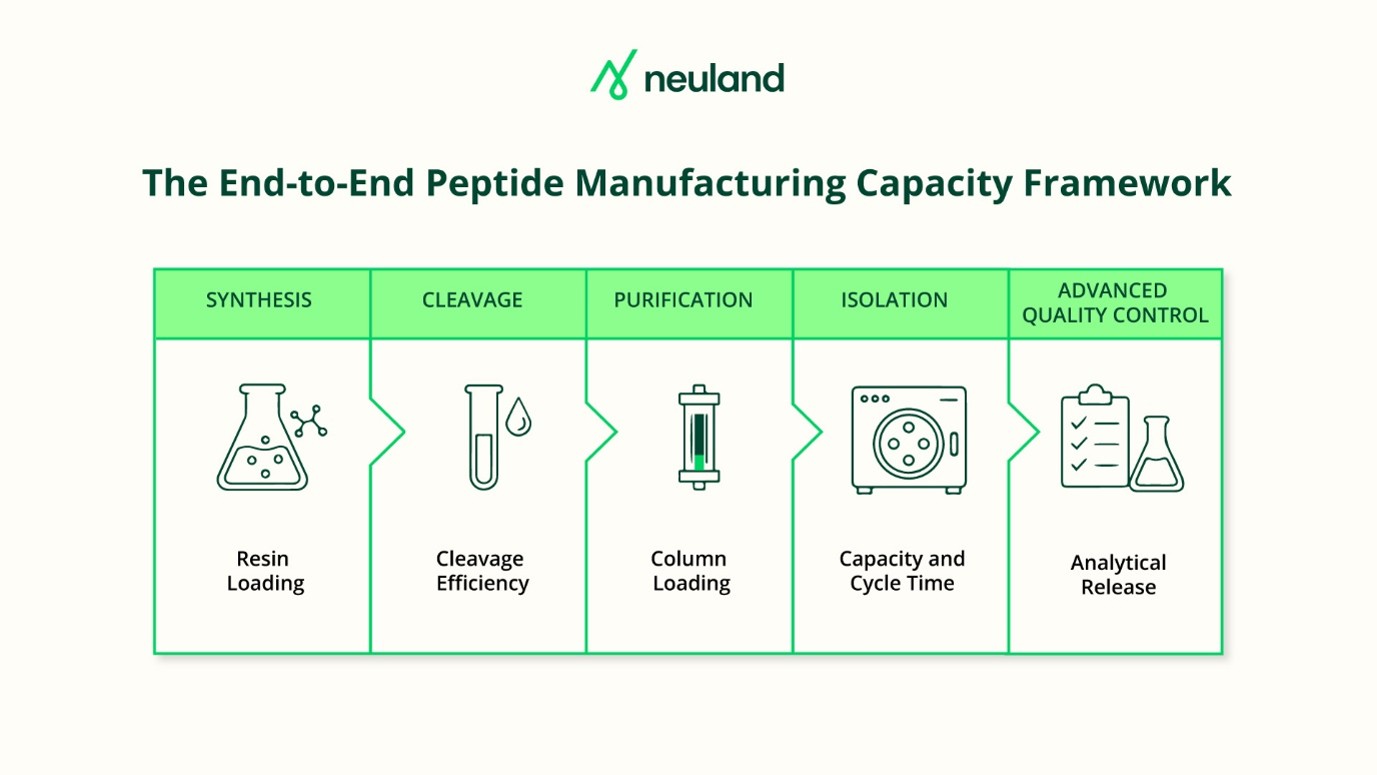
Peptide manufacturing capacity is inherently constrained by practical scale limit of key equipment used for the three major process steps:
- SPPS for Synthesis
- DAC for purification
- Isolation by freeze drying/ Lyophilization
Process complexity significantly increases with further scale up & lead to the risk of failure.
Overall plant capacity is governed by the throughput of those critical process steps rather than simply increasing equipment size.
8. Rethinking Capacity: From Equipment to Process
Peptide manufacturing requires a shift in mindset.
Rather than evaluating capacity based on equipment size alone, a more accurate approach considers:
- Design a phase appropriate synthesis strategy
- SPPS
- LPPS
- Hybrid (combination of SPPS & LPPS)
- Selecting orthogonal purification strategy
- Innovative solution for isolation
- Lyophilization throughput
- Spray drying
- Precipitation
- End-to-end process efficiency
This transition from an equipment-driven to a process-driven perspective is essential for realistic planning and successful scale-up.
Conclusion
Peptide manufacturing capacity is shaped by molecule-specific characteristics, starting material quality, synthesis strategy, cumulative yield, and impurity complexity. Purification throughput, equipment limitations, and scale-up constraints make traditional capacity models insufficient. True capacity must be redefined as an integrated process that balance chemistry, technology, quality systems, and skilled manpower.
This holistic, industry‑driven approach ensures sustainable peptide capacity, enabling companies to meet rising therapeutic demand with confidence and secure long‑term competitiveness in the peptide market.
Connect with our scientists to understand how your molecule will behave at scale—and how to build a manufacturing strategy around it.