Meet Neuland at CPHI India 2026 | Hall 2, Booth 2D38 | Yashobhoomi Convention Centre, New Delhi | 24-26 November 2026 Schedule a Meeting
Meet Neuland at CPHI India 2026 | Hall 2, Booth 2D38 | Yashobhoomi Convention Centre, New Delhi | 24-26 November 2026 Schedule a Meeting
Synthesis scouting is the systematic evaluation of alternative chemical routes to make a target molecule, in order to select the one that is most efficient, scalable, safe, and cost-effective for manufacturing. It is also called route scouting or synthetic route scouting.
The exercise draws on several disciplines at once, including medicinal, synthetic, and process chemistry. Every step in a candidate route is examined before any decision is made to combine, reorder, or eliminate steps.
The goal is not simply a route that works. It is the route that will still work reliably when it moves from grams in a laboratory to hundreds of kilograms in a commercial reactor.
Synthesis scouting is important because the route chosen early in development determines the cost, safety, and manufacturability of the API for the rest of its commercial life. A poor route is difficult and expensive to correct once it is embedded in a regulatory filing.
As molecules grow more complex, the first route discovered by discovery chemists is rarely the right one for manufacturing. It was designed to make a few grams to prove the science, not to make a metric tonne economically.
Route scouting bridges that gap. It is the point in pharmaceutical process development where a molecule that is scientifically interesting becomes a product that is commercially viable.
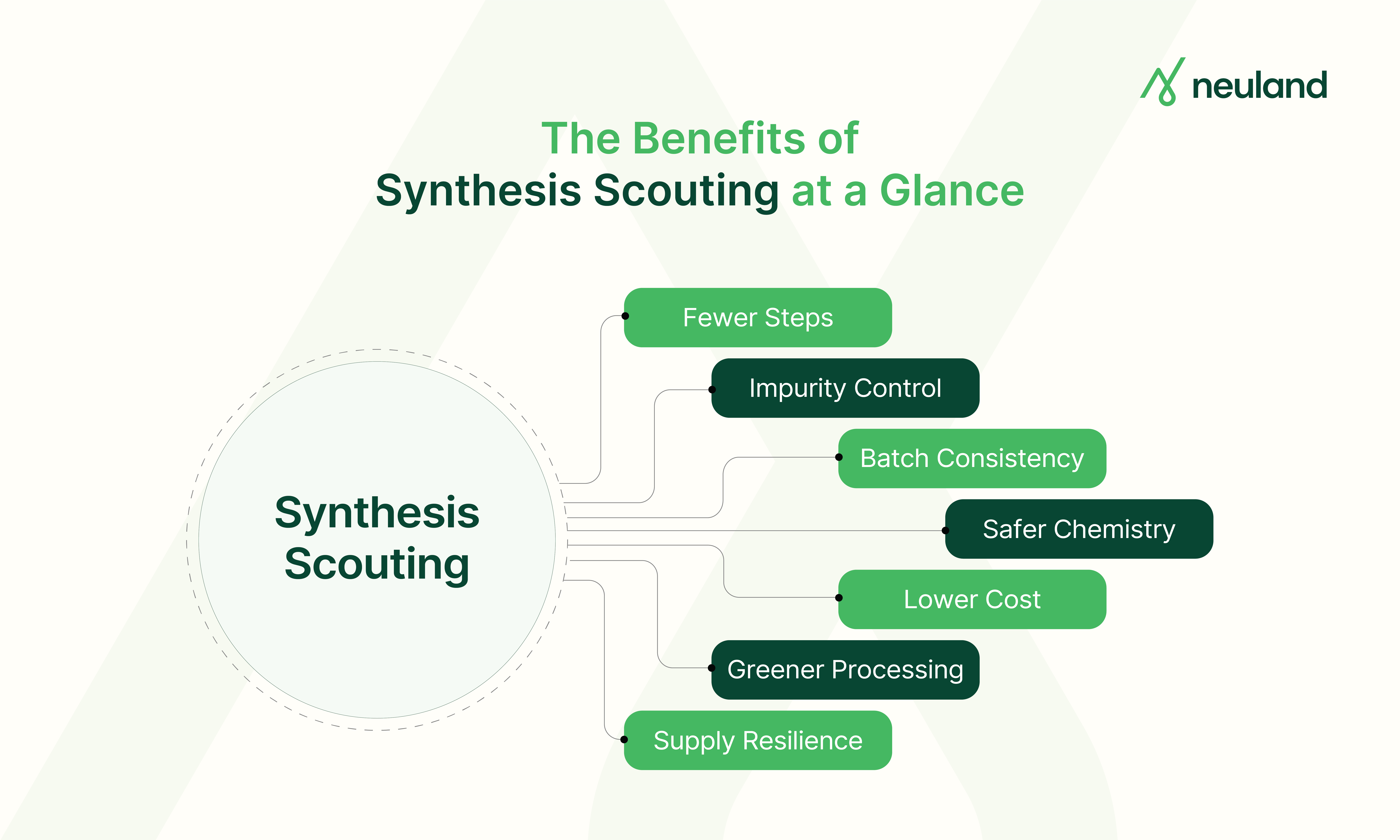
The key benefits of synthesis scouting span cost, quality, safety, and sustainability. A well-scouted route improves all four simultaneously rather than trading one against another.
Here are the main benefits a strong route scouting exercise delivers:
Route scouting reduces steps by combining, reordering, eliminating, and simplifying the reactions in a synthetic sequence. The chemistry of each step is understood first, and only then are steps consolidated.
The most direct lever is step reduction. Two reactions that can be telescoped into one, without isolating the intermediate in between, remove handling, drying, and analytical testing from the process.
Reordering matters just as much. When a particular reagent or transformation is introduced in the sequence can change the entire impurity profile downstream, and in some cases determines whether a candidate succeeds or fails.
The payoff is compounding. Fewer steps mean fewer critical control points, less equipment and utility use, shorter cycle times, and fewer opportunities for out-of-specification product. A shorter route is very often a more consistent and more economical route.
Solvent selection is important because solvents drive a large share of an API's cost, safety profile, waste burden, and processing complexity. Choosing the right solvent and introducing it at the right step is one of the highest-leverage decisions in route scouting.
The wrong solvent adds cost in several directions at once. It can require additional processing steps to clear toxic residues, increase hazardous waste handling, and complicate the manufacturing infrastructure needed to run the process safely.
A useful strategy is to front-load any hazardous or toxic chemicals as early in the sequence as possible, giving the maximum number of downstream steps to clear them before the final API.
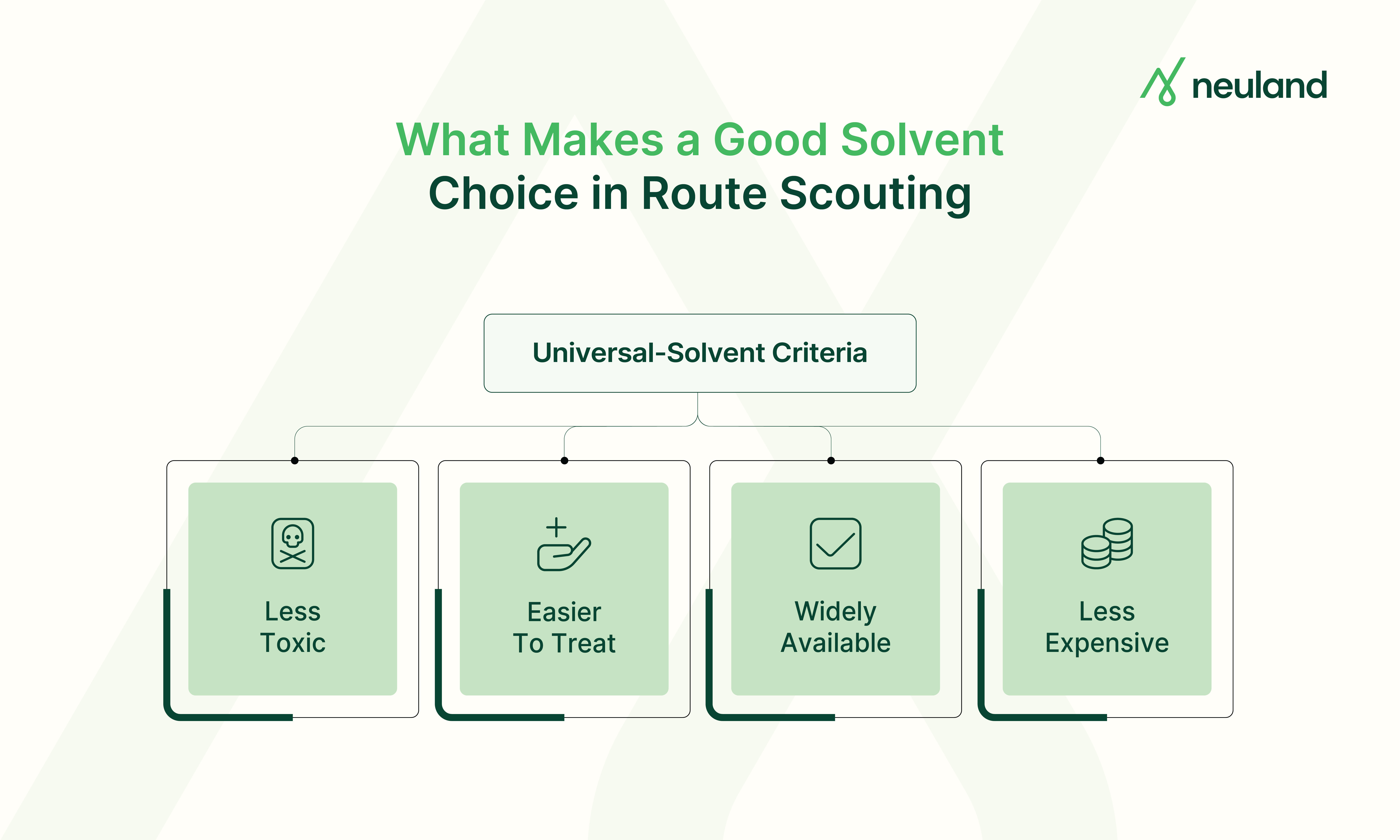
Wherever possible, the preference is for universal solvents, including water, that carry well-characterized safety profiles. These tend to be:
Selecting the right solvent and introducing it at the optimal step delivers a shorter process, cleaner batches, and measurable savings on the back end through reduced hazardous waste, treatment, and disposal.
Synthesis scouting supports impurity control by designing routes that generate fewer impurities in the first place, rather than relying on downstream purification to remove them. Prevention is cheaper and more reliable than correction.
Every reaction step is a potential source of byproducts and process-related impurities. A route with fewer steps and cleaner chemistry gives fewer opportunities for these impurities to form.
This links directly to quality. Under a Quality by Design (QbD) approach, understanding how the route influences the impurity profile is part of building quality into the process, so that the final API consistently meets its specification.
Route scouting improves scalability by choosing chemistry that behaves predictably as volumes increase and improves supply chain resilience by favoring routes built on accessible, low-risk raw materials.
Scalability is a design decision, not a later discovery. A reaction with a sharp exotherm or a difficult mixing requirement may be trivial at laboratory scale and dangerous or uncontrollable at commercial scale.
Follow these considerations to keep a route scalable and resilient:
Synthesis scouting should happen early in API process development, ideally before a route is committed to regulatory filings or commercial scale-up. The earlier a better route is found, the cheaper it is to adopt.
Changing a route after it is embedded in a DMF or regulatory submission is possible but costly, requiring comparability work and new filings. Finding the efficient route before that point avoids the expense entirely.
That said, scouting can also add value later, when an existing commercial process is under cost pressure or facing a raw material constraint. A second-generation route can extend the commercial life and margin of a mature product.
Summary Points
Looking for a CDMO that can identify efficient, scalable routes for your API?
Neuland Labs partners with pharmaceutical and biotech companies on complex API development, from route scouting and process development through to commercial supply. Connect with our process development team to discuss your project.
Synthesis scouting identifies and compares alternative routes to a molecule, selecting the best candidate. Route optimization then refines that chosen route to improve yield, purity, and efficiency. Scouting decides the path; optimization perfects it.
The order of reagent addition can change the impurity profile, yield, and safety of a reaction. In some cases it determines whether a candidate molecule succeeds or fails, which is why reordering steps is a core part of route scouting rather than a minor adjustment.
Synthesis scouting reduces cost by cutting the number of steps, selecting cheaper and safer solvents, improving yield, and lowering hazardous waste handling. These savings compound across the route, producing a materially lower cost of goods at commercial scale.
Yes. By reducing step count, favouring less toxic and more manageable solvents, and cutting hazardous waste, route scouting directly supports green chemistry goals. Cleaner processing also lowers the environmental, health, and safety burden of manufacturing.
Yes, and it is often worthwhile. A second-generation route can reduce cost, remove a supply-constrained raw material, or improve safety for a product already in commercial production. Neuland's custom development work covers both new and existing routes.
Synthesis scouting is carried out by process chemists and process development teams, drawing on medicinal, synthetic, and process chemistry expertise. At a CDMO, this sits within process development and works closely with analytical, safety, and manufacturing functions.