Meet us at Tides Europe 2026, Stand No. 805, Nov 3-5, RAI Amsterdam, Netherlands Schedule a Meeting

From pain relievers to cancer therapies, small-molecule compounds have long been the foundation of modern medicine.
These compounds, typically with a molecular weight under 900 Daltons, are chemically synthesized, easy to formulate as pills or capsules, and capable of targeting a wide range of diseases.
Small molecule development refers to the full journey of turning a promising chemical compound into an approved pharmaceutical product.
For pharmaceutical and biotech companies, understanding the fundamentals of small-molecule drug development is essential. Whether you're in early discovery or preparing for commercial launch, having the proper roadmap and the right CDMO can accelerate success.
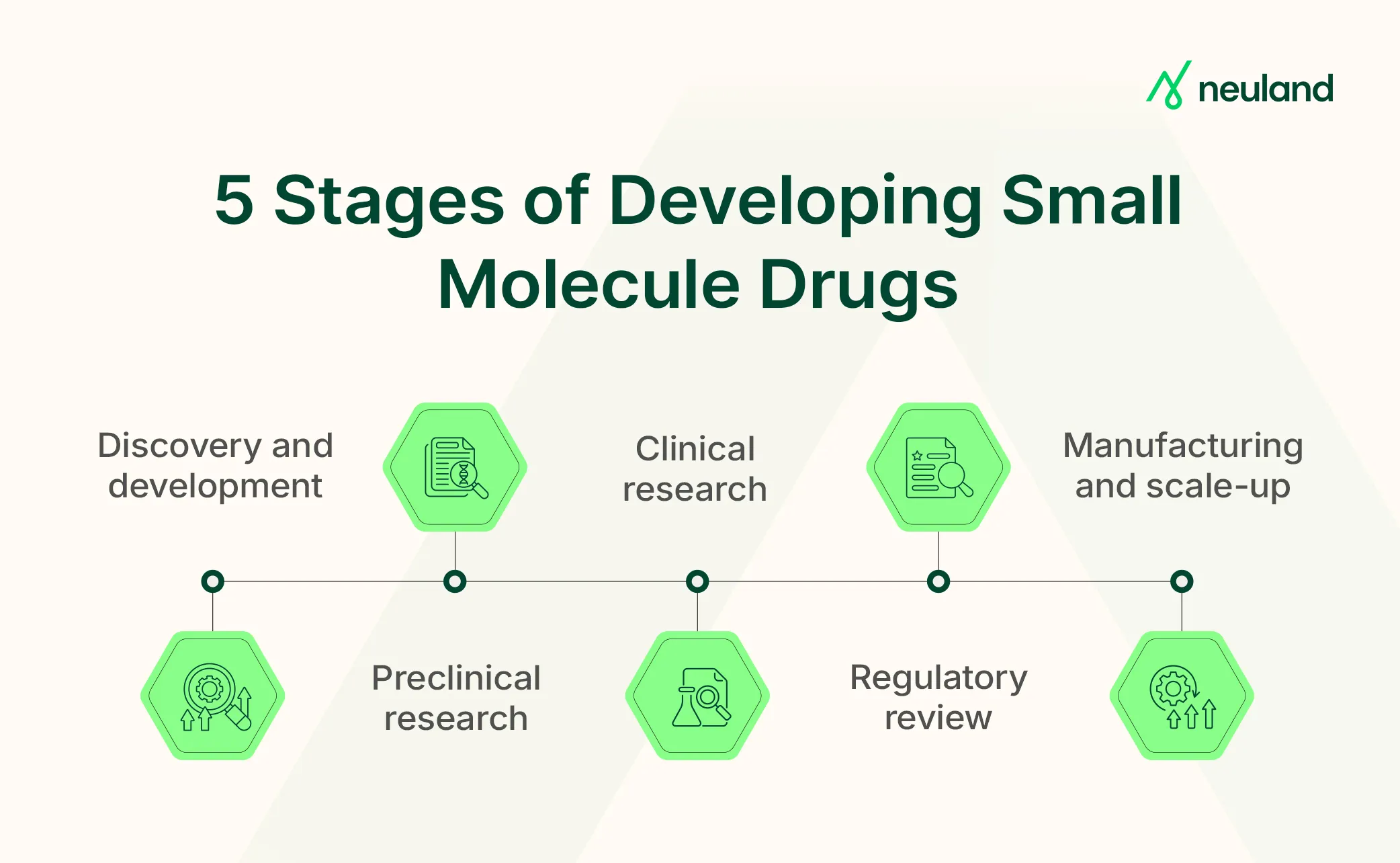
Developing a small-molecule drug is a long, rigorous journey with several key stages. Each stage builds evidence of the drug’s safety, efficacy, and quality:
Drug discovery for small molecules begins with identifying a biological target, such as an enzyme or receptor linked to a disease, and designing chemical compounds that can modulate that target.
Researchers screen libraries of compounds to find “hits,” then optimize those molecules’ properties (potency, selectivity, ADME profiles) through medicinal chemistry. The result is one or more lead candidates that are ready for further testing.
This small-molecule drug discovery phase can take several years of iterative design and testing to yield a viable candidate for development.
In the preclinical stage, researchers assess pharmacokinetics, i.e., how the drug is absorbed, distributed, metabolized, and excreted.
The goal is to ensure the small molecule has an acceptable safety profile before giving it to humans. This involves assessing potential toxicological risks, such as mutagenicity or organ-specific toxicity, and determining safe and effective dosing parameters.
Successful completion of this stage is typically when an Investigational New Drug (IND) application is filed with regulators to authorize clinical trials.
Clinical development is the most resource-intensive part of small-molecule drug development. It is usually conducted in three phases:
If a small-molecule drug shows compelling results in clinical trials, the data are compiled into a New Drug Application (NDA) for regulatory review. This review process ensures the drug’s benefits outweigh its risks for the intended use.
A critical component of this evaluation includes Chemistry, Manufacturing, and Controls (CMC) information to confirm the compound can be consistently made at high quality. Upon a positive review, the drug is approved for marketing.
Upon regulatory approval, the drug receives market authorization. Post-approval, Phase IV studies (post-marketing surveillance) are conducted to track long-term safety or rare adverse events in the broader patient population.
An often underestimated but critical stage is small molecule manufacturing and scale-up.
Process chemistry teams optimize the synthetic route to be cost-effective and scalable from grams in the lab to kilograms or tons in a manufacturing plant. They also ensure purity and stability meet strict quality standards.
Small molecules typically offer an advantage, as their manufacturing is more straightforward “chemistry," as opposed to cultivating living cells for biologics. However, challenges can still arise in scaling reactions, controlling polymorphs, or improving yield.
Many companies engage specialized Contract Development and Manufacturing Organizations (CDMOs) to assist with process development and commercial-scale production.
Small-molecule drugs have formed the backbone of medicine for decades. They offer notable strengths, but also come with challenges in development and use. Below is a summary of key advantages and drawbacks:
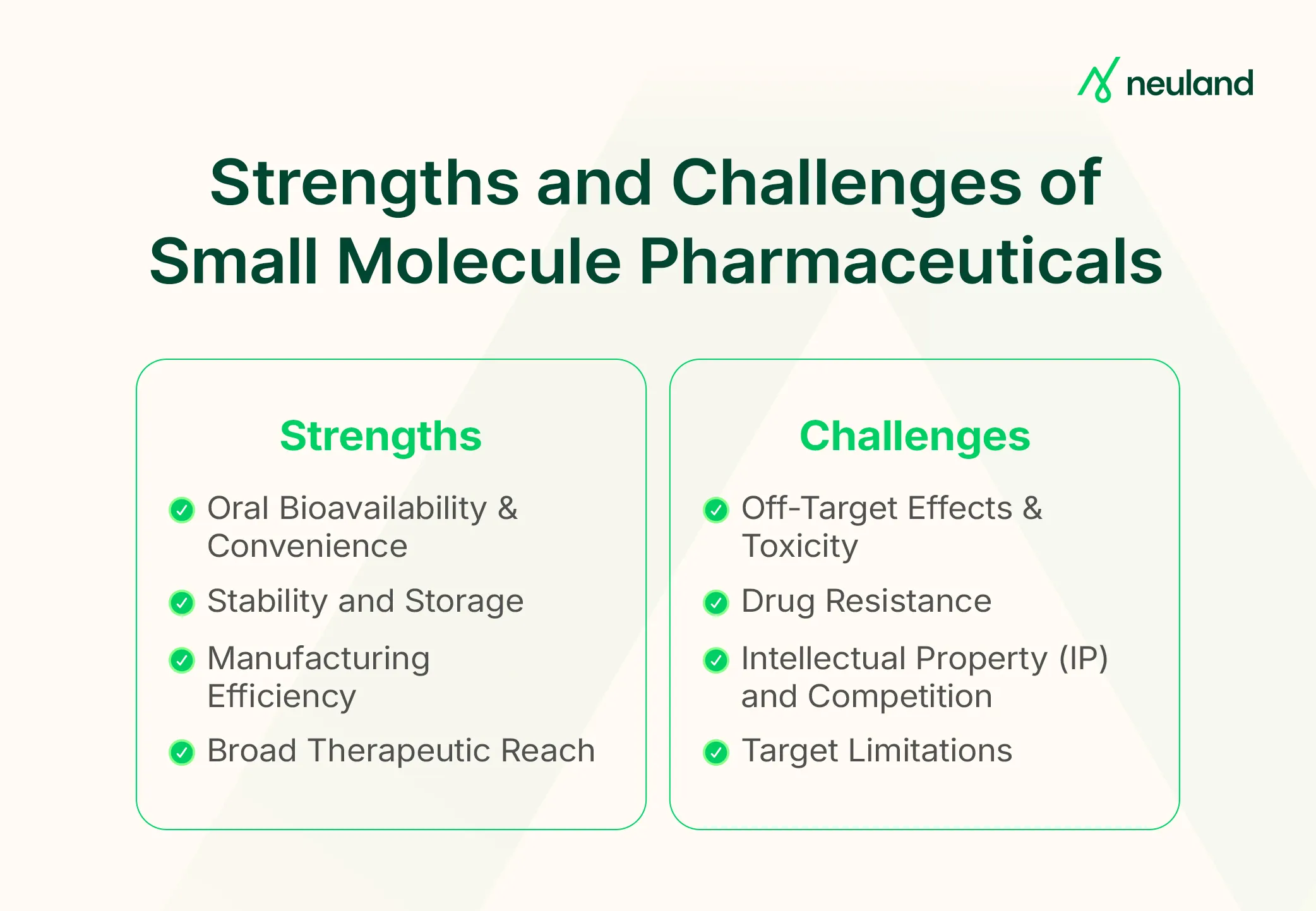
Despite these challenges, small molecules continue to thrive as a modality due to their pharmacological flexibility and the industry’s accumulated experience in discovering and developing them. Ongoing innovations are also addressing many of these issues.
Given the complexity and cost of small-molecule drug development, choosing the right partner is often critical. Partnering with an integrated CDMO has been shown to streamline the development timeline and mitigate risks through a one-stop solution.
Neuland Labs is an example of a CDMO with extensive expertise in small-molecule development services:
With its long-standing expertise, Neuland Labs continues to enable innovators to bring life-changing medicines from bench to market, solidifying its role as a go-to partner in small molecule development and manufacturing.
Many rare disease therapies are small molecules due to their scalability and targeted action. They also benefit from orphan drug designations, which incentivize their development.
Compounds that are chemically synthesizable, have good absorption properties, and target intracellular or enzyme-driven pathways are typically suitable. Early ADME and toxicity profiling can help confirm viability.
Route scouting identifies the most efficient synthetic pathway to create the molecule. Process development then refines this route to ensure it’s scalable, cost-effective, and compliant with regulatory standards for manufacturing.
A major one. Analytical development ensures batch consistency, verifies purity, and detects impurities. It’s essential for meeting regulatory expectations and is often developed in parallel with process chemistry.