Meet Neuland at CPHI India 2026 | Hall 2, Booth 2D38 | Yashobhoomi Convention Centre, New Delhi | 24-26 November 2026 Schedule a Meeting
Meet Neuland at CPHI India 2026 | Hall 2, Booth 2D38 | Yashobhoomi Convention Centre, New Delhi | 24-26 November 2026 Schedule a Meeting
With the cost pressures of today’s competitive market, active pharma ingredient (API) sales profit margins are continuously falling. As a result, pharmaceutical manufacturers find themselves under pressure to cut production costs to sustain market share and maintain position.
One particular source of production inefficiencies – current batch manufacturing and manual process control using traditional equipment – has limitations in terms of capacity and process variation. In addition to this, Deviation closure and reprocessing both increase overhead, by cutting into plant productivity and ultimately raising production costs.
A Few Techniques to Boost Your Bottom Line, Instead of Your Costs
In the process development stage of R&D, the concept of Quality by Design (QbD) can be used to understand and control processes, based on sound science and quality risk management. Design of Experiments (DOE) is very useful in optimizing & validating processes, creating accurate design space, with flexibility for operability at plant scale. The processes operating in the defined design space have more consistency and are less likely to be prone to OOS and deviations.
Plant automation can reduce human error by controlling the process parameters and ensuring consistency (e.g., temperature control, pH adjustment, rate of additions, quenching time, etc.) This also improves process safety, and semi-batch mode operation can make exothermic reactions inherently safer. Automation includes feedback control loops and special utilities, along with heating and cooling.
Automated crystallizers can offer built-in flexibility for temperature control, supersaturation, nucleation, crystal growth, and the other parameters that affect particle size distribution.
Solvent/reagent recovery and recycling during processes is a very effective and modern way to lower solvent consumption and costs, while reducing environmental pollution at the same time. You can also design a synthesis route that does not generate pollutants, thereby reducing the hydraulic load sent to effluent treatment plants.
Getting More from Less
As an API producer who never competes with customer formulations, we provide continuous API manufacturing to reduce costs and meet market requirements of high throughput and process intensification. By doing so, you can get more from less.
Specifically, you can take advantage of more:
While also benefiting from less:
Another technique employed at Neuland is to increase productivity and yield using the most efficient equipment available in current batch processes. For example, by using a rising/falling-film evaporator or wiped film evaporator for distillation, less time is needed and quality is improved through less exposure to higher temperatures.
Putting PAT to Work for You
One final step is using PAT, or Process Analytical Techniques, during lab development and plant implementation. Using PAT tools enables a shift from Quality by Analysis to Quality by Design. This brings continuous process validation to a plant via key monitoring of critical on-line processes and operations rather than the current one-time process validation (3 to 5 batches).
PAT tools are especially useful for:
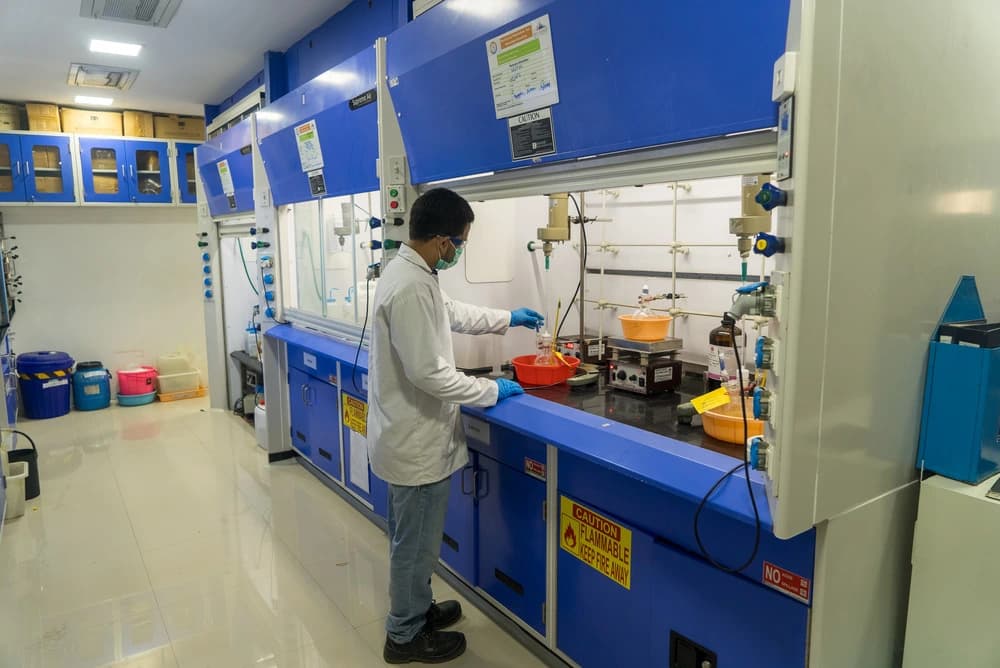
At Neuland, our R&D department is establishing a dedicated research team with expertise in continuous processes, flow chemistry and particle engineering. Our research team is a QbD group supported by state-of-the-art technology and infrastructure.
With a now-established track record of successful implementations, it is clear that PAT tools and innovative automation result in cost-effective drug products while providing robust quality assurance in real time. Going forward, partnering with manufacturers who take advantage of these measures will keep your business at the forefront of pharmaceutical manufacturing.
What new techniques or technologies are you considering to increase your profit margin?